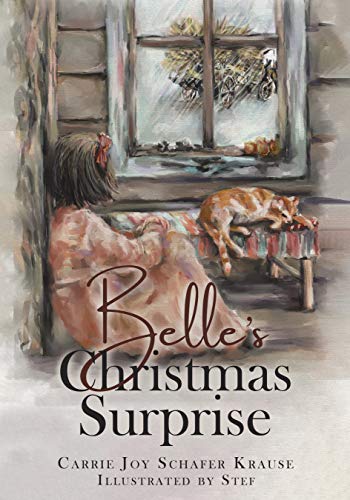
This children’s picture book is beautifully illustrated with soft colors and detailed images of a close-knit family living in a small cabin on the Canadian prairie at the beginning of the twentieth century.
Belle is one of eight children living with her parents. Christmas is nearly here. She is excited. Each family member receives one small gift. Belle cherishes her delightful wiener treat. When she wakes up the next morning, her gift has disappeared! Will her Christmas be spoiled? Read the heartwarming tale to find out.
This multicultural book entertains and educates children. They learn a bit of history, culture and family traditions. Bonus activities include a find the hidden picture on each page, discussion questions for parents and teachers to use after reading, a Christmas cookie recipe, and instructions for a walnut Christmas decoration.
I recommend this book for elementary school and middle school children and their families or classrooms to share.
If you enjoyed reading this post, please subscribe by clicking on the word Follow or by hitting the orange RSS FEED button in the upper right-hand corner of this page.
Last month, I posted an article on #World Kindness Day. Then I thought about the lack of it.
It seems life has taken us to a place where we no longer value kindness as a trait. In fact, kindness has been replaced with self-importance and wanting to stay impersonal. The question is why has the world become less kind? Is it that we no longer care about others? Do we believe kindness makes us weak? Is the lack of kindness from some global change?
I believe that kindness has become less important in the world today for many reasons:
We’re in a big hurry. Life has become so fast paced, filled with appointments and places to be that we no longer take the time to simply listen to someone.
Technology has taken place of the human face-to-face, voice-to-voice interactions of the past. No longer do we pick up the phone or meet face-to-face to talk to others. Now we spend our time texting, posting, getting involved in others drama or simply playing mindless games on our cell phones, tablets, computers and even our watches.
Technology has allowed us to say it’s okay to be late all the time. After all, we can simply text our friend we’re running late, and they’ll know. It’s taken away the common courtesies of saying thank you, hello, nice to meet you, please and “how can I help you”.
We no longer smile at others when we see them. We no longer sympathize or help someone who is having a rough day. Instead we place an emoji on our social media post or in a text and call it done.
There’s an app for everything. Want to have a relationship? Use this app. Want to order your dinner? Use this app. Are these apps taking away the connectedness we once had that created kindness? I believe they do.
Self-centeredness and greed is another reason kindness has taken a backseat. Many people are focused on their own lives, on getting ahead and doing whatever is necessary to beat the other guy.
People are more interested in taking care of their own self before they reach out and extend some type of kindness to others. We’ve become a society of “me first” that wasn’t seen as often just a few years ago.
Our environment causes us to withdraw from others. Living in crowded cities among strangers can make you quickly hide your natural tendency to be generous and kind to others. With crime, kidnappings, murders and other fears running wild in many cities, people have found it safer to keep to themselves. Road rage keeps people from stopping to help someone with car trouble.
Family structure has changed. Our upbringingwas different 30 years ago. We believed in helping each other. Neighbors looked out for each other. People weren’t afraid to help the poor and needy. People and children were taught to respect others and to be trustworthy and honest.
Today people are more afraid to show their kindness. Society is deeply divided. There is fear that we will be attacked for what we say or do. We don’t want to appear vulnerable and to get hurt so we attack with words and actions as a way to self-protect ourselves.
Kindness has taken a backseat to greed, technology, poor manners and the environment we live in. Instead of showing kindness we’re afraid to be seen as the nice guy because we might be taken advantage of.
I do not mean to imply all is lost. Like my Little Miss HISTORY character, I prefer to look at the world through rose-colored glasses. There are many philanthropic organizations out there that strive to alleviate suffering and help those in need. But I think we all need to be consciously aware of how easy it is to shut others out because we are too much wrapped up in ourselves.
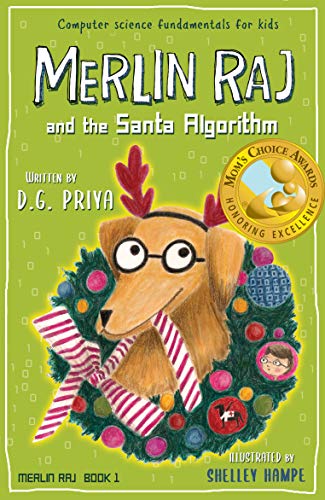
Merlin Raj and the Santa Algorithm: A Holiday Yuletide Dog’s Tale
Written by D.G.Priya
Illustrated by Shelley Hampe
The author creates a unique plot that will engage middle-grade and young teens. She does a good job of explaining how algorithms work, while creating a heart-warming tale of family devotion and holiday spirit.
Peter has a service dog named Merlin who accompanies him to school. His Golden Retriever friend tries hard to serve his master but often winds up in trouble instead. Readers are treated to a Christmas tale in while the family struggles to maintain traditions like baking and cutting down the Christmas tree while mom is traveling for work.
Along the way, readers learn how algorithms work, enjoy a bit of humor, and empathize with a close family who just want to get things right.
The black and while illustrations are charming. They enhance the feeling of identification with both human and animal characters. Recommended for ages eight and older.
If you enjoyed reading this post, please subscribe by clicking on the word Follow or by hitting the orange RSS FEED button in the upper right-hand corner of this page.
About 64 million Americans get their news from social media. The reliance on newspapers, radio, and television news segments has been diminished or disappeared. Even broadcasts advertised as the “breaking news” rely on panels of “experts” to relay information. The days of a journalist simply reporting the facts without attaching opinions are gone.
Our children probably rely on social media to an even greater degree. How can we teach them to cut through the noise, sift through the mire, and uncover the objective truth? I have a few suggestions.
VARIETY IS THE SPICE OF LIFE
Make it a point to watch and listen to many different stations and social media outlets. Show your children how different outlets and reporters present information. Do they show both sides of an issue? Are certain people and groups ignored? Tell children they need to hear and see both sides of an issue before judging it as authentic. Ask them if the information was reported fairly. Did they get the whole picture?
EVERY STORY HAS MANY ANGLES
Explain how different people look at the same situation differently. Use examples of how family members like different foods, play different sports and choose different friends. Even mom and dad sometimes argue about preferences. The same applies to news issues. Adults can choose different media outlets and reporters to illustrate how there can be a multitude of different views about the same topic in the news.
IS THAT A FACT?
Use everyday situations to illustrate the difference between a fact and an opinion. I am wearing a red shirt today. That is a fact. When you say, that red shirt is ugly, you are issuing your opinion. Facebook and Twitter are littered with opinions. What do people share or retweet? They share and comment on the opinions with which they strongly agree or disagree. Social media outlets do not report the news, they display the opinions of those followers who have decided to reject or endorse them. Children need to understand that reality does not coincide with the majority of social media opinions. Point of view on an issue does not necessarily make what is communicated true. In fact, the reality might be something completely different.
YOU BE THE JUDGE
Adults and children can have fun and learn a lot by analyzing the ads seen in print and on TV. Study that boring commercial and think deeply about the message that is being communicated. How are the actors dressed? What do their gestures tell you? What words do they use? Do they exaggerate the benefits of the product? How are they trying to manipulate you into buying something you don’t really need?
After doing this a few times, take what you learned and apply it to the commentators, reporters, and “expert panels” that you see reporting the news. You will learn a lot about how much opinion is introduced into what is being reported as factual news. This knowledge will go a long way in developing critical thinking skills that will benefit children as they mature and develop the life skills they will need in future careers.
SEEING IS NOT BELIEVING
It’s okay to be skeptical. In the world of modern technology in which we can press a button to order in minutes, see ourselves in virtual reality, and communicate with friends, family, and co-workers instantly, it has never been more important to be vigilant and careful. We worry about computer hackers but often neglect to train our own brains to filter out the noise and the mixed messages that seek to distract and deceive us.
Guerilla Publishing: a sleaze-free guide to publishing and marketing
Written by Derek Murphy
I have read quite a few books offering publishing advice to independent authors. This one filled in some of the blanks about my still unanswered questions.
Most new and independent authors worry incessantly about marketing and spend too much time on it. I will admit to being guilty on that count. Murphy believes authors should spend more of their time and resources writing. He believes the only two things an author should worry about are visibility and conversion. Getting your book in front of the right readers is more important than spinning your wheels using every available marketing tool available.
Before writing authors need to do preparation. Rather than write about what they want, do research, and find genres that will sell. Of course, one still needs to balance that with the need to enjoy writing in that area. Answering who, what, when and where to find your target readers and how to write the best story that appeals to their needs are the next steps.
Murphy discusses the kinds of errors authors make and how to fix them. Then he provides links to problem solve embedded in the text. This allows the reader to go straight to the source and find information about how to fix them. Practical advice on layout, formatting, book covers, and options for distribution are clearly presented. The necessary skills of locating the best keywords, categories, and book reviewers are explained and examples given. Finally, launching the book and getting the sales you need are handled, as well as editing and making changes.
There is a free download to a companion workbook to implement strategies and an invitation to join The Guerilla Publishing Facebook Group in which authors share problems and offer solutions to each other as they come across them.
I would highly recommend this book to fledgling authors as well as experienced authors. After seven years in publishing, I still have much to learn. This book will become part of my toolkit.
If you enjoyed reading this post, please subscribe by clicking on the word Follow or by hitting the orange RSS FEED button in the upper right-hand corner of this page.
The author presents an interesting set of exercises for children to discover the “superpower” within themselves. She encourages her readers to use mindfulness practices to dig within themselves and discover cognitive, emotional and physical strengths. Simple objects like a seashell, index cards, stones, and a hula hoop, as well as food items, are used in the exercises. By performing these activities children will become much more aware of the abilities they possess.
I would recommend this book primarily for a middle-grade audience as the book is a bit difficult for younger children to follow. A parent, teacher, or counselor would enhance the usefulness of the skills being taught.
If you enjoyed reading this post, please subscribe by clicking on the word Follow or by hitting the orange RSS feed button in the upper right-hand corner of this page.
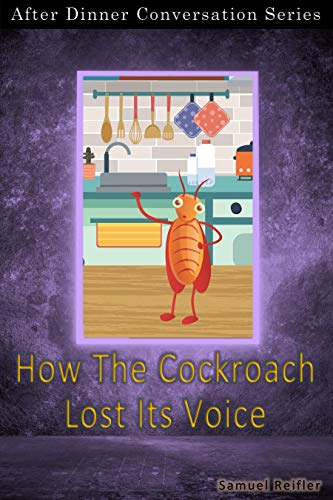
How The Cockroach Lost Its Voice: After Dinner Conversations
Written by Samuel Reifler
This book certainly will provoke unique discussions. The protagonists are two cockroaches who venture on a journey to the top of the refrigerator. They carry on a conversation about the squishy humans with three eyes. The third eye is their brain. Unfortunately, their brain allows them to focus on the past and the future as well as the present. That makes them unable to appreciate the beauty around them.
The book contains approximately 17 pages. While I found the plot interesting, it ended rather abruptly and left me wanting to hear more. Readers are provided with discussion questions and a link to a podcast group.
I believe families and couples might enjoy these books to stimulate interesting conversations. Recommended for children and adults ages eight and older.
If you enjoyed reading this post, please subscribe by clicking on the word Follow or by hitting the orange RSS Feed button in the upper right-hand corner of this page.
Little Miss HISTORY Travels to INDEPENDENCE HALL & The American Revolution makes its debut on the world stage.
No Fake News here….just the facts
The United States Constitution is the oldest federal constitution in existence. This document, along with the Bill of Rights, lays out the rights and responsibilities of its citizens. The Founding Fathers embraced the principles of the Enlightenment and a vision of liberty and justice for all. Trace their footsteps at Independence Hall and the Museum of the American Revolution.
Available in hardcover or paperback
AVAILABLE ONLINE OR ASK FOR IT AT YOUR FAVORITE BOOKSTORE
A delightful science book about trees targeted for preschoolers and primary grade children. The author poses the question, can trees be blue? and goes on to examine different types of trees and the colors of their leaves. She explains that many trees change colors in the fall. Winter changes them into grays and browns. Sauble reminds readers about evergreens and how they retain their green leaves. Just when the reader concludes no leaves are blue, the author introduces a surprise.
The illustrations are simple but explain the text appropriately. I enjoyed the interactive features of searching for bugs hidden throughout the pages and the scavenger hunt activity. This is a fun book to add to a science homeschool or distance-learning curriculum.
If you enjoyed reading this post, please subscribe by clicking on the word Follow or by hitting the orange RSS FEED button in the upper right-hand corner of this page.
 December 13, 2020
 bamauthor
 Comments Off on THE TRUE CHRISTMAS SPIRIT








 Barbara Ann Mojica's BLOG
You must be logged in to post a comment.