Posts from the ‘nonfiction’ Category

FUTURE ENTREPENEURS

Teach Your Child to Fish: Five Money Habits Every Child Should Master

Written by Holly D. Reid

teachchildtofishpicThis is an excellent guide for teaching children how to handle and save money. The book has nothing to do with fishing. Written by a CPA, the language is not complicated but clear and easy to follow. As a bonus, the author includes a downloadable printable workbook to accompany the text. In the first chapter children are introduced to why we work and the kinds of tasks children might find engaging. Chapter Two explains how to be conscious about spending and how to do so wisely, stressing what is worthwhile and how we can help community, Chapter Three encourages children to save and invest and lays out different ways to do so. In the fourth chapter children learn how to be responsible with credit, how it works, and how to minimize debt. In the final chapter the author talks about how give generously to others in their community.

I particularly enjoyed the recommended activities section at the end of each section and the final thoughts in which the chapter is pulled together. While the author is a CPA, she also presents a strong Christian viewpoint and quotes scripture to reinforce her lessons. This book may serve as a reference manual to be implemented at many different stages in a child’s life. I particularly recommend it for parents of children in the eight to twelve age group.

If you enjoyed reading this post, please subscribe by clicking on the word Follow or by hitting the orange RSS FEED button in the upper right hand corner of this page.

ANCIENT GREECE IN A NUTSHELL

If You Were Me and Lived in …Ancient Greece

Written by Carole P. Roman

Illustrated by Mateya Arkova

ancientgreece,picThis book is part of a new series which looks at the cultures and customs not of individual countries but about civilizations throughout time. Ancient Greece is the topic of the first release. The author begins by describing the geographical location of Greece and how Greece may have looked in the past contrasting it with the present. Unlike the other series, this book covers a much broader time period, and the author chooses to stage her character as a child living around 350 B.C. in classical Greece. There is no mention of the previous Greek Archaic Period, the rule of the aristocracy or the tyrants which eventually evolved into the establishment of democratic city states. Much of the book discusses everyday life, food, dress, education, family structure, occupations, and religion. Roman ends her discussion with the military conqueror Alexander the Great who established an empire, and whose death would usher in the end of the classical period and the beginning of the Hellenistic Age.

There is a great deal of information simplified and condensed for the elementary school and middle school reader. I would have liked to see more detailed maps showing locations and some actual photographs, though the simple, soft pastel illustrations are lovely and appealing for a younger reader. The glossary and list of gods and goddesses are helpful because readers will need to reference these to keep track of all the information. No doubt this book will open a child’s eyes to the vast legacy of ancient Greece and provide an excellent starting ground for future explorations on the political, social, religious, scientific and educational contributions of ancient Greece.

If you enjoyed reading this post, please subscribe by clicking on the word Follow or by hitting the orange RSS FEED button in the upper right hand corner of this page.

WHO’S AT FAULT?

Blame the Child – It’s Easier: Learning Difficulties Can Be Solved!

Written by Henry Blumenthal

Blamethechild,pic


This book portrays a common sense approach based on the author’s lifelong experiences in education. He bases his conclusions on study and experience which dictates it is far wiser to withhold blame and take an objective and realistic approach to the difficulties manifested in the learning process.

Student victims are often stressed because of the undue pressures placed upon them by parents, teachers and other students. The author attempts to explore flaws in the educational system, parents and supporting personnel. There are many reasons why a student falls behind, excessive absence, changing schools, peer pressure, and poor foundation in basic learning concepts. The system often finds it easier to do a complete psychological testing rather than allow the teacher to discover a particular educational diagnosis of a specific weakness that can be easily remedied. Some teachers move too quickly, teach only in large groups, and do not allow for individual differences. Placed under stress by school districts, teachers feel compelled to cover everything in the curriculum rather than ensuring a firm foundation for future learning. Understanding rather than memorization should be the goal. Teachers need to acknowledge that they too have weaknesses. Rather than fall into the trap of labeling and treating with medication, they should investigate possible symptoms of learning problems.

Blumenthal provides teachers with suggestions for teaching as well as hints for parents. He explores new ways of testing, approaches to curriculum and suggestions for incorporating good nutrition in successful learning environments, as well as productive ways to assess successful teaching. Instead of blaming, parents, students, teachers, and medical personnel can share in their success.

If you enjoyed reading this post, please subscribe by clicking on the word Follow or by hitting the orange RSS FEED button in the upper right hand corner of this page.

FROM THE SOURCE’S MOUTH

50 Core American Documents:Required Reading for Students. Teachers, And Citizens

Edited by Christopher Burkett

50core,pic


A valuable collection of primary sources for anyone who wishes to truly understand the evolution of American history and government. The core documents upon which the American republic is founded include the Declaration of Independence, The Constitution, and Bill of Rights provide readers with the framework. Of course there were differing views aptly displayed in the Memorial and Remonstrance Against Religious Assessments, the Virginia Statute for Religious Freedom, Notes on the Debates held in the Federal Convention of 1787 as well as samples from the Federalist and Anti-Federalist Papers. Opinion letters from statesmen like Andrew Jackson, Alexander Hamilton and Thomas Jefferson present private viewpoints.

Landmark cases heard in the Supreme Court give insight as to the evolution of government as seen from the highest court in the land. Marbury vs. Madison, Dred Scott vs. Sandford, Plessy vs. Ferguson and Brown vs. The Board of Education are among them. Foreign policy touchstones like the Monroe Doctrine, New Nationalism Speech and A Time for Choosing demonstrate debates over foreign policy.

Human rights are discussed by Frederick Douglas and John C. Calhoun, Martin Luther King, Jr. and Lyndon Johnson. Milestone documents include the Emancipation Proclamation, the Gettysburg Address and the “I Have a Dream” speech.

While by no means exhaustive, this well organized collection of historic documents that are keystones of American history are a valuable reference resource for students of history, teachers and librarians. Appropriate for ages ten and older. Put this one on your reference shelf or homeschooling curriculum.

If you enjoyed reading this post, please subscribe by clicking on the word Follow or by hitting the RSS FEED button in the right hand corner of this page.

POIGNANT AND POWERFUL

Ever the Patriot: Recollections of Vincent J. Riccio World War II Veteran and POW

Edited by Candace Riccio Salem

EverthePatriot,pic

This book is told in first person based on the experiences of Vincent J. Riccio and edited by his daughter. It begins with the attack on Pearl Harbor and Riccio’s subsequent draft a few months later. Riccio began his service as an aviation mechanic in Mississippi. The first part of the book focuses on his hi jinks and pranks with his buddies as a young soldier. But Riccio wanted to fly; he eventually manages to get training as an aviator. After being sent to Horhem in England, Riccio flew combat missions over Germany. On the Luduigshafen mission, his plane was shot down. Riccio parachuted to safety, but eventually was taken prisoner by the Germans.

The second part of the story focuses on his imprisonment in POW camps and resourcefulness in surviving the Black Hunger March. As the war came closer to its end, Riccio uses his ingenuity to obtain weapons, food and German prisoners. Down to 84 pounds when he was freed from captivity, Riccio warms the reader’s heart when he relates his elation at seeing the Statue of Liberty in New York harbor upon his return to America. I think the gist of the book is best summarized in his own words, “You learn about people, you learn about human nature. You learn what the human body can take. The ones that couldn’t take it, didn’t make it.”

This story contains the gamut of human emotions; Riccio is at once the boy next door and a war hero. He does not judge, but simply tells it like it is. Recommended for teens and adults interested in history and human behavior.

If you enjoyed reading this post, please subscribe by clicking on the word Follow or by hitting the orange RSS Feed button in the upper right hand corner of this page.

SIGNS OF SUCCESS

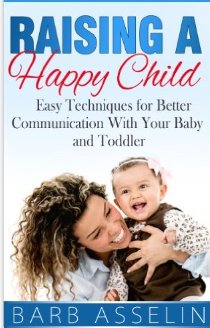
Raising a Happy Child: Easy Techniques for Better Communication With Your Baby and Toddler

Written by Barb Asselin

ASLsign,pic

This book focuses on using American Sign Language with babies and young children in an effort to provide a means for parents to better answer the communication needs of their children. Learning and using ASL allows a child to communicate with parents before they are able to use spoken language.

Asselin bases the book on her own experiences with her two girls. She begins by explaining what American Sign Language is composed of and the types of populations for which it was designed. The author provides some history of its use. While ASL is used primarily with the deaf, Down’s Syndrome or Learning Disabled children, parents and caregivers have learned that babies can easily learn the basic signs to use for communication. She lists the 50 plus signs that are most common, milk, again and more are often starting points. Asselin cautions parents not to overdo or force learning, but to gradually build up a set of vocabulary words. Once you have begun to communicate with your child, the next step is to introduce the program to caregivers and teachers. Finally, the author provides a comprehensive list of resources for reference and additional support in using the program.

I have a nephew whose parents have introduced him to sign language. He is quite adept and comfortable with basic sign and takes to it naturally. This book is a good tool for any parent who is interested in exploring earlier and better communication with a child and is willing to take the time to invest in mastering it. I would recommend all parents and prospective parents to take a look at it.

If you enjoyed reading this post, please subscribe by clicking on the word Follow or by hitting the orange RSS FEED button in the upper right hand corner of this page.

HIPPIE HAPPENING

What Was Woodstock?

Written by Joan Holub

Illustrated by Gregory Copeland

Woodstock

This book is part of the Who, What, Where series of books written largely for the beginning reader and pre-teen audience. Woodstock is one of the most famous events in the 1960’s, one of the most tumultuous decades in American history. Not only does this book portray in words, drawings and photos, the Woodstock music festival, but it furnishes a birds-eye view of the history of the 1960’s. Well-written concise profiles of the Vietnam War, political and social change, and sixties slang are included. There are time lines of the sixties for the United States as well as one of events happening around the globe. An age appropriate bibliography for additional reading on these topics is also included.

Music promoter, Michael Lang conceived the concert idea. Desiring to open up a recording studio for young artists in Woodstock, about 120 miles north of New York City, he convinced Artie Kornfield of Capitol Records that this was a good idea. While playing a game of pool one night, they decided to raise money for their project by having a giant outdoor music concert. They needed a large space, security, lighting, outdoor toilets, food, water, a stage and lots of music bands. Problem after problem arose. Their plans fell through and the location was changed three times. Eventually, they contracted with a local farmer, Max Yasgur in Bethel, NY. They planned for 50,000 people, but 500,000 came. The roads were so clogged that people had to walk ten miles from their cars, and bands had to be flown in by helicopter. A thunderstorm threatened to destroy it, but the three day event in August, 1969 became a message of peace and hope for people young and old. Well-known artists like Jimi Hendrix and Joan Baez played as well as then unknowns like Santana and Credence Clearwater Revival. The organizers made no money. Despite its success, organizers wound up letting everyone in free because they could not manage to collect tickets.

Young pre teen readers will love this book. History, music and popular culture are woven together into a mesmerizing look at sixties people, places and things. Readers absorb a great deal of knowledge without even realizing it. Highly recommended for students, teachers, parents and all those baby boomers who lived through or have heard about Woodstock.

If you enjoyed reading this post, please subscribe by clicking on the word Follow or by hitting the orange RSS FEED button in the upper right hand corner of this page.

TRAVELING RIGHT

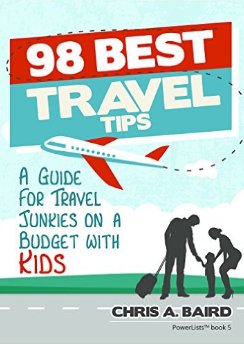
98 Best Travel Tips: A Guide For Travel Junkies on a Budget with KIDS

Written by Chris A. Baird

98Best,pic

I have done quite a bit of traveling in my lifetime, but I must say this book is the best guide that I have seen. It covers any conceivable topic related to travel from soup to nuts.

Baird begins by explaining the broad definition of travel; it does not necessarily mean a long, time-consuming journey. He gives us concrete reasons for travel like being able to connect better to others, discover ourselves and expanding our children’s horizons. Baird lists many of the excuses people use not to travel like not having enough time, money or physical resources.

The heart of the book gets down to the nitty-gritty of where you start, how to budget, and plan for your safety. His list of reminders like careful research, passport and insurance information, and booking don’t leave anything out. Baird lays out what you need to know about packing and planning, when and what to do at the airport, and invaluable tips on planning, packing and involving your children in the trip. The author does not forget about preparing for the trip home while still on vacation, and how you should already be thinking about your next family adventure.

This book is a good choice for anyone who is hesitant about traveling with the family, as well as those who are seasoned travelers. Parents can share the book with older children. I can’ think of anything that has been left out. Strongly recommend reading this one before you plan your next vacation.

If you enjoyed reading this post, please subscribe by clicking on the word Follow or by hitting the orange RSS FEED button in the upper right hand corner of this page.


ELLIS ISLAND WINS B.R.A.G. MEDALLION

EllisFrontCVRPNG registered- 800

JUST FOUND OUT…Little Miss HISTORY Travels to ELLIS ISLAND has won a B.R.A.G. MEDALLION joining the other five books in the series. CELEBRATE!

CHECK OUT THE ENTIRE SERIES AT http://littlemisshistory.com

Amazon http://www.amazon.com/Little-HISTORY-Travels-ELLIS-ISLAND/dp/0988503069/

National Parks Week April 16-24, 2016 FREE ADMISSION

http://www.nationalparks.org/national-park-week

If your enjoyed reading this post, please subscribe to my biweekly family friendly book reviews by clicking on the word Follow or by hitting the orange RSS FEED button in the upper right hand corner of this page.

A WALK THROUGH THE JUNGLE

The Amazon Rainforest: Animal Facts and Photos

Written by KC Adams

amazonrainforest,pic

Despite the title, this book is not merely a list of facts, but a comprehensive view of the Amazon RainForest and the life within it. I knew that this rainforest was the largest on earth, but I did not realize that this rainforest receives a whopping 52% of the daily precipitation for South America containing 2/3 of the world’s fresh water supply and 20% of the world’s oxygen.

The animals inhabiting this world are diverse and bizarre. Most of us are familiar with tropical birds like the macaw and toucan and monkeys like the squirrel monkey and marmoset. Some of the unusual animals include the sloth who sleep fifteen to eighteen hours a day and the nocturnal maned wolf that is often called a red fox on stilts. Poison dart frogs can be as small as a paper clip, but their poison excreted through their skin is powerful enough to kill a human. Capybaras are the world’s largest rodents, who are friendly to humans. On the other hand, the piranhas living in the river eat their prey alive. Be on the lookout for the anaconda, the largest most powerful snake on earth. Living in the water, these hunters catch their prey with their fangs and drag them under water to drown it before they swallow it alive.

Animal selections are written well even if they are succinct. Pertinent information on diet, habitat and lifestyle is presented. Questions follow the descriptions for discussion. The photos are clear and appealing, I would recommend this book to anyone with an interest in learning about this intriguing region. Great choice for elementary and middle school students or homeschooling parents.

If you enjoyed reading this post, please subscribe by clicking on the word Follow or by hitting the orange RSS FEED button in the upper right hand corner of this page.