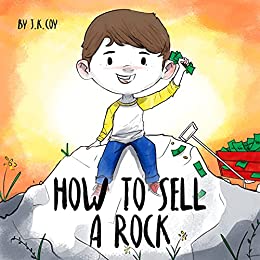
How to Sell a Rock: A Fun Kidpreneur Story about Creative Problem Solving
Written by. J.K. McCoy
Illustrated by Umair Najeeb Khan
Sebastian wants a skateboard, but his father says they don’t have extra money. Does Sebastian give up? No! He decides he will earn the money by selling something. But what? After deciding against his mother’s meatloaf, he comes up with the idea of selling rocks. He is disappointed when none of his neighbors are interested. So he paints them. Still no interest.
Sebastian refuses to give up. A mailman gives him an idea. Will Sebastian get his skateboard? Read about this amazing kidpreneur in this fun picture book. Recommended for readers five through eight.
If you enjoyed reading this post, please subscribe by clicking on the word Follow or by hitting the orange RSS FEED button in the upper right-hand corner of this page.
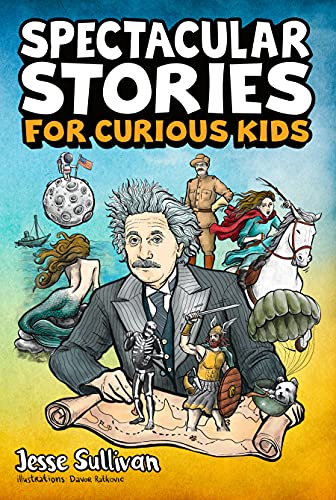
The author has a way with words. Sullivan has succeeded in telling 100 stories about history, science, art, and culture and with wit and charm. Young readers will be intrigued by topics like ghosts, curses, snakes, space, and vampires. Each story reveals an adventure and interesting facts. Black and white illustrations accompany many of the chapters. Young readers unwittingly learn a lot while they are laughing and having a great time reading.
This is a book they will want to share with friends and family. Targeting the middle-grade audience ages nine through fourteen, but any age reader will enjoy and appreciate these gems.
If you enjoyed reading this post, please subscribe by clicking on the word Follow or by hitting the RSS FEED button in the upper right-hand corner of this page.
This book is a delightful new version of The Underground Toy Society. This society is a group of toys that are no longer being used by their former owners. Together they work as one to find new homes to love them.
Children will love these adorable toys that act like human characters. When the toys find their way to a toy store, they are excited to find a donation box for Christmas toys. Their hopes are dashed when they discover the toys must be new.
I love the section that describes how these toys make themselves new again. Will these toys find a way into the hearts of new children owners?
Adorable illustrations and characters will make this book a new holiday favorite. Recommended for a Christmas story or any time of the year.
The author is an educator and parent of six. She shares the hopes that most parents have for their children. Courage, resilience, empathy, and kindness are a few of these. The short rhymes are easy for young children to remember. Illustrations are multicultural and include references to the author’s own family as revealed in the fun facts at the end of the story. Adults and children will enjoy learning about the symbolism of nature and the themes included in this book.
A delightful read-aloud or bedtime story for elementary age readers.
If you enjoyed reading this post, please subscribe by clicking on the word Follow or by hitting the RSS FEED button in the upper right-hand corner of this page.
Publisher: Big Ideas Press | ISBN-13: 978-0645099805
I feel like I’m a piece, a fragment that’s missing all the good bits, but I don’t know where to find the rest … the parts I need to work properly. I bet they wouldn’t fit anyway. (Lexy, age 17)
Publisher’s Synopsis: Eight young people navigating high school and beyond, each struggling to hold on – to family, to friends, to a piece of themselves. Perhaps you know them. The bubbly girl who keeps telling you she’s okay. The high achiever who’s suddenly so intense. The young teen obsessed with social media. The boy challenged by communication. Every single day they, and others, are working hard to keep it together. So hard, they don’t see their friends are struggling, too. Through eight imagined stories, Fragments moves from a place of disconnection to connectedness.
The action of Fragments takes place in the minds and hearts of an ordinary group of young people. Their stories encompass anxiety, depression, neurodivergence, gender dysphoria, social media, bullying, family dysfunction, cross-cultural diversity, and more, culminating in a sense of hope. Although set in Australia, their stories could take place anywhere.
From the Playwright: Rarely presenting as neat packages, mental health issues often involve feelings and behaviors with jagged edges and blurred origins. Fragments embodies the theme that stress at home, at school, and in life is challenging young people beyond their usual coping abilities, leaving them disenfranchised and vulnerable. So much of adolescent life is spent looking inwards that it’s perhaps not surprising that mental health issues are often internalized. I wrote Fragments to start a conversation. It’s only when we speak openly about mental health issues – without fear or judgment – that we can chip away at the stigma that prevents many people from seeking help. It is my hope that the work will find its way into schools in Australia and overseas. The publication includes a comprehensive Study Guide, detailing activities and curriculum links for English, Drama/Arts, Health & PE, Civics, and more.
A powerful and timely mental health resource for young people and their families. Essential reading for high school.
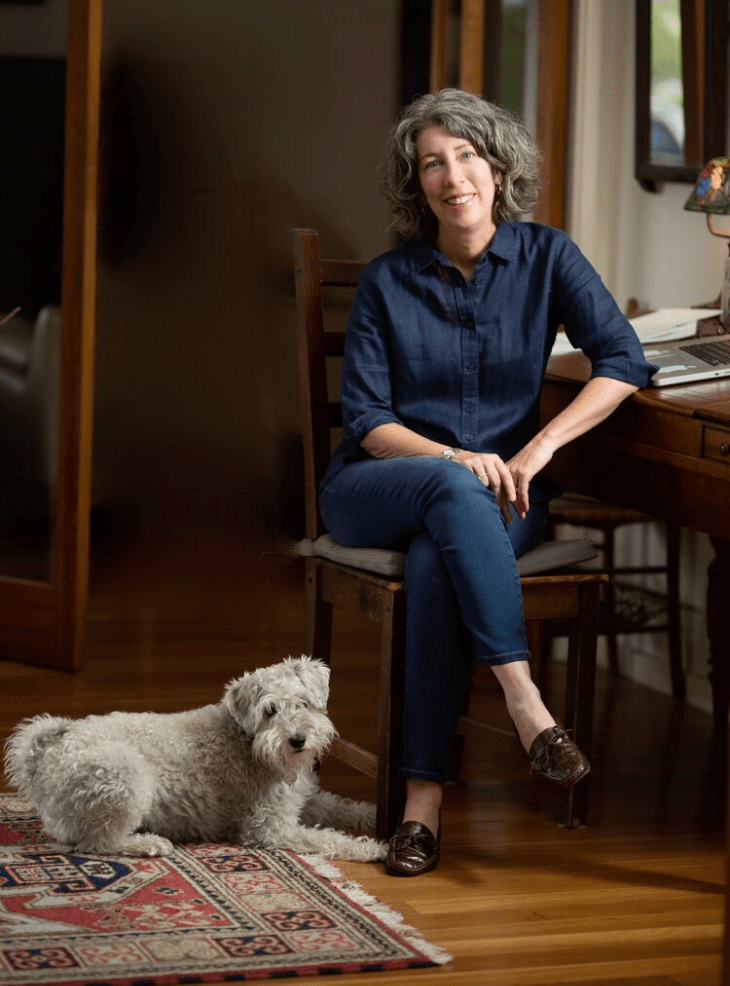
Maura Pierlot is an award-winning author and playwright who hails from New York but has called Canberra, Australia home since the early 1990s. Her writing delves into complex issues including memory, identity, self, and, more recently, mental health. Following its sellout 2019 season in Canberra, Maura’s debut professional theatre production, Fragments is being adapted for the digital space, supported by artsACT. The work is published online by Australian Plays Transforms and in print by Big Ideas Press.
Maura is a past winner of the SOLO Monologue Competition, Hothouse Theatre for her play, Tapping Out. Her plays have been performed in Melbourne, Canberra, Sydney, Brisbane, and Hollywood. A former medical news reporter and editor of Australian Medicine, Maura also writes for children and young adults. In 2017 she was named winner of the CBCA Aspiring Writers Mentorship Program, and recipient of the Charlotte Waring Barton Award, for her young adult manuscript, Freefalling (now True North). Maura’s debut picture book,The Trouble in Tune Town won the 2018 ACT Writing and Publishing Award (Children’s category) along with international accolades.
Maura’s poetry, short stories, microfiction, and essays appear in various literary journals and anthologies. Maura has a bachelor’s degree, master’s degree, and doctorate, each in philosophy, specializing in ethics. When she’s not busy writing, Maura visits schools and libraries as a guest reader and speaker, serves as a Role Model for Books in Homes, and contributes reviews for the Children’s Book Council of Australia’s online magazine, Reading Time.
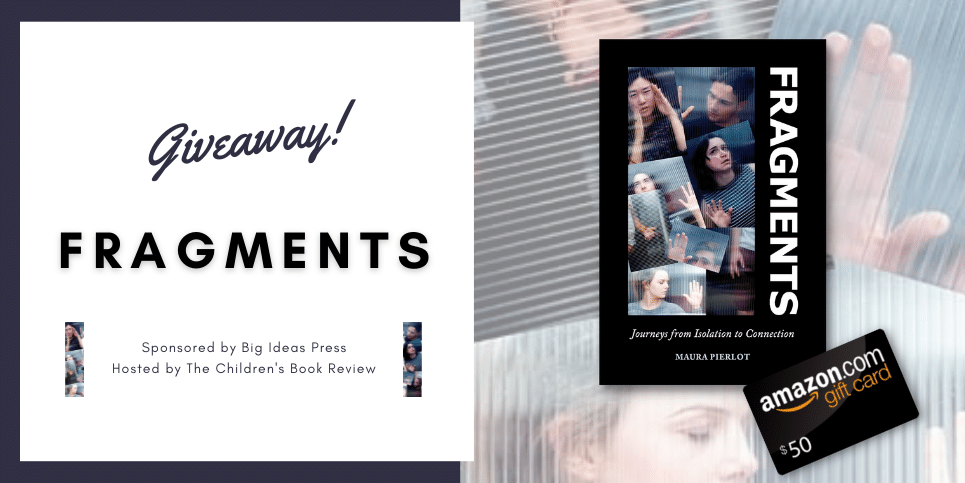
The giveaway begins September 6, 2021, at 12:01 A.M. MT and ends October 6, 2021, at 11:59 P.M. MT.
MY REVIEW OF FRAGMENTS:
FRAGMENTS: Journeys from Isolation to Connection
Written by Maura Pierlot
Fragments is a series of monologues that lend a voice to issues of mental health faced by teens all over the world today. In these monologues, readers follow the struggles of eight teens who seek hope as they fight mental health challenges. Each fight to maintain their connections to family, friends, and the community in which they live. The monologues are representative of the issues faced by youth and adults in the challenging times of which we live.
The actors represent young people around the world struggling with emotional, social, physical, and mental issues during their teenage years. As they reveal themselves, readers at once laugh, cry, feel their pain, and empathize with one or more of the issues described. The actors may appear to be disconnected, but in truth, they are seeking the possibility of connecting with one another.
The study guide included delineates themes, the background of characters, summaries of each monologue, and curriculum guide. While the monologues are matched to the Australian curriculum for high school studies, it can readily be adapted to standards used around the world.
Pierlot’s play provided her audience an opportunity to witness the problems and challenges facing youth today. Now readers of Fragments are given the opportunity to read and ponder the insights of these teens into the causes of mental issues and the realities they present for those who are suffering. Highly recommended read and discussion opportunity for teens and adults.
TOUR SCHEDULE
Monday, September 6, 2021The Children’s Book ReviewTour Kick-OffFragments: Journeys from Isolation to Connection
One Big Heart: A Celebration of Being More Alike Than Different
Written by Linsey Davis
Illustrated by Lucy Fleming
This is a very short interactive book that parents or teachers may use to discuss diversity with preschool and primary grade children. The author presents the material from a Christian viewpoint. Some families who reject that concept will need to explain or eliminate those parts of the story.
Children are asked to study the pictures and relate how we are all alike, make friendship bracelets, draw faces with different skin tones, and share their favorite foods. The heart activity demonstrates the love we feel within for all.
The book is a good starting point on the topic of multiculturalism.
If you enjoyed reading this post, please subscribe by clicking on the word Follow or by hitting the orange RSS FEED button in the upper right-hand corner of this page.
This beautifully written picture book is a wonderful addition to the library of late elementary and middle-school students. It relates the story of an African princess who became queen of two African kingdoms of the 1600s.
Njinga survived a difficult birth. After her father breathed life into her, he realized she was a survivor. Despite the jealousy of her older brother, Njinga succeeded in school and observed carefully. When her brother became king, she had to flee, but she returned when the country needed her.
This story is told simply yet eloquently. The illustrations are exquisite. There are beautiful maps, a timeline and historical facts that provide a plethora of information on African and Portuguese history.
I highly recommend the book to parents, teachers and librarians as a valuable reference book on medieval African history. It also provides a strong role model for young women who seek to be the future leaders of tomorrow.
If you enjoyed reading this post, please subscribe by clicking on the word Follow or by hitting the orange RSS FEED button in the upper right-hand corner of this page.
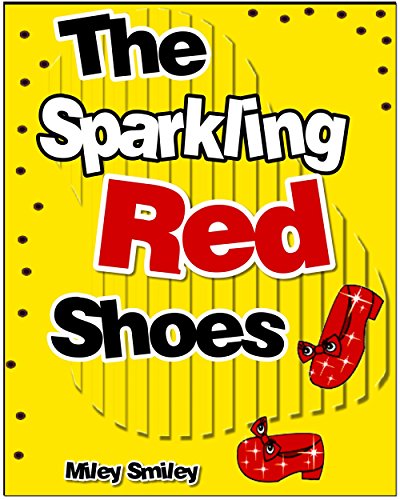
The sparkly little red shoes sit on the shelf in the shoe store. They cannot believe no one has chosen them because they feel themselves superior to all the other kinds of shoes.
One day, Lisa and her mother visit the shop seeking a pair of shoes to wear on her birthday. Lisa chooses the red shoes, but after her birthday they are put away in the closet. The little red shoes need to learn there is a place and time for everything.
This is a short picture book with color illustrations. There is quite a bit of text in this short story which makes it suitable for a beginning reader. Recommended for ages four through seven.
If you enjoyed reading this post, please subscribe by clicking on the word Follow or by hitting the orange RSS FEED button in the upper right-hand corner of this page.
Many people place value on educational success. Whether you feel it’s important to attain socioeconomic status, increase earning power, or simply be more of a well-rounded person, there are many arguments for pro-school attitudes.
From the start of a child’s beginning in school, when they are in preschool or kindergarten, we can cultivate an attitude of success, growth, and eagerness in them.
As they grow, their own success will depend more and more on themselves as they make their own choices. However, there are some things you can do to make it more likely they’ll succeed.
Routines and Daily Habits
For example:
Bodybuilders’ routines involve going to the gym each day.
A firefighter’s routine involves putting on gear and getting into the truck as quickly and safely as possible.
Police officers have routines when clearing a crime scene.
Garbage men have routines to pick up trash in the most methodical order as possible.
A routine for a child in school is no different. Explaining to your child that everyday professionals and jobs use routines is also important so they will understand the value in it.
The routine you choose for your child depends on your individual child, but basically involves setting aside a specific time of day and place for something related to their education.
What do successful school routines look like?
Consider these routines:
Completing homework everyday after school at the kitchen table
Writing down each subject’s homework in a daily journal or planner
Eating a healthy breakfast each morning with your student and discussing school
Asking your child about one or two important lessons they learned in school that day
Educational Check-In
While the singular job of a student is to go to school each day, the job of that student’s parent or caretaker is to help the student cultivate an attitude of learning. Despite the fact that we, as parents and guardians, have our own busy lives to deal with, it’s important to keep in mind that our children also are growing and learning.
There are many conversation starters revolving around school, and it is critical that parents set aside time each day to ask about school.
For example, you can ask:
What happened in school
How the school day went
What they learned
Whether anything was surprising
Or even what grades they got on tests
For older students, having a more in-depth conversation related to the transfer of educational knowledge to the real world is important.
Value of Report Card Grades
Some parents choose to motivate their children with rewards for good grades. While there are arguments for and against giving a child money for earning an “A” or a “B” on a report card, this can be done in a responsible way.
The basic idea is to motivate them with external rewards, but then phase it out as they grow older and the motivation comes from within themselves.
Overall, there are certainly many things you can do to jumpstart the excitement and energy that students have for school. With parenting, there are no right or wrong answers and you can even devise your own system for motivating your student for success.
SUBSCRIBE TO THIS BLOG FOR TIPS AND TRICKS, BOOK REVIEWS, AND ALL THE NEWS YOU CAN USE!
Publisher’s Synopsis: Who doesn’t love to color beautiful illustrations and learn interesting facts that enrich the mind?
If you also like amazing drawings and cool facts and believe it’s important to impart knowledge and broaden your child’s horizons, the We Can Color! series was created especially for you!
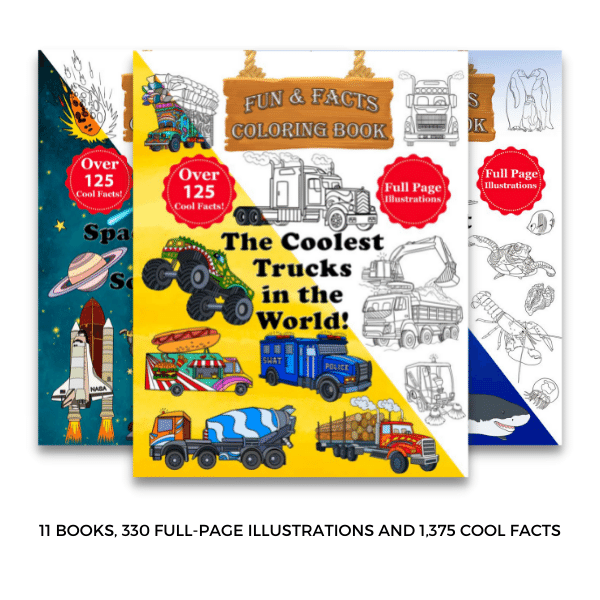
These eleven books cover topics that will interest anyone at any age: Dinosaurs, Vehicles, Aircraft, Space, and Animals from around the world in their natural environment: Farm, Jungle, Ocean, Savannah, Forest, and Desert!
Did you know that the most dangerous animal in the savannah is the hippopotamus? That the oldest koi fish lived to be 226 years old? That some goats can climb trees? And that the terrible T-Rex was not the biggest dinosaurs predator?
How big is the Sun relative to the Earth? What was the first man-made object to reach space? What is the fastest land animal? The tallest? The heaviest?
Did you know that scorpions glow in ultraviolet light? That male seahorses are the ones that get pregnant? That one of the astronauts lost his glove in space? That one of our planets was given its name by a girl in elementary school? And that there is an aircraft that takes off like a helicopter but flies like a plane?
Do you know the speed of the fastest truck in the world? Or how much does the heaviest tractor weighs?
What is the price of the world’s most expensive fighter jet? How much does an Air Force One flight hour cost?
What is the most venomous snake in the world? The most venomous jellyfish? The most poisonous frog? And do you know how to distinguish between a mammal and a fish in the ocean? Or how to tell a jaguar from a panther?
Next to each of the 330 full-page illustrations you can color, there are interesting facts: over 1,375 facts throughout the 11 books!
All the books contain full-page original coloring pages that are not repeated!
The extra-large pages are 8.5 x 11 inches in size!
All the illustrations are single-sided to prevent bleed-through and can be torn out and displayed without losing the images on the back!
All the illustrations and information are suitable for ages 5 and up. Children, teens, and adults will enjoy relaxed moments while coloring and learning fun facts!
The We Can Color – Fun & Facts Coloring Books series includes the following books:
What kid would not want this collection of cool coloring books. Space, trucks, animals, oceans, jungles, deserts, and the world as your oyster!
The large outline images are clear and simple enough for a young child to color. But there is a plethora of information packed into each one. Young artists will also learn more than 1300 facts about each of the topics in the series.
Gershowitz provides hours of entertainment for children as young as five that can also be enjoyed by grandparents who are ninety.
I love books like these that provide an outlet of artistic expression and creativity, while expanding and enriching the mind. Highly recommended.
GIVEAWAY
Enter for a chance to win a set of the We Can Color! coloring books, as well as a Crayola Inspiration Art Case Coloring Set!
One (1) grand prize winner receives: A set of the eleven We Can Color! coloring books, as well as a Crayola Inspiration Art Case Coloring Set.
One (1) winner receives: A set of six We Can Color! coloring books.
 October 27, 2021
 bamauthor
 Comments Off on NEVER GIVE UP







 Barbara Ann Mojica's BLOG
You must be logged in to post a comment.