Al’s Journey: The Night Everything Changed: A Magical Story of Growing Up Fast and Learning Who You Are
Written and Illustrated by Marin Darmonkow
This intriguing book contains 32 illustrated pages, but is far more than a picture book story.
The author has combined an earthly tale with mystical elements. At the outset, readers encounter a young boy being raised by his grandfather, who is the shaman of the village. When the shaman turns one hundred years old, he informs his grandson that he must climb the mountain to talk with God about his mission and purpose in life. The boy is guided by fireflies as he continues on his journey.
A book that begins as an adventure story becomes one of philosophical questions as the boy must grow up virtually overnight. Older readers will come face-to-face with finding answers on their own journey.
The illustrations are compelling. They draw the reader into the story and rapidly change its mood as the story evolves. This is a book that can grow with the reader who will return to it time and time again.
SUBSCRIBE TO THIS BLOG TO RECEIVE BOOK REVIEWS EVERY WEDNESDAY AND SUNDAY.
As a retired educator who bemoans the fact that our schools no longer teach critical thinking to young children, I applaud the author for taking on the challenge of teaching primary grade children that their first impression is not always correct.
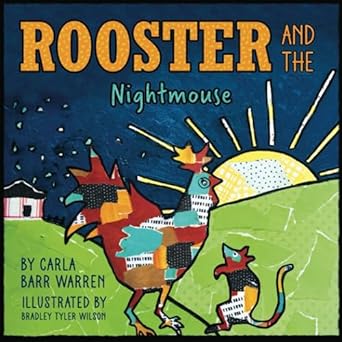
A young mouse named Tiny hears his family tell stories about enemies like the rooster. One day Tiny meets Dell, a rooster, and fears terror until he bravely stops to look into Dell’s eyes. He is surprised to find out you cannot believe everything you hear. Many misunderstandings can be prevented when rational thinking replaces false judgments.
The illustrations are an interesting collage of shapes and colors which force the reader to take the time to think about each page of the tale carefully.
I highly recommend the book to parents and teachers who will hopefully integrate the message of critical and creative thinking skills within the lives of themselves and their children.
I received a copy of this book from the publisher and voluntarily chose to read and review it with my honest opinions for no compensation.
SUBSCRIBE TO THIS BLOG FOR NEW BOOK REVIEWS EVERY WEDNESDAY AND SUNDAY.
If you have listened to me on a podcast, watched one of my you tube videos, or read this blog, you probably already know how passionate I am about the importance of learning how to think both critically and creatively and the importance of passing down these skills to our children.
Today, I would like to explain in this short article, how to quickly develop your superpower using these two ways of thinking.
In this short report, I want to introduce you to an innovative way of thinking and problem solving that combines creative and critical thinking. These two approaches are very different. Each of them has advantages and disadvantages. By combining the two, you can tap into the power of both.
Let’s start by taking a look at creative thinking, what it is, and how we can start to think more creatively. The phrase most often used to describe creative thinking is “think outside the box.” I like to think about it as a way to think about something in a new and different way. Look for the not so obvious solutions not thought of by anyone else. Yes, it will be out of the box thinking, but it can be so much more.
Let’s look at an example of creative thinking. Suppose you just bought a new house, and between the cost of the down payment and renovations you had to make, you’re broke. Your neighborhood association sends you a letter that your yard needs to be redone to fit in with the overall landscape. There’s no money in the budget for landscaping. What do you do?
You have to get creative. The obvious answer is to do it yourself, but that takes time, money, and skill that you may not have. Some creative options may be to get in touch with an up and coming landscaping company to see if they are willing to redo your yard for free or at cost price in exchange for putting up a sign to advertise their business in your yard. If you have web design skills, you could barter those in exchange for the work. Think outside the box and come up with a creative solution.
To get your creative thinking cap on, you can ask yourself some interesting questions:
Start with what if. Keep it very open-ended. In this first brainstorming stage, no idea is too ridiculous or impossible to throw out. While the idea itself may turn out to be unusable, it may spark a creative thought that will lead you to the perfect solution.
Another great question to ask is “What else.” It encourages brainstorming and expanding on existing ideas. Last but not least, you can spark creativity by introducing an off the wall concept. For example, you could pretend that you have no income for the following year. How would you live and how would you pay for your home and renovations, including the yard? The solution may be to work on a side hustle like graphic and web design for small businesses in your area. That, in turn, will help you realize that you can pay for the landscaping by spending a few weekends on freelance projects.
Another problem-solving skill is critical thinking. It’s very different from creative thinking. Here the idea is to think logically and work from information and data collected. You start with the information gathering process and then sort and analyze it to find the best solution. You want to be as objective and unbiased as possible and come up with the best possible judgment based on the information you have.
For example, if you are a project manager for a construction firm, you would gather information on what you need on the job site and then order the materials at the best price you can find. Another example a little closer to home would be the critical thinking you use when you’ve lost your car keys. You start to search the house room by room, possibly retracing your steps until you find them. That’s a small-scale example, but it gives you an idea of what critical thinking is.
The significant advantage of critical thinking, as opposed to creative thinking, is that you usually come up with a workable solution. When you let your creativity run too wild, you end up with a fun potential solution but possibly not something that will work or even something you want to attempt to try.
Let me show you what I mean by an off the wall example that will illustrate my point. Let’s say you want to lose 25 pounds. When thinking creatively, you realize that the average human leg weighs about 26 pounds. Cutting one of yours off would instantly result in a 25+ pound weight loss. While creative, it’s also absolutely ridiculous.
When you switch to critical thinking, you gather data and information on various weight loss programs as well as how the biological process of burning body fat works. As a result, you fast intermittently, eat more whole foods, and start to go for daily walks. It’s a much more workable solution, isn’t it?
Think about some other times when you’ve used critical thinking to make important decisions. Maybe it was choosing the right health insurance or 401K plan. Maybe it was picking a house in a good neighborhood with great schools for your kids that fit within your budget. Maybe it was whether or not to make a big career move or relocate to a different area of the country. We use critical thinking skills all the time. They serve us well at home, school, and work.
Last but not least, we come to the fun stuff. In this section, we take a look at how we can combine creative and critical thinking to come up with out of the box solutions to problems that work. By combining both critical and creative thinking, we can take advantage of the benefits of both while avoiding the downsides.
Let’s go back to the silly weight loss example to show how this can work in action. Again the idea is to lose a fair amount of weight. Cutting off a limb is obviously not an option, but we can take a look at some of the reasons that make this an attractive consideration. We lose a set amount of weight, and we lose it in a set amount of time. That may spark a thought about tracking weight loss in interesting increments (like losing the equivalent of 3 packs of butter, or the equivalent of your arm’s weight). It may also inspire us to set a date for which we want to have x number of pounds gone. It may even get us to think about and consider surgical alternatives like liposuction or stomach stapling. While those may not end up being the right solutions for you, it’s good to include them and think about those options. You never know where they may lead you.
Looking into weight loss surgery may have you considering alternatives like fasting. At the very least, it will serve as a motivator if you want to avoid surgery at all costs.
In this case, we started out with creative thinking and then moved into critical thinking. We got a complete picture, collected a lot of data, and then analyzed it logically to come up with the best solution. That’s a great way to approach this process.
Another option is to start with critical thinking, then switch to creative thoughts to come up with more alternatives and more data sources. Then go back to critical thinking to determine what will work in the end.
By combining these two ways of thinking, we can come up with new and innovative solutions that will work. At other times we may find that the old tried and true way of doing things is popular for a reason. It may end up being the best possible solution. We won’t know that though until we’ve thought about it critically and creatively, working through all possible alternative options.
That’s why combining aspects of both critical and creative thinking is such a powerful strategy. Give it a try the next time you face a complex problem. Since switching between thinking creatively and analytically can be a little tricky at first, it can be helpful to sit down and work on creative brainstorming first. Get out a notebook and spend some time thinking of as many ideas as you can and write them down. Walk away for a bit and then get to work on the critical thinking part of the process, collecting more data, organizing it, analyzing it, and finally coming up with a workable solution. Rinse and repeat as needed until you find something that works well for you.
The more you get in the habit of practicing those creative and critical thinking skills and combining them, the better you get at it. Before long the entire process will become an integral part of how you approach problem-solving.
Want to learn how to become a problem solver today?
Little Miss HISTORY Travels to INDEPENDENCE HALL & The American Revolution makes its debut on the world stage.
No Fake News here….just the facts
The United States Constitution is the oldest federal constitution in existence. This document, along with the Bill of Rights, lays out the rights and responsibilities of its citizens. The Founding Fathers embraced the principles of the Enlightenment and a vision of liberty and justice for all. Trace their footsteps at Independence Hall and the Museum of the American Revolution.
Available in hardcover or paperback
AVAILABLE ONLINE OR ASK FOR IT AT YOUR FAVORITE BOOKSTORE
Mind Mapping for Kids: How Elementary Students Can Use Mind Maps to Improve Reading Comprehension and Critical Thinking
Written by Toni Krasnic
Cautionary Note; This book is not intended to be read and forgotten; be prepared to spend time putting it to the test! Krasnic’s goal is to engage elementary students to use mind maps to connect the dots not just collect them. Once that task is accomplished, students can see and use the big picture to ask meaningful questions allowing them to become better readers and learners. The author’s purpose is to provide a guide for teachers and parents to help young students use mind maps to improve their reading comprehension and critical thinking.
Krasnic divides the book into three parts. Part One explains the fundamental principles of visual mapping both in mind mapping and concept mapping. In the second part, the Concise Reading Method (CRM) is fully explained. This technique marries the eight reading strategies to mind maps. These strategies will sound familiar. They include Summarizing, Applying Previous Knowledge, Visualizing, Evaluating, Synthesizing Information and then asking Critical Questions. Teachers and parents working with the common core curriculum will recognize many of these. Part Three contains enrichment activities with additional examples, templates, and tips for students, parents and teachers on how to use these techniques.
The author speaks to each of the target audiences. Teachers are encouraged to experiment and teach children to use their unique abilities and interests to create many kinds of maps Students are urged to believe in themselves by taking control of their learning and assuming personal responsibility for their education. Parents of very young children must allow their children to choose what and how to learn by facilitating their natural curiosity. Once a child becomes school-aged, a parent needs to partner with the school and display the child’s work throughout the home.
The materials in this book are comprehensive but well organized and easy to follow. Readers are encouraged to ask questions and seek additional assistance. The drawings and illustrations make the concepts easy to understand. I urge parents, teachers and students to spend some time looking them over. Time and energy invested now might last a lifetime.
If you enjoyed reading this post, please subscribe by clicking on the word Follow or by hitting the orange RSS Feed button in the upper right hand corner of this page.

 December 24, 2025
 bamauthor
 Comments Off on A PICTURE BOOK THAT GROWS WITH THE READER


 Barbara Ann Mojica's BLOG
You must be logged in to post a comment.