I would describe this book as a short story that could easily be developed into a full-length novel.
Molly Marsh is a curious ten-year-old whose parents are off on a scientific expedition to New Guinea. Her trepidation begins with a bumpy plane ride. Molly is enchanted when a beautiful blue butterfly alights on her. When the family arrives at their new home, Molly meets Yosia, who will be working for them in their new jungle home. She is intrigued by him. At first his strange habits scare her. Then she learns about his magical talents.
These two characters are interesting and could be developed in a fuller narrative. I consider the adventure book a short, chapter book. It is well-written with challenging vocabulary that is most appropriate for nine to twelve-year-old readers.
If you enjoyed reading this post, please subscribe by clicking on the word Follow or by hitting the orange RSS FEED button in the upper right-hand corner of this page.
Kid Legends (True Tales of Childhood from the Books Kid Artists, Kid Athletes, Kid Presidents, and Kid Authors
Written by David Stabler
Illustrated by Doogie Horner
This book will inspire children to address their fears and reaffirm their aspirations. It is divided into three parts. The first part explores difficulties overcome by J.K. Rowling, Peyton Manning, and Charles Schultz before they became successful. The second part discusses the struggles of Pablo Picasso, Muhammed Ali, and Ulysses Grant during childhood and how they overcame their handicaps to achieve fame. Part Three examines the role that family life played in the early lives of Jeff Kinney, John F. Kennedy, and Gabby Douglas. Before closing, the author and illustrator reveal facts about themselves
The illustrations are rich in detail and humorous. They are fun to look at and read. This book is perfect for middle-grade readers who are dealing with the same type of issues, bullying, family and peer relationships, and self-esteem. The book also provides an opportunity for jump-starting group discussions.
If you enjoyed reading this post, please subscribe by clicking on the word Follow or by hitting the orange RSS FEED button in the upper right-hand corner of this page.
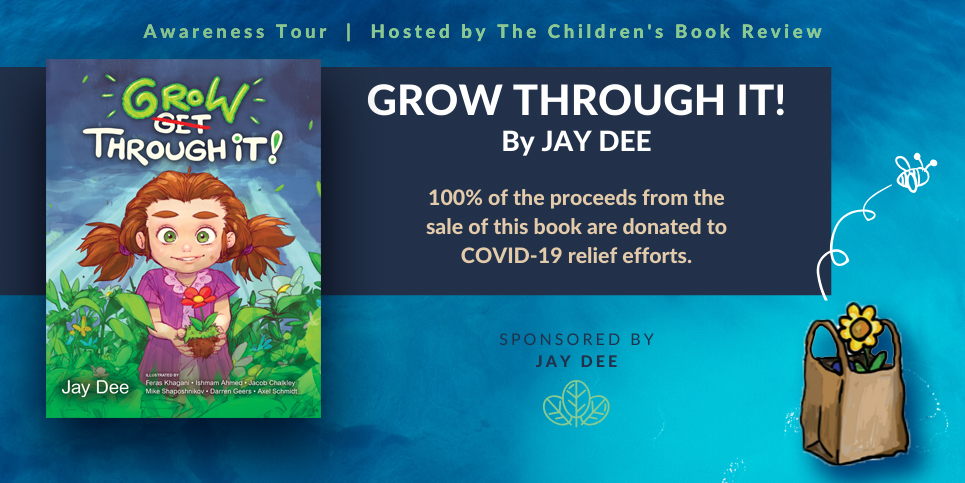
This book review and giveaway is in partnership with The Children’s Book Review. Please note that 100% of the profits from book sales are donated to COVID-19 relief efforts.
ABOUT THE BOOK
GROW THROUGH IT
Written by Jay Dee
Illustrated by Jacob Chalkley, Darren Geers, Feras Khagani, Mike Shaposhnikov, Ishmam Ahmed, and Axel Schmidt
Publisher’s Synopsis: Ellen is stuck at home. There’s no school and no friends, and Mom is working all the time. It seems terrible until she learns about the choice each day offers: GET through it or GROW through it. See how starting each day with purpose and gratitude can make all the difference! Created during the CV-19 pandemic, 100% of the proceeds from sales of this book are donated to coronavirus relief efforts.
This is the first children’s book on Covid -19, which I have read. Dee writes in a graphic novel style to portray in pictures and words the emotions and frustrations of an elementary school child in dealing with the pandemic.
Ellen feels angry because she cannot go to school and play with her friends or resume the lifestyle to which she is accustomed. Her mother tells her that she has a choice. Ellen can choose to spend her time complaining, watching TV, or hiding in her inside tent. Her other choice is to grow through this crisis by finding new opportunities to learn and help others in her community. Ellen struggles with this decision. She shifts back and forth between the two extremes. How can she stay positive? She desperately wants to see her grandmother to celebrate grandma’s special day.
This book speaks to the disappointments children are experiencing. Ellen’s mother provides a good example as to how parents may assist their children cope with this crisis. I would highly recommend it for elementary school age readers.
I received a copy of this book from the publisher and voluntarily agreed to read and review it with my honest opinions.
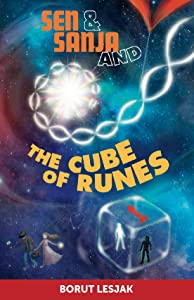
This is book one of a middle-grade detective fantasy series. Sanja is awakened by a thunderstorm. Her older brother seems unconcerned. Shortly after the two siblings discover their parents are missing under mysterious circumstances. To make matters worse, Social Services wants to place them in foster care.
These intrepid siblings find a mysterious cube in the attic. They vow to employ their detective skills to solve the mystery and outrun Social Services. Sen and Senja employ magic and wizardly to navigate through time dimensions and mysterious portals encountering many interesting characters along the way. Will they solve the mystery of the cube, find their parents, and stay together?
The plot moves quickly and sustains interest. Lots of fun for readers ages eight through twelve.
If you enjoyed reading this post, please subscribe by clicking on the word Follow or by hitting the RSS FEED button in the upper right-hand corner of this page,
As a special educator, I have worked with preschoolers and elementary school age children diagnosed with reading disabilities and speech language problems. I taught the Wilson Reading Program, which is a phonics based approach to reading. While I found it effective with many of my students, it did not meet the needs of all of them.
A lifelong book-lover, Dr. Karen Holinga’s interest in helping children learn to read began during her six years as a classroom teacher, where she saw how much some children struggled to master the skill. Her desire to solve the puzzle only increased during the twelve years she homeschooled her own children.
Eager to better understand the reading process, Dr. Karen pursued a doctorate in Developmental Reading, Curriculum, and Professional Development from The Ohio State University.
With Happy Cheetah Reading, she has taken all her expertise—years of classroom experience, years homeschooling, her doctoral research, and her extensive clinical practice—and crafted a simple plan. As The Reading Doctor, she has successfully helped over 25,000 children learn to read— many of whose parents had lost hope. She knows how some students struggle, and she knows how to help.
I am presenting this program as a resource for parents and educators and not as an endorsement or beneficiary of any of its products.
As you might guess from the name, auditory processing relates to sound. But children with poor auditory processing are not usually hearing impaired. Rather, these children’s brains don’t interpret the incoming sounds correctly.
Is There a Cure?
Auditory processing is a developmental issue.
This means it’s like losing teeth, which is another developmental milestone. Children who lose their first teeth at age four are not “better” than those who lose their first teeth at age seven. If your five-year-old doesn’t have a loose tooth yet, you don’t get angry, or start Tooth Loosening Therapy. Teeth loss is developmental, and it will happen when it happens.
With auditory processing, it’s the same way. You can’t make it happen, so release yourself from any pressure. There is no appointment for you to make, no official diagnosis that will help. There is no fix for the neurology.
Most children work through their auditory processing issues and eventually catch up with their peers, when their body is ready.
Symptoms of Poor Auditory Processing
If, as you read through these symptoms, one or two stand out to you, then assume that, yes, your child deals with auditory processing.
1) Poor phonemic awareness. A single sound is called a phoneme (FOE neem), and children who can’t hear the difference between sounds have “poor phonemic awareness.” This means they cannot easily separate or distinguish individual sounds, and have an especially hard time distinguishing between short vowel sounds, such as bet and bit.
Children with poor phonemic awareness will probably not be able to determine which of these pairs of words rhyme:
sock – sell
rim – slim
sink – drink
tap – shirt
These children can’t hear the wrong rhymes, and can’t guess the right rhymes.
This also can show up in very slow letter sound acquisition. It took my son three years of daily work to (mostly) remember the 26 basic letter sounds and their written component.
2) Difficulty with word retrieval. My son would know what he wanted to say, but his brain couldn’t access the specific words. For example, he might say, “Hey, Mom, remember the book about the person who went on a trip?”
And based on the context of whatever we had recently been talking about, I could usually guess, “Do you mean the book about Chris taking the logs down the Mississippi in Swift Rivers?”
But not always. “Hey, Mom, do you remember when we went to that place and rode on that thing?” could equally apply to the time when our family went to the amusement park and rode the tram, or to the airport and rode on the moving sidewalk, or to the lake and rode on the paddle board. Which sentence is my son trying to communicate?
When children have difficulty with word retrieval, the specifics of language are missing, those clarifying and important words that differentiate experience.
3) Unclear or delayed speech. Self-explanatory.
4) Delayed auditory processing. These children’s brains overload really easily, because they can’t process language quickly.
In fact, some children process information 80% more slowly.
Think about trying to do anything if your brain had slowed down 80%. How much less would you comprehend?
4) Poor auditory memory. Children with poor auditory memory don’t remember what they hear, so they miss a lot.
If a parent says, “Go to your room, get your shoes, and meet me at the door,” the children will show up at the door, but without their shoes.
This isn’t because they’re deliberately disobeying. They simply cannot remember.
On occasion, my son will have listened to almost all of a chapter book. Then, on page 250 of 300, he’ll ask about a key secondary character, “Now who was that again?” He more-or-less has understood the book, but he clearly doesn’t have specific ideas about the different characters.
5) Difficulty with hearing the number of syllables in a word. You may have heard the trick of clapping syllables, a clap for each syllable. So one clap for cat, two claps for tiger, three claps for beautiful, four claps for hyperactive.
My son would guess: “Does computer have one syllable? Does cake have two?” It was astonishing to see all the ways he would contort his speech to make the syllable claps fit the word.
When children can’t hear syllables, it makes reading programs that focus on syllables almost impossible.
Does this sound like your child?
If this sounds like your child, I encourage you to keep reading. Some children, like my son, have both auditory processing delays, and the other challenge that we’ll cover tomorrow.
But if this sounds like your child, only one reading program on the market is going to help your child. Every Orton-Gillingham program, supposedly the “gold standard” for struggling readers, focuses on syllable division and rule memorization. For a student who has a hard time hearing and remembering the letters themselves, loading them down with rules is unhelpful at best, and destructive at worst.
I am thrilled that a program exists that acknowledges and allows struggling readers to move forward, even with delayed auditory processing.
The Happy Cheetah Reading System is designed to get your child up to speed as quickly as possible. happycheetah.com
If you have enjoyed reading this post, please subscribe to my blog by hitting the RSS FEED button in the upper right-hand corner of this page or by clicking on the Follow button.
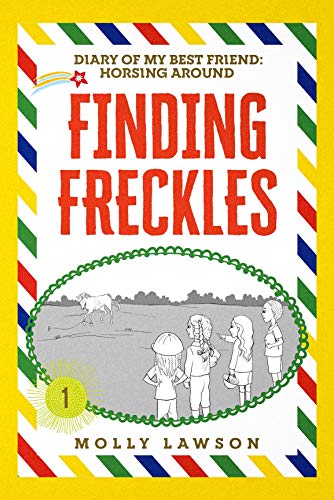
Finding Freckles, Diary of My Best Friend, Horsing Around
Written by Molly Lawson
This middle-grade chapter book is narrated by Emma Williams, an eleven-year-old girl living in a rural South African village. The impetus for the diary is a writing assignment from Emma’s English teacher.
Emma writes honestly and openly. She reveals her hopes, fears, and dreams. Her fervent desire is to own a horse and become an expert jumper. Unfortunately, her single mom cannot afford to buy her a horse. Luckily, Emma’s best friend, Christine, lives on a neighboring farm. Christine is a good rider and that allows Emma to be around horses.
Emma’s story pulls the reader in because she is relatable to her readers. The characters are believable and appealing to a middle-grade audience. Not only do readers learn about horses, but they also pick up knowledge of geography and South African culture. This is book 1 of a series that promises to be the first of an interesting series. Will Emma achieve her dreams?
If you enjoyed reading this post, please subscribe by clicking on the word Follow or by hitting the orange RSS FEED button in the upper right-hand corner of this page.
Never ask a Dinosaur: Funny Read-Aloud Story Book for Toddlers, Preschoolers and Kids 3-6) Book 4
Written and illustrated by Melinda Kinsman
A little boy decides to bring his pet triceratops to school with him, thinking that they will both have lots of fun. At first, his friends think this is cool. His teachers, principal, cafeteria workers, and staffers don’t agree.
This book contains terrific illustrations that are colorful and expressive. The rhyming text flows well and is fun to read aloud. Children will love the humor and funny antics. The bonus puzzles, matching activities, and games keep the fun rolling along. Book 4 in this series does not disappoint. Preschoolers and primary grade readers can have lots of fun with this series of books.
If you enjoyed this post, please subscribe by clicking on the word Follow or by hitting the orange RSS FEED button in the upper right-hand corner of this page.
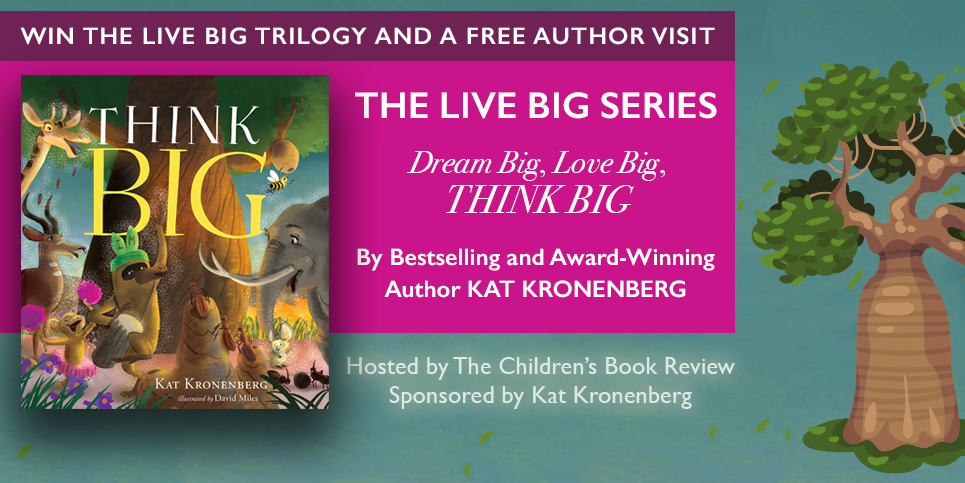
Giveaway begins April 20, 2020, at 12:01 A.M. PST and ends May 20, 2020, at 11:59 P.M. PST.
*Date, time, and school for the visit is to be worked out between the winner and author Kat Kronenberg. The school must be within 2 hours driving distance to a major airport. Click here for the giveaway rules.
Publisher’s Synopsis: In the third installment in her Live Big Series, best-selling, award-winning author Kat Kronenberg takes readers back to the wilds of the African savanna where the animals not only still struggle to find food, but now they face life-threatening situations. They must fight to survive and are terrified.
But when our beloved moody Baboon challenges Kudu on what to do, everything begins to change. One by one, Kudu, Giraffe, and Bee are faced with the dilemma of who they want to be. After watching Bee choose to do good, Baboon figures out a new secret: We can light the stars in our hearts, empowering our lives, once we smile big deep within, truly believing in who we are, our ideas, and the importance of caring for others.
The danger continues to mount and Baboon finally gets so scared that he cries out for help. Luckily, some fun animals and Baobab Tree come to the rescue! Will they try the new SHHH secret so their collective ideas not only help all the animals survive but thrive together so that their dreams can come true?
Once again, Kronenberg creates a mythical evolution story of some of nature’s most fascinating characters to teach young readers foundational skills for life in this case, helping them build a loving community that knows the joy of gratitude, giving, and going for the extraordinary. Through playful dialogue and beautiful illustrations, readers learn to take a deep breath when life gets hard, connect their heads to their hearts, and celebrate their best lives as they problem-solve together. As with Dream Big and Love Big, Kronenberg includes hands-on activities at the end of the book and on her website. Her dream is that the whole experience will inspire young readers everywhere to learn to think big together.
Ages 2-8 | Greenleaf Book Group Llc | May 12, 2020 | ISBN-13: 978-1626347106
DON’T KNOW HOW TO ORGANIZE FAMILY SCHEDULES WHILE WE ARE ALL WORKING FROM HOME?
Here are a few ideas to keep things running smoothly and making everyone in the family more productive.
Create a To-Do List the Night Before
Instead of waking up in the morning to make your to-do list, make your list the night before. This way you can go to bed relaxed and confident for the next day. You also wake up in the morning knowing exactly what you have planned for the day. You might also consider planning on Sunday night for the upcoming week. Then when you wake on Monday you have a plan in place.
Prioritize
Take a look at the tasks on your list. What tasks offer the largest return? What tasks offer the most value and achievement? For example, answering email or paying bills isn’t a task that offers a large return. However, making a sale or meeting with a client is a very productive task. Put your most profitable or results-oriented tasks first on your list.
Get a Good Night’s Sleep
The quality of your sleep is important to sustain your energy levels throughout your day. Good sleep means you’ll be fresh and energetic all day long. Creating a to-do list is a good way to help you get a good night’s sleep because you can put the day’s stresses to rest.
Also consider adding soothing nighttime rituals to your routine. For example, meditate, stretch or read before you go to bed. Keep a gratitude journal and write before you sleep. Go to bed and wake at the same time to help your body know what to expect.
Eat Healthy
The food you eat has a direct correlation to how energetic and productive you are. Junk food will make you sluggish. Healthy food will help you stay energized all day long. Feed your body well and it will respond by keeping you alert and energetic.
Get Organized
If you spend half your time searching for files, names and numbers, you are wasting time. Make sure any items that you use on a regular basis are easy to grab from your desk chair or find in your computer. They should be easy to find and use.
Take Breaks
Productivity doesn’t mean working from sun-up to sundown. In fact, if you work without stopping, you’re likely to burn out. Instead, commit to taking a break every hour. Walk around or get some air to get the blood moving throughout your body.
Focus
Do you multi-task hoping it’ll make you more productive? Do you manage one task while your mind is already onto the next task? Both habits are unproductive. When you focus on what you’re doing, not only is the task more enjoyable, it also gets done faster and better.
Productivity is possible. With a little planning, attention, and self-care you can get more done in half the time. These tools are simple but effective. Try just one of these steps and watch your own personal productivity improve.

 July 12, 2020
 bamauthor
 Comments Off on #ANewWayofLife







 Barbara Ann Mojica's BLOG
You must be logged in to post a comment.