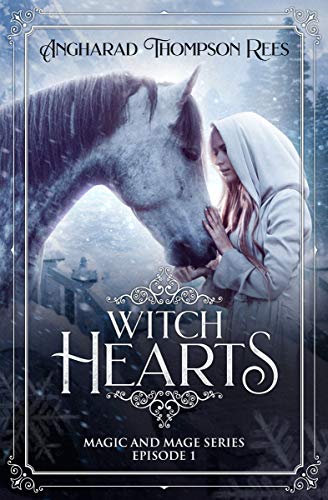
This is the first book in a fantasy series for young adults. Triplets Morganne Amara, and Fae despair because their mother appears to be nearing death. They live in a secluded cottage at the edge of Mystic Wood.
Desperate to find a cure for their mother’s mysterious illness, the sisters venture into the woods in search of a cure. Little do they realize their problems are just beginning. Something or someone appears to be following them.
Once captured, the girls are deemed to be witches. How will they be able to save their mother? Will they succeed in escaping or are they doomed to the pyre?
I was impressed with the writing. The author succeeds in creating the mood and getting the atmosphere right. For a book that is fewer than one hundred pages, the characters are remarkably well-developed. This is a clean read and would be appropriate for advanced middle-grade readers as well as teens and adults.
If you enjoyed reading this post, please subscribe by clicking on the word Follow or by hitting the orange RSS FEED button in the upper right-hand corner of this page.
This book is a charming, coffee table book that can be used to spark conversations with family or friends. An elderly woman dressed in retro fifties clothing discovers an old trunk in the attic. The stuffed animals that are trapped inside have been there since their former owner abandoned them. They are torn, soiled, and tattered. The old woman can communicate with the stuffed animals. She offers to repair them and make them new once more. Then one of them announces he doesn’t want to change the way he looks or feels.
At the end of this short story, there is a set of discussion questions for readers with open minds and open hearts. I would recommend the book for all ages.
If you enjoyed reading this post, please subscribe by clicking on the word Follow or by hitting the orange RSS FEED button in the upper right-hand corner of this page.
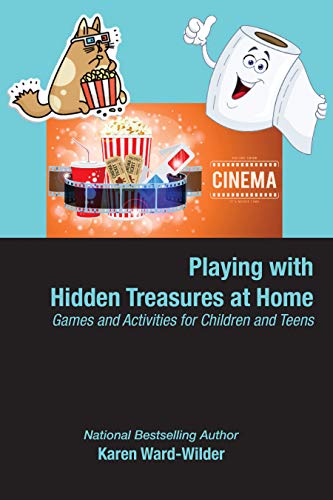
Playing with Hidden Treasures: Games and Activities for Children and Teens
Written by Karen Ward-Wilder
This book is a compilation of games and activities that parents can enjoy with children. It employs common household materials like vinegar, paper, pencils, photos, ribbon, paper plates, and water to develop and enhance skills.
The activities involve memory, communication, math skills, listening skills, spatial orientation, music, movement, personal hygiene, and sensory awareness. Here is one example, dancing, and singing to the music of different generations. Each player selects two or three songs and writes the names on paper. Mix up papers on the table. Each player selects dances and/or sings that song, receiving points for being able to do so. Adults and children learn about each other’s music.
Adults and older siblings may need to supervise younger children in some of these activities. This book offers many opportunities for family-sharing while staying inside during the Covid-19 pandemic.
If you enjoyed reading this post, please subscribe by clicking on the word Follow or by hitting the orange RSS FEED button in the upper right-hand corner of this page.
As a special educator, I have worked with preschoolers and elementary school age children diagnosed with reading disabilities and speech language problems. I taught the Wilson Reading Program, which is a phonics based approach to reading. While I found it effective with many of my students, it did not meet the needs of all of them.
A lifelong book-lover, Dr. Karen Holinga’s interest in helping children learn to read began during her six years as a classroom teacher, where she saw how much some children struggled to master the skill. Her desire to solve the puzzle only increased during the twelve years she homeschooled her own children.
Eager to better understand the reading process, Dr. Karen pursued a doctorate in Developmental Reading, Curriculum, and Professional Development from The Ohio State University.
With Happy Cheetah Reading, she has taken all her expertise—years of classroom experience, years homeschooling, her doctoral research, and her extensive clinical practice—and crafted a simple plan. As The Reading Doctor, she has successfully helped over 25,000 children learn to read— many of whose parents had lost hope. She knows how some students struggle, and she knows how to help.
I am presenting this program as a resource for parents and educators and not as an endorsement or beneficiary of any of its products.
As you might guess from the name, auditory processing relates to sound. But children with poor auditory processing are not usually hearing impaired. Rather, these children’s brains don’t interpret the incoming sounds correctly.
Is There a Cure?
Auditory processing is a developmental issue.
This means it’s like losing teeth, which is another developmental milestone. Children who lose their first teeth at age four are not “better” than those who lose their first teeth at age seven. If your five-year-old doesn’t have a loose tooth yet, you don’t get angry, or start Tooth Loosening Therapy. Teeth loss is developmental, and it will happen when it happens.
With auditory processing, it’s the same way. You can’t make it happen, so release yourself from any pressure. There is no appointment for you to make, no official diagnosis that will help. There is no fix for the neurology.
Most children work through their auditory processing issues and eventually catch up with their peers, when their body is ready.
Symptoms of Poor Auditory Processing
If, as you read through these symptoms, one or two stand out to you, then assume that, yes, your child deals with auditory processing.
1) Poor phonemic awareness. A single sound is called a phoneme (FOE neem), and children who can’t hear the difference between sounds have “poor phonemic awareness.” This means they cannot easily separate or distinguish individual sounds, and have an especially hard time distinguishing between short vowel sounds, such as bet and bit.
Children with poor phonemic awareness will probably not be able to determine which of these pairs of words rhyme:
sock – sell
rim – slim
sink – drink
tap – shirt
These children can’t hear the wrong rhymes, and can’t guess the right rhymes.
This also can show up in very slow letter sound acquisition. It took my son three years of daily work to (mostly) remember the 26 basic letter sounds and their written component.
2) Difficulty with word retrieval. My son would know what he wanted to say, but his brain couldn’t access the specific words. For example, he might say, “Hey, Mom, remember the book about the person who went on a trip?”
And based on the context of whatever we had recently been talking about, I could usually guess, “Do you mean the book about Chris taking the logs down the Mississippi in Swift Rivers?”
But not always. “Hey, Mom, do you remember when we went to that place and rode on that thing?” could equally apply to the time when our family went to the amusement park and rode the tram, or to the airport and rode on the moving sidewalk, or to the lake and rode on the paddle board. Which sentence is my son trying to communicate?
When children have difficulty with word retrieval, the specifics of language are missing, those clarifying and important words that differentiate experience.
3) Unclear or delayed speech. Self-explanatory.
4) Delayed auditory processing. These children’s brains overload really easily, because they can’t process language quickly.
In fact, some children process information 80% more slowly.
Think about trying to do anything if your brain had slowed down 80%. How much less would you comprehend?
4) Poor auditory memory. Children with poor auditory memory don’t remember what they hear, so they miss a lot.
If a parent says, “Go to your room, get your shoes, and meet me at the door,” the children will show up at the door, but without their shoes.
This isn’t because they’re deliberately disobeying. They simply cannot remember.
On occasion, my son will have listened to almost all of a chapter book. Then, on page 250 of 300, he’ll ask about a key secondary character, “Now who was that again?” He more-or-less has understood the book, but he clearly doesn’t have specific ideas about the different characters.
5) Difficulty with hearing the number of syllables in a word. You may have heard the trick of clapping syllables, a clap for each syllable. So one clap for cat, two claps for tiger, three claps for beautiful, four claps for hyperactive.
My son would guess: “Does computer have one syllable? Does cake have two?” It was astonishing to see all the ways he would contort his speech to make the syllable claps fit the word.
When children can’t hear syllables, it makes reading programs that focus on syllables almost impossible.
Does this sound like your child?
If this sounds like your child, I encourage you to keep reading. Some children, like my son, have both auditory processing delays, and the other challenge that we’ll cover tomorrow.
But if this sounds like your child, only one reading program on the market is going to help your child. Every Orton-Gillingham program, supposedly the “gold standard” for struggling readers, focuses on syllable division and rule memorization. For a student who has a hard time hearing and remembering the letters themselves, loading them down with rules is unhelpful at best, and destructive at worst.
I am thrilled that a program exists that acknowledges and allows struggling readers to move forward, even with delayed auditory processing.
The Happy Cheetah Reading System is designed to get your child up to speed as quickly as possible. happycheetah.com
If you have enjoyed reading this post, please subscribe to my blog by hitting the RSS FEED button in the upper right-hand corner of this page or by clicking on the Follow button.
DON’T KNOW HOW TO ORGANIZE FAMILY SCHEDULES WHILE WE ARE ALL WORKING FROM HOME?
Here are a few ideas to keep things running smoothly and making everyone in the family more productive.
Create a To-Do List the Night Before
Instead of waking up in the morning to make your to-do list, make your list the night before. This way you can go to bed relaxed and confident for the next day. You also wake up in the morning knowing exactly what you have planned for the day. You might also consider planning on Sunday night for the upcoming week. Then when you wake on Monday you have a plan in place.
Prioritize
Take a look at the tasks on your list. What tasks offer the largest return? What tasks offer the most value and achievement? For example, answering email or paying bills isn’t a task that offers a large return. However, making a sale or meeting with a client is a very productive task. Put your most profitable or results-oriented tasks first on your list.
Get a Good Night’s Sleep
The quality of your sleep is important to sustain your energy levels throughout your day. Good sleep means you’ll be fresh and energetic all day long. Creating a to-do list is a good way to help you get a good night’s sleep because you can put the day’s stresses to rest.
Also consider adding soothing nighttime rituals to your routine. For example, meditate, stretch or read before you go to bed. Keep a gratitude journal and write before you sleep. Go to bed and wake at the same time to help your body know what to expect.
Eat Healthy
The food you eat has a direct correlation to how energetic and productive you are. Junk food will make you sluggish. Healthy food will help you stay energized all day long. Feed your body well and it will respond by keeping you alert and energetic.
Get Organized
If you spend half your time searching for files, names and numbers, you are wasting time. Make sure any items that you use on a regular basis are easy to grab from your desk chair or find in your computer. They should be easy to find and use.
Take Breaks
Productivity doesn’t mean working from sun-up to sundown. In fact, if you work without stopping, you’re likely to burn out. Instead, commit to taking a break every hour. Walk around or get some air to get the blood moving throughout your body.
Focus
Do you multi-task hoping it’ll make you more productive? Do you manage one task while your mind is already onto the next task? Both habits are unproductive. When you focus on what you’re doing, not only is the task more enjoyable, it also gets done faster and better.
Productivity is possible. With a little planning, attention, and self-care you can get more done in half the time. These tools are simple but effective. Try just one of these steps and watch your own personal productivity improve.
Children’s book week is coming up the first week of May. This year I will be marketing online as schools are closed and the largest children’s book festival in my state has been canceled. No personal appearances in schools or book signings for the foreseeable future. In the meantime, here are a few ways authors can use their free time to help fellow authors.
I found this article on Book Marketing Buzz and would like to share it because its message is a positive one. There will be light at the end of the tunnel for all of us.
Many libraries, schools, and bookstores are closed. Amazon is behind in deliveries. Speaking appearances and book signings have been canceled. So how are books being sold in this environment?
Here are the answers each correct in some fashion:·
Social media is helping to sell more books·
Traditional and digital media is covering books·
Authors are doing webinars and online courses to sell books·
New online retailers are sprouting up·
Not everything is closed everywhere – it just sounds like that·
E-books are skyrocketing·
Audiobook downloads are surging
There is reason to hope. Everyone is cooped up and is open to reading books. Many run to the safe confines of books, whether to escape reality or to use this time to learn what they had been meaning to finally get to. So many books do well in this environment, including:
Children’s Books – kids need to learn and be entertained without school·
Thrillers – always a good time for them·
History – let’s learn from past disasters, depression, and pandemics – or read about better days of the past·
Entertainment – love a good distraction·
Personal Finance – time to balance a budget and grow your assets·
Investing – gotta make back the money lost on Wall Street·
Survivalist Techniques – we are all preppers now·
Politics – the 2020 election is coming·
Humor – we need a laugh·
Sports – we can read about the past until the future games begin·
Health – this is our number one focus – how to stay healthy in mind and body·
Religion – we need some spiritual nourishment, especially when the churches and temples are closed·
Self-Help/Motivation – we all need uplifting stories now·
Cooking – if you can’t hit a restaurant or even afford takeout, learn how to cook
Travel — if you can go somewhere physically, time to go with your mind — and plan a future trip
Plus, let’s look forward, whether it is weeks, a month or a few months – stores will reopen, delivery times will improve, and the financial devastation will slow down and start to return to better times. But for the moment, as the world is upside down and filled with pain, fear, and uncertainty – and financial insecurity fills millions of homes and thousands of others confront death and severe illness – the book world is combusting. Indie stores have laid-off workers and shuttered operations.
Some publishers are looking at bankruptcy or a merger. Book releases scheduled for April or May are getting pushed back. Even the nation’s leading book trade show, Book Expo America, had to reschedule its date but right now its home, the Javits Center in NYC, is being used as a makeshift hospital to battle a plague. It is ugly out there. Still, the belief is it is temporary and we just need to weather the storm for the moment.
A decade ago the industry was hit by many challenges – the Great Recession, the ebook revolution, Amazon taking over the industry as Borders drop dead, technology allowing for the majority of published books to be self-published, and the Internet providing free competition for content providers.
But the American book industry rose from the dead and all of that transition and uncertainty. It is going through another tough time now, as many Americans are. Every day that passes means we get a day closer to recovery. The pandemic seems like it is a book that has no end, but the truth is, we know how it ends. And we know that the book world will get a new beginning and rise up. I can’t wait for the sequel!
So, I want to end this post with a positive message for my author friends. In the meantime, stay strong, stay safe, stay calm and REMAIN PRODUCTIVE!
A boy and his father visit the pound a couple of days before Christmas. The little boy chooses a black puppy with a white spot on his chest and a red bow around his neck.
They bring the dog back to their farm where he eagerly plays in the snow. On Christmas morning, the puppy receives three gifts, for which he is so grateful. The boy promises to love, feed and train the puppy, and he is rewarded with all the love the puppy can give.
This book is written in rhymes that are easy to read. Children learn respect for animals, love, kindness and responsibility. Harwell captures the mood well in her illustrations. This is a winner for any child who loves animals. Caution, they may ask you for a wet nose puppy after reading this book.
If you enjoyed reading this post, please subscribe by clicking on the word Follow or by hitting the orange RSS FEED Button in the upper right-hand corner of this page.
Topsy Turvy: Bedtime with a Smile Picture Book (Bedtime Stories with Uncle Willy 3)
Written by Sarah Mazor
Illustrations by Sergii Zavadskyi
I always look forward to a new collection of Uncle Willy’s zany stories for preschool and primary grade children.
In Book 3, Uncle Willy tells the tale of a town named ComeGo where everything is topsy turvy. The children teach their parents basic skills like how to ride a swing or a bike. People say goodbye when they meet and hello when the leave. Animals behave strangely. Bears hang on trees like monkeys and cows play like puppies. Pigeons lick themselves like cats and people pull carts instead of horses. Children learn about opposites while having a good laugh.
The fun continues as readers are urged to create their own fanciful stories. They are presented with fifteen riddles and given four choices. Correct answers are given. These activities can be done with an adult or in a group with other children. I highly recommend the entire Uncle Willy series of books.
If you enjoyed reading this post, please subscribe by clicking on the word Follow or by hitting the orange RSS FEED button in the upper right-hand corner of this page.
 June 15, 2020
 bamauthor
 Comments Off on #VIRTUALREALITY #SECONDLIFE #CHILDRENBOOKAUTHORS









 Barbara Ann Mojica's BLOG
You must be logged in to post a comment.