Posts from the ‘young adult’ Category

7 Ways To Tap Into Your Subconscious

Do you ever wonder what really makes you tick?

How can you get in touch with your subconscious?

Here are seven different ways to discover what lies below the surface and then learn how to connect with it effectively.

Contents

1.) Positive Affirmations.

2.) Meditation..

3.) Use Free Association..

4.) Daydream Visualizations.

5.) Find A Creative Hobby.

6.) Get Plenty of Sleep.

7.) Listen To Your Instincts and Your Inner Self

1.) Positive Affirmations

One of the best ways of tapping into your subconscious mind is by the use of positive affirmations. Affirmations bypass your conscious mind with its tendency to examine and judge everything and go straight to your subconscious mind.

Used consistently for a sustained period of time, positive affirmations can successfully reprogram your self-talk to make it more positive and upbeat. This unleashes the power of your subconscious to help you achieve your goals because you will have removed the blocks created by self-doubt and a negative self-image.

Using positive affirmations in this way is simple but time-consuming. First, you need to know the biggest issues you have to work on. Pick the ones that stand directly between you and your goals, not the ones that are only minor obstacles. Write them down so you know what you need to work on.

You should only work on one issue at a time. Select a single issue. This issue may be self-confidence, doubt, fear, or anything that stands in your way. Find or create some positive affirmations around it that speak to you. You only need two or three affirmations. You can find plenty of affirmations online and in books or write your own.

The only requirements are a) these affirmations must be positive and b) they need to resonate with you. If both things are not true, you will not succeed with this method.

Next, you are going to start speaking aloud, thinking, or writing down these affirmations 3-5 times each several times a day. Many people speak them aloud in front of a mirror or while driving. You can think of them to yourself when you are around other people. All you need to write them down is a pen and a sheet of scrap paper.

You can also use a combination of these three methods throughout the day.

You should use your affirmations no less than three times per day -once in the morning, once before bed, and once sometime during the day. The more you use them, however, the better and faster they will work. You must be consistent and use the affirmations every day for them to work.

Over the course of weeks or a few months, these affirmations will sink into your subconscious and slowly reprogram your self-talk and your self-image. The negative thoughts they are replacing will slowly fade and eventually become extinguished entirely. When you see success with one issue, you can move on to the next.

2.) Meditation

You have undoubtedly heard about meditation and its many uses. It is one of the best, if not the best, methods of tapping into your subconscious known. It is primarily used for that purpose, in fact, and has been for thousands of years because it works so well.

There are many forms of meditation. The most common, and the one you have probably heard about several times, is the method where you sit cross-legged and focus on your breathing while clearing your mind of all thoughts. That is one method, yes, but it does not work for everyone.

Not only do some people not like traditional meditation, but others simply cannot use it due to issues such as ADHD. The other forms of meditation tend to be much more user-friendly for them.

A few of the kinds of meditation available for you to choose from include mantra/chanting meditation, movement mediation, progressive-relaxation meditation, focused meditation, mindfulness meditation, loving-kindness meditation, guided meditation, and visualization meditation.

You can spend months or years just trying different kinds of meditation to find the one that is best for you. You do not need a teacher or a class to learn meditation. If you want to do some kinds, such as guided meditation, you will need a guide, but you can find these in recordings online or use an app.

Meditation will not only help you tap into your subconscious, but it will give you many other benefits as well. Meditation helps you relax, lowers stress, anxiety, and depression, and increases overall well-being. People who meditate regularly tend to be healthier than those who do not. They are also happier overall.

Try several different kinds of meditation before you decide on the one (or ones) that you want to use for your personal practice. There is no rule saying you only have to do one type. You can switch back and forth whenever you want to.

Whichever form of meditation you decide to try, be sure to start slowly. You do not want to dive into an extensive form of a new practice without preparation. Trying to meditate for forty-five minutes five days a week starting from nothing is a great recipe for fast failure.

Instead, start slowly and do your meditation practice a few minutes at a time. Do it two or three times per week. Once you have it down to a routine, you can gradually add days and times to your practice.

3.) Use Free Association

Free association is a common technique used to access the innermost thoughts of your subconscious mind. These are the ones that you have trouble even tapping into, much less expressing to yourself or others in an intelligible form.

Free association works well to let you express those thoughts and the feelings behind them. It is used for many applications, most particularly in therapy, but a less intense form of it has been used as a method of brainstorming creative ideas.

If you want to try free association, it is paramount that you do so in a quiet, safe space. Safe does not refer to physical safety here (though that is also important), but emotional safety. Do this exercise either alone or with people you trust to support you and not exercise judgment.

There are two ways to do free association. The first is topical. That is, you choose a topic -usually a single word -to base the session on. The second is completely free and just makes use of the first thought to come into your mind when you start the session.

Whenever you are ready to do a free association session, go to the space you have selected and make yourself comfortable. You can do this alone or have another person there to assist you.

You are going to be speaking your thoughts, so if you are alone you will need to dictate your thoughts to a recorder or a text-to-speech device. If you have someone else with you, they will need something to write your thoughts on.

When you are ready, either think about the topic you have chosen or wait to see what comes to your mind. Begin speaking these thoughts aloud as they come up. Do not analyze them. Do not hold them back to see what they are. Do not judge them. Just speak them as they come to your mind.

It is extremely important that you do this properly and it will be difficult for you to do so for the first few times. We all want to examine our thoughts before they leave our brains -especially via speech. We have filters in place to keep us from doing so, and you will have to let those filters down to use this method.

Doing so lets you tap into your unconscious mind directly, however. Keep speaking your thoughts until you run out of thoughts on the subject or cannot keep going. Later you can go back and see what you said. You will learn much about yourself and your beliefs with this method.

4.) Daydream Visualizations

You are probably familiar with the use of visualizations as a technique to help you achieve your goals and dreams. Deliberate visualizations are often used for the purpose of motivating you and training your subconscious mind to believe you can reach them and help you do it.

When you use visualizations that way, what you visualize is deliberate. You think about what you want and picture it in your mind. You see it, feel it, and taste it as if it were real in the here and now. You do this often and spend a good deal of time doing it every day.

You can also use a different visualization process to tap into your subconscious. Are you trying to understand your thoughts, feelings, or motivations? Are you not clear about what you want? Is your subconscious sending you mixed signals? Are you just plain confused about life? Daydream visualizations can help you with all of these things.

This process is simple, but like many simple techniques, it is much harder to do it properly than it seems. The first thing you need to do is find a quiet place and make yourself comfortable. Close your eyes and relax.

Now let your mind begin to drift. Do not try to guide it. Do not tell it what to do or what to think about. See what comes up. Let yourself drift into daydreaming like you are a child imagining riding a dragon or scoring the winning goal in the big game.

What comes up and forms dreams and images in your mind will be your innermost dreams and desires, what you really want from life. Some of the things you daydream about might be things you had no idea you wanted, such is how closely we sometimes guard our hearts.

Both your conscious and subconscious minds may try to fight you in this process. Sometimes we try to keep our innermost dreams secret from even ourselves to protect us from the hurt and rejection that can accompany them. We can be our own harshest critics.

It may take you several sessions to relax enough and let your guard down enough to let yourself engage in this process without fighting. That is normal, particularly if you are experiencing a lot of confusion. The more confused you are, in general, the more your mind will fight this process.

Keep going, and you will eventually succeed and be able to tap into the deepest parts of your subconscious mind.

5.) Find A Creative Hobby

The subconscious is extremely complex and often not very direct. This means that tapping into it -and the power it holds -often requires approaching it from the rear or side. One of the best ways to do this is to access your creativity.

Every human being is creative. It is part of our nature. You do not have to be an exceptional artist to be creative or enjoy creating. The subconscious mind is the source of all our creativity, which means that engaging in creative pursuits inevitably taps into the subconscious.

Doing this gives you benefits that can go far beyond making art. It can help you solve problems, figure things out, come up with ideas, and more. That is all just from tapping into your subconscious mind. Creating has other benefits too, including stress reduction and relaxation. It is also fun, something that is important even when you are an adult.

Most hobbies count as creative hobbies. The traditional artistic pursuits -painting, sculpting, pottery, and so forth -are all creative, of course, but there are many more. Did you know that woodworking is a creative hobby? So is glassblowing.

All of the fiber arts, from knitting to spinning, count as creative hobbies. Even adult coloring books are creative. Any hobby in which you make or modify something is a creative hobby, whether it is painting pre-built figures from a hobby store, creating an oil painting from scratch, or crocheting a scarf.

You can find a creative hobby to suit you no matter what your budget is or what your interests are. Look around and try different ones until you find something that catches your interest and creates that “spark” of creativity in you. It does not matter what you choose, as long as you choose one or more that you like.

Do pick a hobby that is different from your day job, however. If you do a lot of writing at your job, pick something not related to words. If you paint for a living, pick something that has nothing to do with paint.

You should engage in whatever hobby you choose regularly to get the most benefit from it. Consistency is the key to this method as with so many others. Try to set aside some time at least twice a week just for working on your hobby. Half an hour is enough to give you the benefits and help you tap into your subconscious.

6.) Get Plenty of Sleep

You may be wondering what sleep has to do with tapping into your subconscious mind. Plenty, as it turns out. What does your conscious mind do while you are sleeping? Absolutely nothing. It shuts off completely.

At no other time in your life (unless you are unconscious for medical reasons) does your conscious mind completely switch off. This gives your subconscious mind free rein to control your body and do whatever it wants and it wants to do plenty -process your memories, help you repair cell damage, solve problems and think about anything that has been bothering you.

Sleep is one of the best, most unhindered ways to tap into your subconscious simply because your conscious mind cannot get in the way. How many times have you woken up in your life knowing the answer to a question or having an idea for solving a problem? Your subconscious did that for you while you were sleeping.

We give sleep short shrift in this society. Sometimes it seems like going without enough sleep is a badge of honor. It is anything but. Not getting enough sleep damages your health, wrecks your job performance, and can impair your relationships. Not to mention that it keeps you from listening to your subconscious.

Our subconscious mind not only does the things mentioned above when we sleep, but it talks to our conscious mind and tells it things (like answers and ideas). It does this through our dreams. To tap into your subconscious mind and talk to it like this, you have to get enough sleep.

Dreaming primarily occurs in the REM stage, which is the deepest stage of sleep. We are supposed to get lots of REM sleep but in our culture today often get much less than is ideal. This means we do not have enough chances to talk to our subconscious minds, among all the other issues it brings.

If you are interested in tapping into your subconscious mind, one of the most important things you can do is make getting enough sleep each night a priority. Most people need between 7 and 9 hours per night. You will need to experiment to find out how much is right for you.

You should also start noticing your dreams when you wake up each morning. Sometimes they are random and meaningless, but most of the time they are indications that your subconscious mind is trying to tell you something.

7.) Listen To Your Instincts and Your Inner Self

Sometimes tapping your subconscious mind is difficult and requires that you learn new methods of self-awareness like those discussed above. Sometimes it is absurdly simple. As in, all you need to do is learn to listen to it.

Your subconscious mind wants to communicate with your conscious mind. It is designed to do so, after all. It is only us silly humans with our silly ways of doing things and ridiculous notions that make this difficult.

Two of those ridiculous notions are that instincts are not real, or at least cannot be trusted, and that we do not have an inner voice that tries to guide us. Neither one of these notions is true. 

What those things are is your subconscious mind trying to communicate with you. It cannot do so directly -the subconscious is rarely able to speak in words and never in a conversational manner -so it does so indirectly by giving you hints and clues.

It would be so much better if your subconscious could metaphorically tap you on the shoulder and say “Hey! I think you should pay attention to this!” Unfortunately, it does not work that way.

Have you ever gotten a hunch that something was wrong and the hunch turned out to be right? Have you ever guessed the answer to a question based on something your gut told you? Both of these are examples of your subconscious mind talking to you and trying to tell you something.

What this means is that you do not need to learn any fancy techniques or methods to begin tapping into your subconscious. The best thing you can do is also one of the oldest and simplest methods of learning anything: start listening.

That is right: taking the time to listen to yourself is one of the best methods for tapping into your subconscious mind.

Instead of ignoring hunches and that little voice inside, start paying attention to them. Slow down and listen when something inside of you is speaking. It is your subconscious mind trying to tell you something, and it has a reason for doing so.

This is not to say that your subconscious mind is infallible, and your instincts and hunches are always right. Sometimes they will be wrong. That is unavoidable. There is still a reason for the message, however, and it may be just as important as the message itself.

But you will never know what it is if you do not slow down and start listening.

©2023 Barbara Mojica

https://fabulous-innovator-745.ck.page/770f35379e

SUBSCRIBE BELOW TO GET NEWS YOU CAN USE EVERY WEEK.

← Back

Thank you for your response. ✨

INTERESTING, RATHER THAN FUNNY

As They Slept

Written by Andy Leeks

A short, interesting read that can be picked up or put down according to your schedule. Probably a good book to read on a lunch break or work commute.

The author takes upon himself the challenge of writing autobiographical thoughts down while commuting to work. His point is that sleeping on the train on the way to work is an utter waste of time after spending the previous night snoozing.

His recollections are random ranging from funny to trivial, to serious. While the book is amusing in spots, I would not classify it as a comical read.

If you are looking for light reading that can be readily interrupted, this book is a good choice for you.

SUBSCRIBE TO THIS BLOG FOR NEW BOOK REVIEWS EVERY SUNDAY AND WEDNESDAY.

AUTHOR TIPS SERIES #COPYWRITING

Copywriting Essentials: 4 Myths That Keep You from Writing Compelling Copy

You’re stuck. You’re not seeing the leads you want for your business. You’re offering quality products and great services but only a few people are buying from you.

You might be tempted to believe that the problem is that your platform isn’t big enough or that your website isn’t interactive enough. But for many small business owners and solopreneurs, these problems are usually the result of poor copywriting.

The good news is that persuasive copywriting is an essential skill that can be learned. But first, you have to understand that some things you might believe about copywriting are actually myths that are harming your business.

Myth #1: Copywriting is all about selling.

Some small business owners believe that copywriting is the equivalent of going to a cocktail party and screaming “Buy my product!” to every person you meet. This couldn’t be further from the truth. Copywriting is about so much more than selling your product or program.

Copywriting is about serving your audience. You can use persuasive copy to address your customers’ concerns, help them make smart buying decisions, and offer solutions to their needs.

Myth #2: Copywriting is all about action.

Many small business owners and solopreneurs think that every piece of content they create has to have a call to action, but that’s not true. Most of the time, you’ll be creating content to increase your customers’ awareness of your business. . This can be called the “know, like, trust” factor.

The ‘know, like, trust’ factor is about guiding your potential customers through the buying stages. In the first stage, the know stage, you’ll give potential customers content that informs them. In the second stage, you’ll share content that makes your brand likeable. The third and final stage is known as trust. It’s the point where your customers will decide whether they should purchase your productive or service.

Myth #3: Copywriting is all about you and your business.

Copywriting isn’t focused solely on you or even your customer. The best copywriting strikes a balance between “about you” and “about your reader”.

You want your copy to show your understanding of and compassion for your ideal clients’ situation. Your copy should highlight that your business cares and why your brand is the best one to choose.

Myth #4: Copywriting is all about making your brand look perfect.

Persuasive copywriting isn’t about positioning your brand as perfect. It’s about connecting with your reader on both an intellectual and emotional level. Your potential customers want to know about your expertise, but they also need to know that you understand them. One simple way to do this is to share stories about your brand. Don’t be afraid to include stories about your business’s failures.

Don’t make the mistake of thinking that your copywriting is set in stone. Even expert copywriters create several drafts before they find a version that truly connects with their readers. The important thing is to keep testing your copy until you find what works best for your business.

Journal Your Thoughts

  1. Which of the copywriting myths do you struggle with the most? Why?
  • What’s your biggest challenge when it comes to copywriting?
  • Do you tend to make your copywriting all about you or all about your reader? How can you strike a better balance?

5 Steps to Reach Your Readers on an Emotional Level

When it comes selling yourself and your brand, it’s essential that you understand that your potential customers want to do business with people that they know, like, and trust. This is even more important if you’re a coach or service provider. Your potential clients may wonder if they’ll enjoy working with you, how you can help them, and if they’ll get their desired results.

This is where persuasive copywriting can help you. Copywriting will allow your ideal client the chance to know, like, and trust you. It also gives you an easy way to answer their questions before they even ask them. But before you start writing your copy, there are a few steps you’ll need to take.

Step #1: Identify Your Client

Describe your ideal client as detailed as you can. You need to be specific about their fears, frustrations, and feelings. Use forums and social media groups to see what words your ideal client uses to talk about their situation. Knowing how your potential clients describe what they’re dealing with will allow you to create copy that connects with them.You also need to think about what your potential client’s desired end result would look and feel like. For example, if you help overwhelmed working moms find time to prepare nutritious food to feed their families, then the end result might be less dinner time stress, more family time, and healthier bodies.

Step #2: Focus on your qualifications.

Next, think about how you’re uniquely qualified to help your potential clients. Describe why you’re qualified as a professional (education) and/or as a person (experience). You’ll want to offer proof of your qualifications in the form of diplomas, testimonials, and endorsements. These qualifications can be placed on the ‘home’ or ‘about’ page or a dedicated ‘testimonials’ page on your website and blog.

Step #3: Describe the milestones.

When you have a clear picture of what results your clients can expect from you, then you’ll want to think about the journey they’ll take. Try to describe the milestones your ideal client typically encounters during their journey. For example, if you’re a weight loss coach, one milestone might be losing the first ten pounds.

Don’t focus on just the good milestones. You’ll also want to consider the setbacks clients may face as well as the emotional aspects of their journey. For example, a setback might be gaining three pounds one week.

Step #4: Think about your clients’ objections.

Once you’re confident that you understand your potential clients’ journey, you need to take a moment to consider their objections. What hesitations might your client bring up when they’re ready to hire you? What are they afraid of if they take that first step? For example, if you’re a fitness coach that helps obese patients lose weight, you might find that potential clients are worried about visiting a gym for the first time.

When you understand these objections, you can offer solutions. Keep in mind that solutions don’t always have to be complex. You might simply tell clients that the first gym session is all about coming in and getting comfortable with the equipment, no workout required. Now, you’ve subtly eased a potential client’s objections to taking that first step toward fitness.

Step #5: Describe the action steps your reader would like to take.

Now that you know the journey your clients are on, it’s time to guide them to your product or services. You can do this by thinking about the action steps readers need to take when interacting with your content. For example, you might have a call to action at the bottom of your blog posts for joining your email list.

When you send emails to potential clients on your list, you might have a call to action at the bottom of each email that invites your subscribers to set up a free consultation with you. You want to continually invite your community to keep taking action. By doing this, you’ll have a list filled with valuable leads.

Understanding your client is the first step toward creating more persuasive copy. When you genuinely care about your clients’ journey, it will shine through in your copywriting efforts.

Journal Your Thoughts

  1. Who is your ideal client? Why are you passionate about serving this client?
  • How will you be helping your ideal client? In what ways will you accomplish this (one-on-one coaching, webinars, etc)?
  • How will your clients’ lives be different after working with you and your brand?

Getting Started With Persuasive Copywriting: The First 3 Pieces of Content to Give A Makeover

When you’re ready to create some persuasive copywriting, you may be overwhelmed and wonder where to start. There are three places where your copywriting skills really matter and this is where you should start. Once you’ve mastered these three elements of your website, you can go on to tackle other areas of your site.

1. Your ‘About’ Page

The ‘about’ page on any website is usually the most visited one. That’s why it should be clearly labeled. Don’t use a cutesy name in the hopes that more people will click on it. You’ll just confuse your website visitors. 

Your ‘about’ page should share your journey and cover why you’re qualified to help potential clients. Spin your journey into a story format that readers can relate to. For example, if you’re a business coach, you might share how you struggled to get your own business started for several years before finding success. By sharing your story, you’ll make it easy for your potential clients to relate to you and show them that you’re qualified to help.

2. Your ‘Services’ Page

Your ‘services’ page is your chance to stand out from other solopreneurs that offer similar services. But don’t cram every single service you offer on the same page. That will overwhelm visitors and they may leave your website before reading through all of the services you perform. That’s why it’s smart to have each service listed on a separate page of your website.

You want your service pages to show that you understand your ideal client and can deliver what they need. Then you should explain how you work and what end result your ideal client can expect. For example, if you’re a social media strategist, don’t tell potential clients that you can handle their Facebook advertisements. That’s vague and doesn’t describe what you can do. Instead, you might tell potential clients that you can increase Facebook ad conversions by 20%.

Now, include an easy next step, like joining your mailing list. Direct your visitors to your freebie sign up page with a helpful link, like this one:  ===> Add Your Download Link to Your Free Report <===.

By doing this, you stay connected to potential clients that are interested in working with you but aren’t ready to hire you quite yet.

3. Your ‘Home’ Page

When it comes to your home page, you have less than seven seconds to make your first impression. You want that impression to be a good one.

When someone visits your home page, they should be able to tell immediately if they’re your ideal client or not from your copy. If you’re a social media strategist that works only with small businesses, then your copy shouldn’t be aimed at large corporations. It should be focused on small businesses and how you can help them.

Your home page is also your chance to state why you’re uniquely qualified to help. Don’t use the same wording you did on your about page. Instead, keep your qualifications to one or two sentences on your home page. If a visitor is interested in knowing more, they’ll click on your ‘about’ page for the full story.

Next, offer social proof on your home page. If you’ve guest posted on several popular blogs, share their logos. If you have testimonials from prominent clients, post those on your home page, too. If you’ve been interviewed in a magazine or podcast, be sure to add this information to your home page as well.

Before you post your new copy on your website, be sure to have a professional editor or proofreader look at it. An extra set of eyes can help you avoid embarrassing typos and make sure that your copy shines.

Journal Your Thoughts

  1. How are you uniquely qualified to help your clients? Is this information on your about page?
  • How can you put more of your personality into your website or blog so that you stand out from other solopreneurs offering the same services?
  • What’s the story behind your brand? Does your copy showcase it or do you need to give some of your copy a makeover?

LARGER THAN LIFE LEGEND

Saint Patrick the Forgiver: The History and Legends of Ireland’s Bishop

Written and Illustrated by Ned Bustard

As a historian, I am familiar with the life of Saint Patrick, but this beautiful picture book written in rhyme presents Patrick in a novel way for both children and adults.

The line cut illustrations in brilliant colors combined with the rhymes that are fun to read and roll off the tongue compel readers to revisit the book and its lessons. Bustard integrates the larger-than-life legends about Patrick, but lays bare his personal human struggles. How could he forgive the slave captors who had kidnapped him and obey God’s calling to voluntarily return to the site of his captivity? Children immediately realize his torment and feel how difficult it might be to forgive.

This book is a good choice for Christian parents seeking to explain the role of St. Patrick in Ireland’s history or for educators teaching about the St. Patrick holiday. It teaches them a valuable lesson about forgiveness.

Highly recommended for children of all ages and adults who enjoy reading a well-written rhyming picture book that educates the mind while pleasing the eye.

Reviewed by Barbara Ann Mojica, children’s book author, for Net Galley

SUBSCRIBE TO THIS BLOG FOR NEW BOOK REVIEWS EVERY WEDNESDAY AND SUNDAY.

AUGUST OR FOREVER – VIRTUAL BOOK TOUR AND GIVEAWAY #augustorforever

In partnership with The Children’s Book Review and Ona Gritz.

ABOUT THE BOOK

August or Forever

Written by Ona Gritz

Ages 9 + | 108 Pages

Publisher: Fitzroy Books | ISBN-13: 9781646033072

Publisher’s Book Summary: Ten-year-old Molly has always loved having a sister, but sisters are supposed to live together, right? Molly certainly thinks so. Unfortunately, her older half-sister Alison lives on a whole other continent. Their video chats are great, and Molly is thrilled when Alison’s hand-written letters arrive in the mail like surprise gifts.

Still, it’s not enough, not compared to what other siblings have. That’s why when Molly finds out that Alison is finally coming to visit over the summer, she devises a plan to get her sister to stay. But then Alison arrives with plans of her own, a fragile heart gets broken, and Molly stumbles upon a painful piece of her sister’s past. Molly has always loved having a sister, but this is the August when she’ll learn what it really means to be one.

PURCHASE LINKS

Amazon

Bookshop

Barnes and Noble

ABOUT THE AUTHOR

Ona Gritz is the author of two previous children’s books, including Tangerines and Tea, My Grandparents and Me, a Nick Jr. Family Magazine Best Alphabet Book of the Year and Scholastic Parent & Child Magazine Teacher’s Pick. Her essays and poems have been published widely. Recent honors include two Notable mentions in The Best American Essays, a winning entry in The Poetry Archive Now: Wordview 2020 project, two 2021 Pushcart nominations, and a 2022 Best of the Net nomination.

Learn more about her work at onagritz.com.

MY REVIEW OF THIS BOOK:

A RELATIONSHIP REDEFINED

August or Forever

Written by Ona Gritz

Ten-year-old Molly is excited that Alison, her older stepsister, will be leaving her home in London to visit upstate New York. Throughout the years Molly has carried on a virtual relationship with her sister, meeting only once years ago. Now Alison has graduated university and Molly devises a plan to ensure her visit becomes permanent.

This tale is narrated in first person by Molly. Perhaps she loves Alison too much. Each of the girls have experienced troubles and losses. Molly needs to learn to recognize her sister’s needs as well as her own.

Gritz develops the characters in detail, using apt dialogue that conveys their emotions. She explores family bonds including complex issues like love and loss. The chapters are short and easy to follow. While the book targets a middle-grade audience, it also strikes a chord among adult readers. A great book for a book club or classroom discussion; the author includes starter questions at the end of the story.

GIVEAWAY

Enter for a chance to win a paperback copy of August or Forever, autographed by Ona Gritz, and a glass heart necklace (like one that figures prominently in the story)!

One (1) grand prize winner receives:

A signed, paperback copy of August or Forever

A glass heart necklace

Nine (9) winners receive:

A signed, paperback copy of August or Forever

CLICK ON THE LINK BELOW TO ENTER THE GIVEAWAY:

https://gleam.io/bOrBE/august-or-forever-book-giveaway

TOUR SCHEDULE

Wednesday, February 1, 2023The Children’s Book ReviewA book review of August or Forever
Thursday, February 2, 2023The Fairview ReviewA book review of August or Forever
Friday, February 3, 2023Writer with WanderlustA book review of August or Forever
Monday, February 6, 2023The Momma SpotA book review of August or Forever
Tuesday, February 7, 2023The Growing Readers PodcastAn author interview with Ona Gritz
Wednesday, February 8, 2023Barbara Ann Mojica’s BlogA book review of August or Forever
Thursday, February 9, 2023My Reading GetawayAn author interview with Ona Gritz
Friday, January 10, 2023J.R.s Book ReviewsA book review of August or Forever
Monday, February 13, 2023BookshelfmamaAn Instagram post of August or Forever
Tuesday, February 14, 2023The Children’s Book ReviewA booklist featuring August or Forever
Wednesday, February 15, 2023Cover Lover Book ReviewAn article by author Ona Gritz
Thursday, February 16, 2023Satisfaction for Insatiable ReadersAn article by author Ona Gritz
Friday, February 17, 2023icefairy’s Treasure ChestA book review of August or Forever
Monday, February 20, 2023Life Is What It’s CalledAn author interview with Ona Gritz

A MAGICAL EXPERIENCE

The Last Fairy Door (Bok 1 of the Titania Series

Written by N. A. Davenport

Amy’s dad is ill and she must temporarily move in with her grandmother. She cannot anticipate the adventure that awaits her when she discovers the fairy land of Titania.

This is the first book of a well-written series. The characters, whether human or fantasy, are carefully detailed and endearing. Language is descriptive and appealing with enough twists and turns to keep the plot lively and interesting.

I would highly recommend the book to its middle-grade target audience, but I must admit adults will find it just as enjoyable.

Looking for more book suggestions for all ages? Subscribe and check out this blog every Wednesday and Sunday.

HOLIDAY RIDDLES AND RHYMES

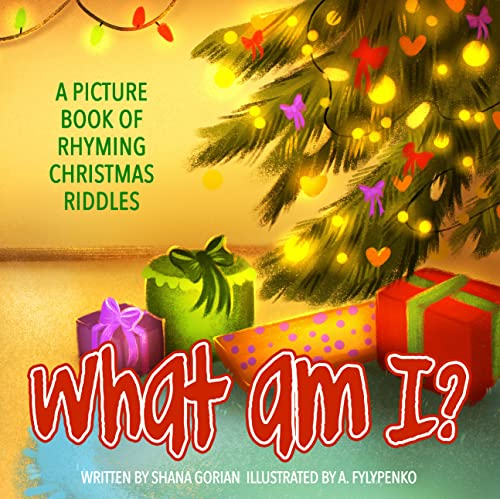
What Am I? Christmas: A Picture Book of Read-Aloud, Rhyming Christmas Riddles

Written by Shana Gorian

Illustrated by Art Porta

A beautifully illustrated Christmas holiday picture book!

Children (and adults) love solving riddles. This book could easily become a family holiday tradition passed down from one generation to another. These rhymes contain riddles about easily recognizable holiday objects appropriate for all ages from preschool on up.

Suggested for families and classrooms. Siblings or classmates might even want to turn the fourteen riddles into a competition to see who might get the most correct answers. Fun for all ages.

LOOKING FOR MORE FAMILY FUN?

SUBSCRIBE TO THIS BLOG FOR MORE REVIEWS EVERY WEDNESDAY AND FRIDAY.

COUNTING DOWN TO CHRISTMAS!

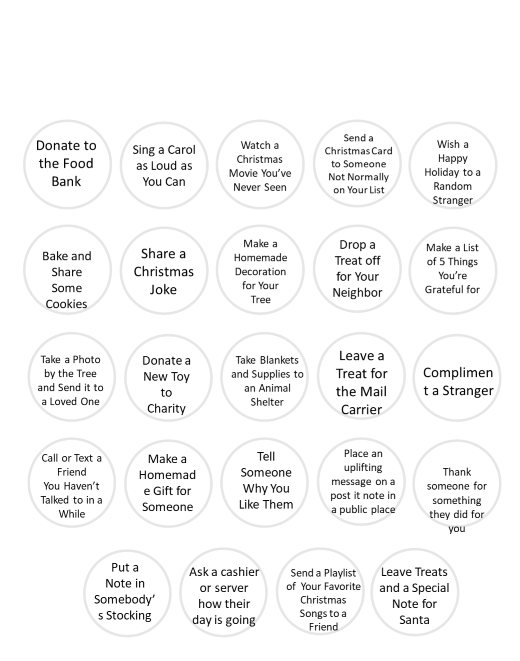
Are you tired of shopping frantically trying to find that perfect gift? I wanted to share with you an Advent calendar that focuses on the giving rather than receiving.

Read down to the end of the page for instructions on different ways to assemble and use this calendar and get into the holiday spirit!

How to Put Your Advent Calendar Together:

1.Print background on one-sided on paper or card stock.

2.Print next two pages double sided on one piece of paper or card stock.

3.Cut out the daily shapes and then arrange the pieces on your background. You can tape or glue the top of each piece and fold over for the message on each day of the month.

Alternatively, you could print last two images double sided, hang them on a string with a clip or tape and then remove one new circle each day.

Fonts:

Allura PW

JoyeuxNoel

A well-written page-turner

The Madonna Ghost

Written by Linda Marie Frank

This mystery appeals to me on many levels. Annie embarks on summer vacation with her Aunt Jill to Fire Island, but her aunt is a detective secretly working on a case.

Annie hopes to find some people her age. She is excited to learn that Ty is visiting neighbors. He is close to her age and soon becomes a romantic interest. Soon Annie discovers they are both adventurers. They will team up to solve the mystery of a ghost reported to haunt the island.

At first glance, the reader might guess this is a book for a middle-grade or young adult audience, but this is not the case. I found myself engrossed in the story and every character. Frank has a background in forensics which allows her to describes the smallest detail. She paints a vivid picture of the setting. The dialogue between the characters is so authentic that readers can visualize themselves in every scene.

A bit of romance, an intriguing mystery, a touch of paranormal and fast-moving events combine to make the book an interesting and unique read for ages eight through eighty-eight.

Looking for more book reviews?

Subscribe to this blog to get new reviews every Wednesday and Sunday.

A book for cat lovers of all ages

Brownie

Written by Christopher Menkhaus

The author targets this book for a middle-school audience but I would say it is a book for all ages.

It follows the journey of a kitten named Brownie which takes readers on an emotional journey. Brownie is separated from his mother and that is when his troubles begin. Will he become a house cat or a stray? Who will take care of him until he is old enough to fend for himself? Can he trust humans? Will Brownie overcome stronger cats who want to bully him?

The book is an emotional journey that pulls the reader into the characters. The author is perceptive and weaves a compelling narrative with appealing feline characters. Recommended for cat lovers of all ages.

WANT MORE BOOK REVIEWS

SUBSCRIBE TO THIS BLOG FOR NEW REVIEWS EVERY WEDNESDAY AND SUNDAY.