Posts from the ‘nonfiction’ Category

LEARNING TO LEAD

Winston Churchill: The Inspiring Story and Lessons of Winston Churchill

Written by Anthony Taylor

Churchill,pic

This book is an interesting reflection on the life of Winston Churchill. Make no mistake; this book is not a comprehensive biography or a carefully researched historical document, but it does provide insight into a passionate leader who was able to lead Great Britain to victory over the Nazi threat. The focus of the book is to use Churchill as an example in studying the steps and strategies necessary to become a successful leader.

Taylor reveals the challenges faced by Churchill’s lack of support from his wealthy parents who viewed him as a failure as well as his disastrous stint as Lord of the Admiralty and removal from office due to his failed naval strategy during World War I. Over the years, Churchill faced political ups and downs; he did not hesitate to switch political parties when they supported causes to which he was morally opposed. He gained first hand battle experience as a war correspondent and was taken as prisoner. He became a prolific writer, securing the Nobel Prize for Literature after the war in 1953. Churchill realized that knowing oneself was the key to inspiring people. He succeeded in this even though he had to overcome a speech impediment to do so. Winston did not know how to admit defeat; he preferred bloodshed and living with the consequences.

The crux of this book comes in chapter six in which Taylor outlines the ten life lessons to be learned from Winston Churchill. He lists them and provides examples of how Churchill used these attributes to maximum potential. These include: courage, learning from one’s mistakes, faith and persistence, good leadership skills, patience, experience, positive attitude, inspiration, knowing oneself, and patriotism. Taylor urges every reader who sees himself as a potential leader in his field to use Churchill’s life as an inspiration to follow.

I would recommend this book in particular for tweens and teens who are interested in learning more about the period between World War I through World War II. Critics who say that the book is not a carefully researched historical document or a biography in the technical sense are correct, but I believe that this short piece is an excellent supplement for teachers who want children to go beyond studying the facts to understand better the motivations and actions of Churchill during the period.

If you enjoyed this post, please subscribe by clicking on the word Follow or by hitting the orange RSS FEED button in the upper right hand corner of this page.

DINOSAUR DIMENSION

Dinosaurs! A Kids Book About Dinosaurs Fun Facts & Amazing Pictures…..

Written by Alexander G. Michaels

DinosaursDimension


This e book of approximately seventy-five pages is thorough and well organized. Despite a few minor editing and program errors, it provides a treasure trove of information for the young scientist who is a dinosaur enthusiast. The table of contents provides an easy reference guide to access quick facts. I would recommend the book especially for children ages nine and older. Younger children will enjoy the pictures, but may find independent reading a bit difficult.

Michaels explains terminology and moves through the three parts of the Dinosaur Age, Triassic, Jurassic and Cretaceous Periods. He covers the fossils, eggs, food, habits, intelligence, speed and size of sixteen different types of dinosaurs. Michaels devotes a few pages to each type, some commonly known species like the Tyrannosaurus Rex and lesser known species such as Spinosaurus. Each section contains the dinosaur’s name, origin, description, photograph, place of habitat, food sources, size, method of locomotion, and level of intelligence.

The last section of the book discusses the possibilities that caused the extinction of a life group that inhabited the planet Earth for 150 million years. Scientists believe a giant meteor or volcanic eruption are most likely. Either of these would have filled the skies with debris that blotted out the sun and destroyed dinosaur food sources. Highly recommended for anyone who is eager to know more about dinosaurs. It deserves a place on classroom and library reference shelves as a good starting point for research on the topic.

If you enjoyed reading this post, please subscribe by clicking on the word Follow or by hitting the orange RSS Feed button in the upper right hand corner of this page.

KEEPING KIDS ENGAGED

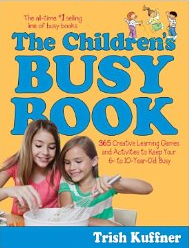
The Children’s Busy Book:365 Creative Learning Games and Activities to Keep Your 6-10 Year Old Busy

Written by Trish Kuffner

365ActivitiesBusy,pic

The author is not trying to reinvent the wheel; she does want to help you make the most of your child’s free time. Contents of this book are designed to stimulate creativity, social skills, imagination and thinking skills. They can be used after school, during the summer, or on a weekend. The ages six to ten are recommended but not arbitrary as younger children as well as adults might also enjoy them. They are not gender specific; the categories are generalized with much overlapping.

Let’s look at some of the chapter headings: rainy days, indoor Olympics, fun outdoors, my family and me, arts and crafts, and holiday fun. Under these headings the reader will find some traditional games like jump rope and hopscotch, marbles and card games. There are some great recipes in the kids in the kitchen section like oatmeal pancakes and Teriyaki chicken. In the math area there are activities like naming that coin and calendar games. Budding scientists learn how to make rock candy crystals fossils, and invisible ink. For a family project children might want to research a family tree, create a scrapbook or set up a “praise box.”

In the Appendix, Kuffner lists more suggestions for reading, resources for parents, and an index of supplies needed to complete or create the projects. This book leaves nothing to be desired. Everything needed is clearly delineated and indexed. The guide is a valuable resource to be placed on the shelves of parents, camp counselors, librarians and teachers. Just the thing to reach for as soon as an adult hears a child say, “I’m bored.”

If you enjoyed reading this post, please subscribe by clicking on the word Follow or by hitting the orange RSS Feed button in the upper right hand corner of this post.

MEET THE CHARACTER BLOG TOUR

I was invited to take part in the Meet The Character Blog Tour by friend and talented fellow author, Kimberly Sentek

Kim,picblogtourKimblognico,pic

Kimberly Sentek has spent her entire life telling stories–so much so that her parents swear she was born talking. A lifelong resident of New Jersey (and a huge fan of Bon Jovi), Kimberly is owned by two cockapoos, Nico and Tugger. Her first book, Oh Brother!: A Nico and Tugger Tale, was inspired by them, and she hopes to continue writing a series of books about her two furry children.


Connect with her at:
www.kimberlysentek.com
@kimberlysentek on Twitter
https://www.facebook.com/pages/Kimberly-Sentek-Author-Page/365737483515252?ref=hl

Buy the book at:
http://www.amazon.com/Oh-Brother-Nico-Tugger-Tale/dp/1466942878/ref=sr_1_1_bnp_1_pap?ie=UTF8&qid=1370221425&sr=8-1&keywords=kimberly+sentek

http://www.barnesandnoble.com/w/oh-brother-kimberly-sentek/1113130704?ean=9781466942875

iTunes interactive app of the book: https://itunes.apple.com/us/app/oh-brother!/id639108492?ls=1&mt=8


AND NOW TO MEET MY CHARACTER…………

LMHFrontCoverLittle Miss HISTORY Travels to The Statue of LibertySEQcover4ReviewFordCover

The fourth book in this series Little Miss HISTORY Travels to FORD’S THEATER is COMING SOON!

What is the name of your character? Is he/she fictional or a historic person?

Little Miss HISTORY is the name of my character. She is a wannabe park ranger wearing camping clothes and hiking shoes that are three sizes too big. Little Miss is an optimist who views the world with rose-colored glasses guiding her readers on adventures to historic events and places that make learning about history a fun experience for readers of all ages. The character is a real one based on a younger version of myself.

What should we know about him/her?

Little Miss HISTORY is always up to a challenge. She might be skydiving, scuba diving, or repelling. She will do whatever it takes to reveal little known facts in a humorous, pictorial and fun to read format. Adults who come along on her adventures will be amazed at the knowledge they will be discovering along with their children. Teachers will find the series easily accommodates common core curriculum standards.

What messes up his / her life? 

Miss HISTORY reveals all the challenges, problems, risks and dangers that the real historical characters encountered in the planning, construction, and events that occurred in the monuments and places that she visits.

What is the personal goal of the character?

Her goal is to make learning about historic events and places a fun experience. Miss HISTORY’s motto is “If you don’t know your history, you don’t know what you’re talking about.” She wants her readers to understand that by learning about the past, you can better shape the events of the future. Of course she would also like children and caretakers to be encouraged to visit these sites in person to explore and learn on their own.

Is there a working title for this novel, and can we read more about it?

All the books in this nonfiction picture book series begin with Little Miss HISTORY Travels to….So far she has journeyed to MOUNT RUSHMORE, THE STATUE OF LIBERTY AND SEQUOIA NATIONAL PARK. Next destination will be FORD’S THEATER, which is currently in production.

When can we expect the next book to be published?

Little Miss HISTORY Travels to FORD’S THEATER will be released around the end of this year.

To learn more about the author please visit my author page at: http://www.amazon.com/Barbara-Ann-Mojica/e/B00B9DOVKC/ref=ntt_dp_epwbk_0

AWARDS: MOUNT RUSHMORE AND STATUE of LIBERTY books have been awarded B.R.A.G. MEDALLIONS.

SEQUOIA National Park book WON HONORABLE MENTION  FOR THE CHILDREN’S LITERATURE AWARD FOR INDEPENDENTLY PUBLISHED LITERATURE. CLIPPA 2014 AWARDS

SOCIAL NETWORKING SITES:

Author website: http://www.littlemisshistory.com

Author blog: https://bamauthor.wordpress.com

Facebook: https://www.facebook.com/Littlemisshistorycom?ref=hl

Twitter. https://twitter.com/bamauthor

Goodreads: http://www.goodreads.com/author/show/6851359.Barbara_Ann_Mojica

Linked in: http://www.linkedin.com/home?trk=hb_tab_home_top

Pinterest http://pinterest.com/bamauthor/

Google + https://plus.google.com/u/0/112118587425339968389

BUYING LINKS:

AMAZON SALES LINK;

http://www.amazon.com/Barbara-Ann-Mojica/e/B00B9DOVKC/ref=sr_tc_2_0?qid=1359994773&sr=1-2-ent

BARNES AND NOBLE

http://www.barnesandnoble.com/s/Barbara-Ann-Mojica?store=book&keyword=Barbara+Ann+Mojica


The books may also be purchased from Createspace or my website http://www.littlemisshistory.com

Thanks so much for stopping by the MEET THE CHARACTER BLOG today!  Bye for now….

Babs4BackCover


VERACITY OF VELOCIRAPTORS

Meet the Velociraptor: Fun Facts and Cool Pictures

Written by Julian Hawking

velociraptor,pic

The author sets out to set straight the facts about velociraptors made famous in the Jurassic Park movie, which are in many ways misleading. They were not huge animals, probably the size of a large chicken; they were appear to have been solitary animals, and they were warm blooded, not cold blooded like the large dinosaurs roaming the earth at that time.

The velociraptor’s name means swift seizer and it flourished in the Cretaceous period about 75 million years ago, shortly before the dinosaurs were wiped from the earth by some disaster, probably a meteor. It probably did not live in the United States but in a hot, arid climate like central Asia because no skeletons have been found in the U.S. Their bones are hollow like that of a bird They probably had feathers, not the scales of cold blooded reptiles. The animal probably stood only two or three feet tall and weighed about 30 pounds similar to the size of a human toddler. Characteristics that the movie presented accurately include the over-sized back feet claws and the serious teeth. The velociraptor had a large brain compared to most dinosaurs and fairly sophisticated sight, hearing and smelling. They probably foraged and hunted for food and had a lifespan of about twenty years. With their long back tails, velociraptors probably had a good sense of balance and could jump very well.

So are we surprised that Hollywood actually modeled the dinosaur in the movie on the larger deinonychus, but changed the name to velociraptor because it had a better ring to it? Children and adults who are into dinosaurs now have the real scoop. I read the kindle version on an HD Fire, but the photos could not be fully appreciated. Print versions show better detail. Recommended for ages eight and up.

If you enjoyed reading this post, please subscribe by clicking on the word Follow or by hitting the orange RSS Feed button in the upper right hand corner of this post.

THE DIRT ON DINGOES

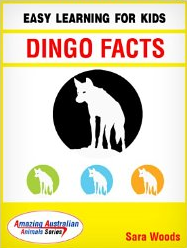
Dingo Facts: Easy Learning For Kids (Amazing Australian Animals)

Written by Sara Woods

DingoFacts,pic

This book is one of the amazing Australian animal series. It will enlighten the reader about what kind of animal a dingo is, where it lives, what it eats, how it moves and breeds, how it is threatened, and why it is important. The book packs a lot of information in thirty-four pages. While the author targets the book as a read aloud for younger children as well as an independent reader for older children, I think it more appropriate for the latter group.

Unfortunately, my travels have not yet taken me to Australian so I am unfamiliar with this animal. Looking at the photos, I immediately thought of a gray wolf and later learned from the author that the dingo is a subspecies of that animal introduced to Australia by seamen about 4,000years ago. I was fascinated to learn that dingoes are double jointed at all their joints, and that they use their paws as we do our hands. They can even open door knobs. Their ears stand straight up and can rotate backwards; they can rotate their heads 180 degrees for better vision. Most dingoes are monogamous and will mate yearly averaging four to six pups for about ten years. The mother will eat, swallow and regurgitate food to feed young much like a bird.

Landowners and hunters are the biggest threat to the dingoes, but crocodiles, snakes, and lack of food and water also factor in their survival. More contact with domestic dogs as urban sprawl progresses could eventually lead to extinction. Farmers who see them as a threat have engineered the world’s largest fence (3,488 miles) to protect sheep and farm lands. But dingoes are special animals because as the only native dog to Australia, they are apex predators at the top of the food chain who protect many smaller mammals and the native natural grasses. Some areas of Australia have set up sanctuaries to protect the dingoes.

This series will eventually include eighteen books about Australian animals. It certainly makes an excellent, well-organized reference source for classrooms in the elementary grades and libraries. Teachers could also use many of these books in science units comparing and contrasting with other animals. Highly recommended for children age seven and up. Adults who read these books to children will find themselves being entertained and informed as well.

If  you enjoyed reading this post, please subscribe by clicking on the word Follow or by hitting the orange RSS FEED button in the upper right hand corner of this page.

SMELLY STORIES

Seriously Stinky Animals (A Children’s Animal Book With Pictures)

Written by Sophia Aguilera

SeriouslyStinkyAnimals,pic

This book is different from most animal nonfiction books because it has an unusual focus—stinky animals. Humans do have a tendency to think that many animals lack the cleanliness we might prefer, even in our pets. Nothing can top the animals discussed in this book! They are big and small, cute and ugly, and geographically diverse. A few of them are probably familiar to you, but there are many that you probably have never heard discussed. Let’s take a look at a few of them.

The Giant Petrel looks like a giant sea gull with some nasty habits. If you get too close, it vomits up a combination of digested food and oil and sprays it all over you. When you try to escape, it tries to push your nose into it. This bird lives in the Southern Hemisphere way down south where it is very cold. Bombardier Beetles are less than one inch long and live only for a few weeks. When threatened they emit smelly poisonous gases that are as hot as boiling water. These beetles have enough spray to get off twenty-nine shots before the chemical runs out. This type of beetle hides under bark and rocks and lives all over the world except for the Arctic and Antarctic. These tiny carnivores eat other insects. One commonly known stinky animal is the skunk. Skunks don’t smell bad unless approached or threatened. Usually just raising the tail is enough to scare predators. They can spray up to five times and up to a distance of fifteen feet. Skunks hesitate to use their spray because once it runs out, it takes their body almost ten days to make more, leaving them defenseless during that time period. Perhaps the fiercest stinky animal is the Tasmanian Devil. Their teeth and jaws are strong enough to cut through a steel trap. They eat almost any other animal including their own species. Once they kill an animal, they will actually get inside of it while they eat. This makes them really stinky when they come out!

The author gives information on many more animals. After each description, four questions are presented to see how well you remember what you read. Of course the answers are provided to self check. While the picture on the cover might imply that this book is for a younger child, the illustrations inside are actual photographs. The text is more appropriate for tweens, teens and adults. This book is well written with a good dose of humor. Highly recommended for children who are animal lovers, and as a fun reference book for teachers and librarians.

If you enjoyed this post, please subscribe by clicking on the word Follow or by hitting the orange RSS Feed button in the upper right hand corner.

GREAT KIDS IN HISTORY- 22 SHORT STORIES

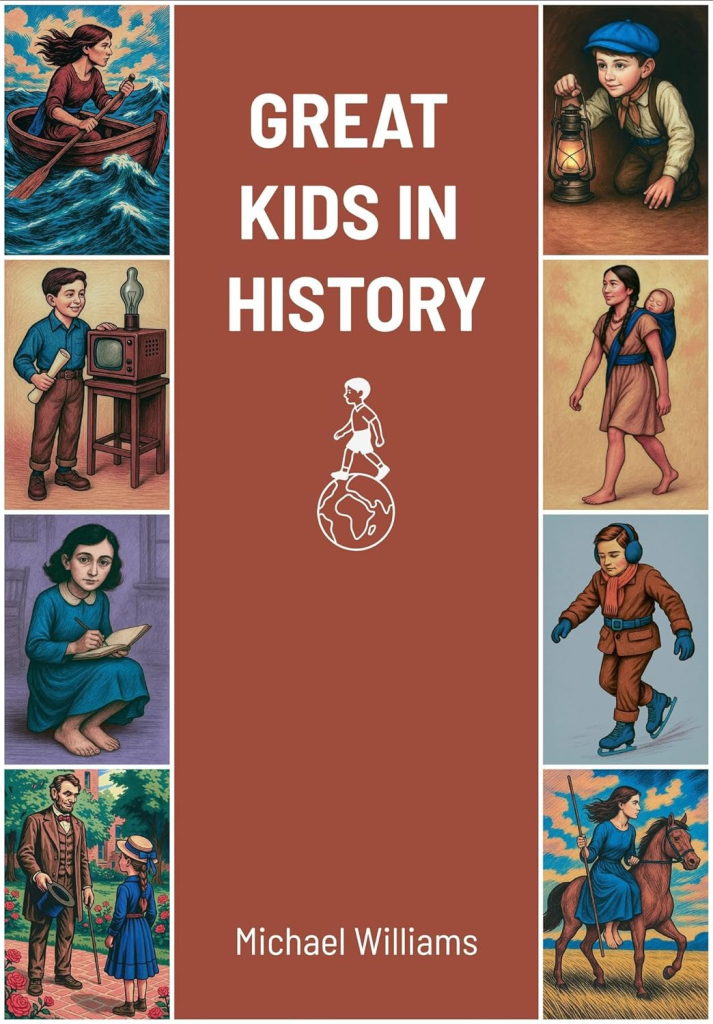
Great Kids in History

Written by Michael Williams

Great Kids in History is a collection of twenty two short stories on the contributions of kids to history. Some of these names will be familiar to adults and many children. For example, there are stories about Thomas Edison, Andrew Jackson and Robert Fulton. But then you probably have never heard of Grace Bedell or Philo Farnsworth. This compilation is a nonfiction book that is not intended to be comprehensive or scholarly. It is written in simple language appropriate for independent reading in middle grades. The information presented is not exhaustive; it may give children a sense of pride in the achievements made by these young people in many fields such as politics, sports, inventions, science, the military and technology. I think that any boy or girl will find at least a few of these stories inspiring. Teachers will be able to select one or more as a springboard for discussion and research on many topics. My guess is that any adult who shares this book with a child will learn a thing or two as well!

SUBSCRIBE TO THIS BLOG FOR NEW BOOK REVIEWS EVERY WEDNESDAY AND SUNDAY.