Ultimate At Home Activities for Kids: 159 ways to keep children busy
Designed by Kate and Chris Stead
This activity book is a parent or caretaker’s go to resource when the kids are bored. The only materials needed are paper, pencils, the internet and common household materials like glue and scissors.
It is not age specific. Some activities are simple enough for preschoolers while others will entertain teens. Here are some of the topics: zoos, Olympics, arts and crafts, movement activities, bears, pirates, legos, music, and libraries.
Children can perform the activities by themselves, in groups, or have a competition.
I highly recommend it for entertaining children of any age.
If you enjoyed reading this post, please subscribe by clicking on the word Follow or by hitting the orange RSS FEED button in the upper right-hand corner of this page.
One Big Heart: A Celebration of Being More Alike Than Different
Written by Linsey Davis
Illustrated by Lucy Fleming
This is a very short interactive book that parents or teachers may use to discuss diversity with preschool and primary grade children. The author presents the material from a Christian viewpoint. Some families who reject that concept will need to explain or eliminate those parts of the story.
Children are asked to study the pictures and relate how we are all alike, make friendship bracelets, draw faces with different skin tones, and share their favorite foods. The heart activity demonstrates the love we feel within for all.
The book is a good starting point on the topic of multiculturalism.
If you enjoyed reading this post, please subscribe by clicking on the word Follow or by hitting the orange RSS FEED button in the upper right-hand corner of this page.
This beautifully written picture book is a wonderful addition to the library of late elementary and middle-school students. It relates the story of an African princess who became queen of two African kingdoms of the 1600s.
Njinga survived a difficult birth. After her father breathed life into her, he realized she was a survivor. Despite the jealousy of her older brother, Njinga succeeded in school and observed carefully. When her brother became king, she had to flee, but she returned when the country needed her.
This story is told simply yet eloquently. The illustrations are exquisite. There are beautiful maps, a timeline and historical facts that provide a plethora of information on African and Portuguese history.
I highly recommend the book to parents, teachers and librarians as a valuable reference book on medieval African history. It also provides a strong role model for young women who seek to be the future leaders of tomorrow.
If you enjoyed reading this post, please subscribe by clicking on the word Follow or by hitting the orange RSS FEED button in the upper right-hand corner of this page.
Many people place value on educational success. Whether you feel it’s important to attain socioeconomic status, increase earning power, or simply be more of a well-rounded person, there are many arguments for pro-school attitudes.
From the start of a child’s beginning in school, when they are in preschool or kindergarten, we can cultivate an attitude of success, growth, and eagerness in them.
As they grow, their own success will depend more and more on themselves as they make their own choices. However, there are some things you can do to make it more likely they’ll succeed.
Routines and Daily Habits
For example:
Bodybuilders’ routines involve going to the gym each day.
A firefighter’s routine involves putting on gear and getting into the truck as quickly and safely as possible.
Police officers have routines when clearing a crime scene.
Garbage men have routines to pick up trash in the most methodical order as possible.
A routine for a child in school is no different. Explaining to your child that everyday professionals and jobs use routines is also important so they will understand the value in it.
The routine you choose for your child depends on your individual child, but basically involves setting aside a specific time of day and place for something related to their education.
What do successful school routines look like?
Consider these routines:
Completing homework everyday after school at the kitchen table
Writing down each subject’s homework in a daily journal or planner
Eating a healthy breakfast each morning with your student and discussing school
Asking your child about one or two important lessons they learned in school that day
Educational Check-In
While the singular job of a student is to go to school each day, the job of that student’s parent or caretaker is to help the student cultivate an attitude of learning. Despite the fact that we, as parents and guardians, have our own busy lives to deal with, it’s important to keep in mind that our children also are growing and learning.
There are many conversation starters revolving around school, and it is critical that parents set aside time each day to ask about school.
For example, you can ask:
What happened in school
How the school day went
What they learned
Whether anything was surprising
Or even what grades they got on tests
For older students, having a more in-depth conversation related to the transfer of educational knowledge to the real world is important.
Value of Report Card Grades
Some parents choose to motivate their children with rewards for good grades. While there are arguments for and against giving a child money for earning an “A” or a “B” on a report card, this can be done in a responsible way.
The basic idea is to motivate them with external rewards, but then phase it out as they grow older and the motivation comes from within themselves.
Overall, there are certainly many things you can do to jumpstart the excitement and energy that students have for school. With parenting, there are no right or wrong answers and you can even devise your own system for motivating your student for success.
SUBSCRIBE TO THIS BLOG FOR TIPS AND TRICKS, BOOK REVIEWS, AND ALL THE NEWS YOU CAN USE!
Family Means…:A children’s picture book about diversity, inclusion, and love
Written by Matthew Ralph
Illustrated by Badrus Soleh
This multicultural picture book reveals the plethora of family groups that may make a family. It includes families of different races, religions and abilities, including those with disabilities.
The author emphasizes the qualities that families share rather than the physical or surface differences. For example, families share activities, work as a team, learn from each other, cheer each other up, and love one another.
At the end of the book, there is a space for readers to interact by defining what family means to them and drawing a picture of their own family. A charming bedtime story or read aloud book for preschool and elementary school children, families, and teachers.
If you enjoyed reading this post, please subscribe by clicking on the word Follow or by hitting the orange RSS FEED button in the upper right-hand corner of this page.
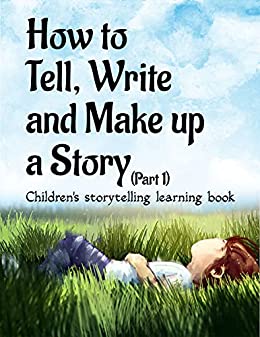
HOW TO TELL WRITE AND MAKE UP A STORY: CHILDREN’S STORYTELLING LEARNING BOOK PART 1
Rose Press House
An interesting approach to teaching the art of storytelling. In Part 1 of this series, readers meet Tom, a 12 year old boy who loves listening to stories. Tom, his uncle, spends lots of time doing telling Tom stories. One day, Tom suggests that they change things up. He asks the boy to tell him a story. The boy is at a loss. He says he does not know how to do that.
Patiently, Tom guides the boy step by step. Through their conversation, he guides readers through the process. First, Tom decides on the main character and describes him. Then he sets a moral and theme for his story. The boy decides on a name for his story and develops an outline to put the details that support his character and theme in order. Then the boy writes a draft of the first part of his story and shows it to an adult to read. But the story is not finished. The boy needs to complete the transitions, details, and supplementary characters that will provide a resolution or completion of the story. That will be coming in Part 2.
I liked this casual approach using storytelling as a vehicle not only to develop communication skills, but also to teach the steps necessary to write an effective story. Many middle-grade students who have difficulty organizing both their ideas and putting them down on paper will enjoy this unique approach to oral and written storytelling.
If you enjoyed reading this post, please subscribe by clicking on the word Follow or by hitting the orange RSS FEED BUTTON in the upper right-hand corner of this page.
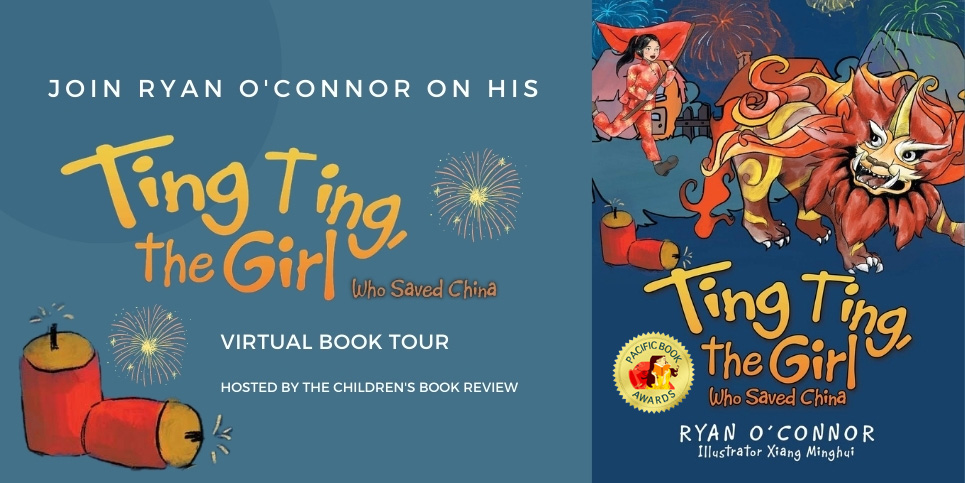
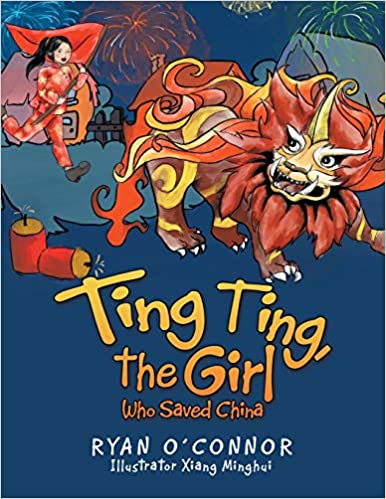
Publisher’s Synopsis: Li Li Wang is enjoying Chinese New Year with her family when her grandparents ask her to sit with them. Before giving Li Li her holiday gift, they tell her the story of Ting Ting Wang, Li Li’s ancestor, and how she became a Chinese hero. Li Li carefully listens as her grandparents tell her about Ting Ting, the monster Nian, and the origin of the Chinese New Year celebration. Ting Ting, the Girl Who Saved China provides insight into China’s biggest holiday, gives a sense of its culture, and shows that girls are just as strong and brave as boys.
Ryan O’Connor is a literature and writing teacher in Shanghai, China, and the author of the children’s book series Bobby the Bear. With a background in sports journalism and education, Ryan has turned his focus to writing children’s books. Through unique characters, Ryan provides children with moral and life lessons. Ryan has earned a bachelor’s degree in journalism and a master’s degree in education; he has also won numerous awards for sports writing. Ryan is a native of Pittsburg, Kansas, but has spent the past ten years living in Shanghai.
Six-year-old, Li Li Wang is getting ready to celebrate Chinese New Year with her parents and grandparents. Her grandmother, Nai, Nai, and grandfather, Ye Ye, decide to tell her about the story of one of her ancestors, Ting Ting Wang.
Ting Ting lived on a farm with her parents and older brothers in the village of Tianyu many years ago. At that time no one paid attention to girls. Ting heard about the monster named Nian who was half unicorn and half dragon. Every year Nian would roam the countryside and attack the villages on New Year’s Eve. Across China, the residents hid themselves, their animals and possessions from the wanton attacks of the monster. But Ting Ting was not afraid. She knew if attacked she would stand and fight. When Nian appeared in her village, she dressed in red, decorated the house with red banners, and set out loud firecrackers. The monster became disoriented and fled. This legend has been handed down from generation to generation.
Elementary grade readers learn about Chinese culture, traditional foods, and customs like the tradition of the red envelope. The multicultural illustrations are charming and vibrant. This tale is a wonderful way to introduce students to Asian culture. Recommended as a read aloud for classroom discussion or a bedtime story for children ages three through eight.
GIVEAWAY
Enter for a chance to win a set of books by Ryan O’Connor, including Ting Ting, the Girl Who Saved China!
One (1) grand prize winner receives:
A copy Ting Ting, the Girl Who Saved China
A Ting Ting Bookmark
A copy of Bobby the Bear and His Missing Dinner
A copy of Merry Christmas, Bobby the Bear
Two (2) winners receive:
A copy Ting Ting, the Girl Who Saved China
The giveaway begins June 1, 2021, at 12:01 A.M. MT and ends June 30, 2021, at 11:59 P.M. MT.
Publisher’s Synopsis: The newest Game On! Awesome Activities for Clever Kids title, this activity book has dozens of new and challenging brain games for ages 8 to 12. More than 100 colorful puzzles feature the excitement and adventure of the United States, including crosswords, secret codes, word scrambles, spot the differences, mazes, and much more. It’s the perfect book for at home or on the go, and the fun starts with just a pencil — no electricity or batteries needed! Complete solutions appear at the end of the book.
Patrick Merrell is a professional puzzlemaker, cartoonist, writer, illustrator, and graphic designer. He’s one of MAD magazine’s “Usual Gang of Idiots.” He’s created over 250 books, including 75 puzzle books, and written 81 crosswords for The New York Times (including 19 Sundays). Six of his Times crosswords appear in Will Shortz Picks His Favorite Puzzles, the most of any constructor. From 2009 to 2011, he wrote for Wordplay, the daily online crossword column for The New York Times. He’s also created puzzles for the Los Angeles Times, Wall Street Journal, Scientific American, People, Sports Illustrated, MAD, National Wildlife Foundation, Crayola, Scholastic, the American Crossword Puzzle Tournament, the World Puzzle Championship, and many, many others.
MY REVIEW OF THE BOOK
IT’S A PUZZLEMENT…
Game On! USA! Awesome Activities for Clever Kids
Designed by Patrick Merrell
This is book three in the Game on series targeted for students in grades three to six or ages eight through twelve. It contains 144 pages of puzzles accompanied by coloring illustrations that cover a wide variety of subjects. While the focus is placed on the USA, the book’s puzzles develop visual acuity skills, math skills, vocabulary, and fine motor development.
I would use it as a go to on those rainy days when the children are bored or as a learning resource while traveling across country in the car or on the airplane. Some of the puzzles are easier and will appeal to younger children, while the coding and crosswords could be a shared activity among younger and older siblings.
Only a pencil and a good imagination are required. Ditch the electronics and go back to paper and pencil brain enrichment.
GIVEAWAY
Enter for a chance to win a set of three Game On! Awesome Activities for Kids books!
Three (3) winners receive:
A copy of Game On! Awesome Activities for Clever Kids
A copy of Game On! MORE Awesome Activities for Clever Kids
A copy of Game On! USA: Awesome Activities for Clever Kids
The giveaway begins May 31, 2021, at 12:01 A.M. MT and ends June 30, 2021, at 11:59 P.M. MT.
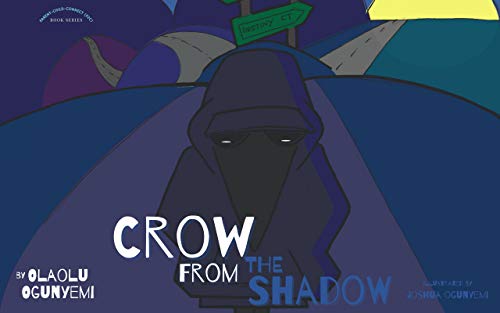
Crow From the Shadow (Parent-Child-Connect (P2C) Book 1)
Written of Olaolu Ogunyemi
Illustrated by Joshua Ogunyemi
Crow is a bird that possesses a high level of intelligence. He wants to push himself to his limits. Perhaps he will be an architect, a superstar athlete, or a military genius. Unfortunately, self-doubt in the form of the shadow is always lurking in the background telling him that he cannot succeed.
Children and adults are so often held back by nagging self-doubts. This beautifully illustrated book urges us to aspire to our best and see the possibilities for success not the fears of failure. There is a wonderful opportunity to continue the discussion with parents and teachers by using the discussion questions. In addition, the information section about crows is highly informative.
Recommended for upper elementary school and middle-school-age students.
If you enjoyed reading this post, please subscribe by clicking on the word Follow or by hitting the orange RSS FEED button in the upper right-hand corner of this page.
This well-written and organized book is a wonderful way to introduce elementary and middle-grade readers to the world of chemistry. Wissinger offers simple explanations with appropriate illustrations making the content clear and easy to comprehend.
The short book packs a ton of information in forty pages. Young scientists learn about matter, elements, atoms, DNA, X-rays, chemical reactions, the periodic table, and so much more. There is a brief history of the contributions by women in chemistry going way back to Cleopatra. The glossary adds additional information to explore. The tone is positive encouraging the young reader to embrace scientific exploration.
I am looking forward to reading more books in this new nonfiction science exploration series.
Thanks to the publisher for providing me an ARC to review, which I voluntarily chose to read and review with my honest opinions for no compensation.
If you enjoyed reading this post, please subscribe by clicking on the word Follow or by hitting the orange RSS FEED button in the upper right-hand corner of this page.

 September 5, 2021
 bamauthor
 Comments Off on RAINY DAY FUN FOR ALL









 Barbara Ann Mojica's BLOG
You must be logged in to post a comment.