Posts from the ‘adult’ Category

A WOMAN AHEAD OF HER TIME

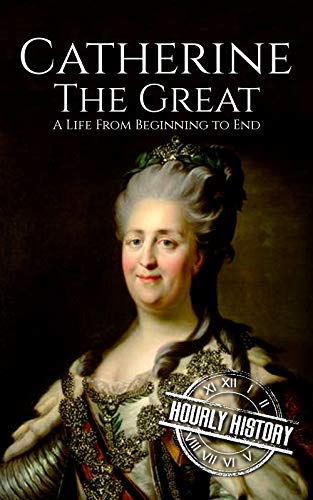
Catherine The Great: A Life from Beginning to End

Hourly History Series

This short summary of Catherine The Great’s life provides good insight into a woman who was able to turn ambition into fulfillment. Catherine was born in modern-day Poland. Her mother’s wealthy relatives played a prominent part in her rise to power. She was betrothed to Peter, the prospective Tsar of Russia. Catherine despised Peter, but she did everything in her power to gain the love and support of the Russian people. She learned the Russian language, converted to the Eastern Orthodox faith, and acquired the support of the Russian military guard.

Catherine was an early feminist. She supported educational reforms for men and women, reformed the farming system by introducing European reforms, and introduced the principles of European Enlightenment, counting the philosopher, Voltaire, as one of her friends. Catherine extended the territorial boundaries of Russia and succeeded in many of her military goals. She devoted her life to power and did not shirk from using violence to achieve it. The principles she set forth laid the foundation for modern Russia.

Recommended as an introduction to Russian history or as a reference for student research into the subject. The essay is easy to read and is recommended for middle-grade and young adult readers as well as adults interested in biographies and history.

If you enjoyed reading this post, please subscribe by clicking on the word Follow or by hitting the orange RSS FEED button in the upper right-hand corner of this page.

SLOTHS 101

Sloths! Two-Toed and Three-Toed Sloths

Written by Leanne Annett

Sloths! Sloth Book On Two-Toed Sloths & Three-Toed Sloths For Children: Fun Animal Picture Book for Kids with Interesting Facts & Wildlife Photos (God's Amazing Creation Series 3) by [Annett, Leanne]


This book discusses the two family groups of sloths which are further broken down into six species. Annett presents information about what they eat, where they live, their relatives, the dangers they face, how they move, and daily living habits. There are lots of color photographs that display sloths in all sorts of positions and situations.

Annett introduces the book by explaining that she feels all the creatures in her book series are part of God’s amazing plan. She urges her young readers to marvel at nature’s beauty. The rest of the book is a nonfiction narrative.

The Fun Sloth Facts is a summary of the most important facts contained in the book. It is a good starting point for those who wish to do a report or additional research on sloths. A glossary is helpful for students who may not be familiar with some of the more scientific terms.

I would recommend the book to readers of all ages who are interested in these curious, friendly creatures. Children of all ages will enjoy looking at the photos and learning about them.

If you enjoyed reading this post, please subscribe by clicking on the word Follow or by hitting the orange RSS FEED button in the upper right-hand corner of this page.

ONLINE SAFETY

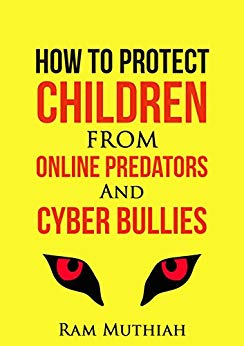
How to Protect Children from Online Predators and Cyberbullies: Survival Guide for Non-Techie Parents

Written by Ram Muthiah

I found this guide informative and essential for parents with children growing up in a world dominated by digital technology. The author wrote this book for two reasons: as a supplement to a novel based on true experience and as a practical guide to help parents navigate the rapidly changing world of the internet in which their children engage daily. Muthiah wants to protect children from those who use the internet to engage in crimes that prey on children. The author’s opinion is that the most important thing parents can do is to gain the trust of their children so that they can engage in honest conversations about internet abuses.

Pedophiles use the internet to lure children into meeting them or to collect pornographic pictures of them. Cyberbullies are cowards to hide behind the anonymity of the internet to attack and scar children mentally. The Internet is a tool to set up human trafficking networks. This author covers all the social media networks like Facebook, Skype, Instagram et al and breaks down different social networks and how they can be used as traps to engage children. He provides links to effective tools for screening out the threats and includes an appendix of secret internet language used by children and teens with which parents may not be familiar,

I would urge parents, teachers, and all those who work with children to keep this book on their shelf as valuable reference material.

TACKLING OUR FEARSI

I DON’T WANT TO GO TO KINDERGARTEN: I’LL MISS YOU TOO MUCH!

Written by Maureen White

Illustrated by Tracy Taylor Arvidson

The author is a school counselor. She uses her expertise to develop a “Powering Up” stress management technique to help us deal with challenging situations. The activity used in this book proves that the body can instantly respond to a change in our thoughts. This book is made interactive by tapping on the pages. White includes instructions on how to reinforce the superpower method and links to videos and workshops that can be used to practice the technique.

White presents a story that features Tina, a young girl who is fearful about beginning kindergarten. While shopping for a backpack, Tina and her mom meet Bobby and his mom. Bobby shares with Tina that he has developed a superpower in preschool that he will teach her. The next day Bobby introduces Tina to Paddy Penguin, a puppet that can help make our muscles strong. He shows Tina that happy thoughts can make one strong.

These techniques can be practiced by children or adults of any age to manage any challenging situation. Recommended for parents and teachers.

If you enjoyed reading this post, please subscribe by clicking on the word Follow or by hitting the orange RSS FEED button in the upper right-hand corner of this page.

OCEAN PLAYMATES

DOLPHINS: Fun Facts and Amazing Photos of Animals in Nature

Written by Emma Child

I have read several of the amazing animals books written by this author. Who can resist looking at the face of a dolphin? Child begins by describing the general features of dolphins like smooth skin and bottlenoses and then goes on to explain there are many variations. I had never heard of the dalmatian dolphin and was surprised to learn that dolphins migrate each year.

Child’s discussion of the way dolphins communicate by echolocation and a whistle sound that is unique to each dolphin is fascinating. I learned that dolphins use sea sponges to protect their mouths from spiny fish and that some dolphins have more than one hundred teeth. Children will be surprised to learn that dolphins live in families like theirs and that they delight in playing with each other. The dolphins’ intelligence level is second only to that of a human and they are good problem solvers.

This book is informative and a great research tool for children in the elementary or middle grades. Only one thing disappointed me. The photos on the Kindle can be enlarged by double-clicking, but this was not simple to do and once enlarged some of the photos looked blurry.

Recommended for dolphin lovers everywhere regardless of age.

If you enjoyed reading this post, please subscribe by clicking on the word Follow or by hitting the orange RSS FEED button in the upper right-hand corner of this page.

B.D. BEFORE THE DIGITAL AGE

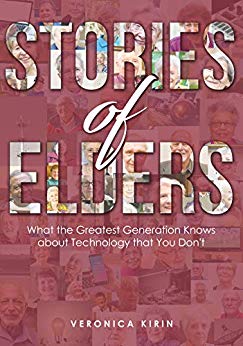
Stories of Elders: What the Greatest Generation Knows About Technology That You Don’t

Written by Veronica Kirin

This book is a fascinating study conducted by a trained anthropologist who became an entrepreneur. Kirin traveled across America to interview members of what she calls The Greatest Generation, Americans who were born before 1945. She wanted to discover what it was like to live before the advent of technology from the mouths of those who grew up living without it.

Kirin developed a list of fifteen interview questions which covered basic demographic information as well as the type of childhood, their occupations, and how technology has changed their lives and those who are growing up in a world dominated by technology. Her questions touched on poverty, economic issues, family, religion, safety, and community. Her conclusions discuss the advantages and disadvantages of growing up with or without technology. Kirin provides a list of participants in an index.

I believe that millennials will find this study interesting and enlightening. As a person who grew up between these two groups, I found the information fascinating.

If you enjoyed reading this post, please subscribe by clicking on the Follow button or by hitting the orange RSS FEED button in the upper right-hand corner of this page.

FOLDING FUN

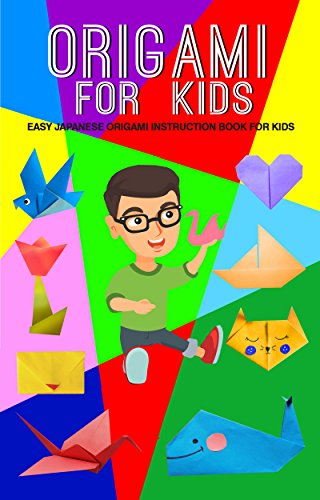
Origami For Kids: Easy Japanese Origami Instruction For Kids

Written by Ben Mikaelson

This book is a practical guide for learning the ancient art of origami, Japanese art of paper folding. I like the fact that the author takes the time to go into the history of paper and the art of paper folding. Mikaelson proceeds to give instructions on how to make fourteen separate origami projects. He begins with simple symbols and shapes like the heart, a cup, and a letter. Then he progresses to a cicada, bird, and a little boat. As one becomes more accomplished, the finished projects evidence a growing sophistication with the art form. If the budding artist keeps practicing, he will be fashioning a peacock, a whale, and a dinosaur before finishing the book.

Readers will learn how to create Japanese letters and how Akira Yoshizawa popularized origami in Japan and throughout the world. He created more than 50,000 unique origami designs. Today the principles of origami are used in building cars, microscopes, robots, and even heart surgery.

I would recommend this book for children and adults of any age. Perfect activity for families and siblings to share or art teachers to introduce to their students.

If you enjoyed reading this post, please subscribe by clicking on the word Follow or by hitting the orange RSS FEED button in the upper right-hand corner of this page.

TAMING THE BEAST

The Monster Under the Bed: Uncovering the Lie that Drives Us

Written by Kim Fiske

This is a thought-provoking book. Fiske believes that what we know of ourselves was developed in our brains at the age of four or five. She wants to explore our fears by producing awareness of the areas of conflict in our lives, asking ourselves is there a monster under our bed, understanding how that monster was created and what is its purpose, and finally deciding what can be done about it in our lives today.

Fiske believes that the fears that haunt adults were developed in our young brains and persist in adult lives filled with stress, financial insecurities, technological dependence and a sense of self-loathing. All these factors exacerbate the fears and test our spiritual and personal boundaries. We become the product of what our emotions decide that we are.

The author believes that by understanding how these fears came to be a part of us and learning how to love them as a part of ourselves we can work to rewire our brain and value ourselves for what we are today. This is an interesting read for young adults and adults who enjoy a challenging read and are not afraid to explore their psyche.

If you enjoyed reading this post, please subscribe by clicking on the word Follow or by hitting the orange RSS FEED button in the upper right-hand corner of this page.

GIVE A LITTLE, GET A LOT

47 Little Love Boosters for a Happy Marriage

Written by Marco Petkovic

This is an interesting book that presents practical techniques to enhance a couple’s love life. In the modern world filled with non-stop activity, couples often neglect to build and maintain their personal relationship. The author admits that he was close to divorce before realizing a turn around was needed.

Petkovic urges the reader to commit to doing something nice for a spouse or partner for the next ten days and to set a reminder to make sure not to forget. It is important to notice what makes a partner happy and to persist in doing those things while constantly adding new ones.

The author briefly explains five little love rituals that involve simple actions like keeping up with your partner’s life and interests as they evolve, spending meaningful time together and reconnecting by simple gestures like an unexpected hug or saying thank you. Readers need to ask, “What can I do to make my partner happy?” It is in giving love, that we receive greater rewards.

Petkovic urges his readers to download his cheat sheet and to subscribe to his list for additional suggestions. While these reminders and techniques will not work for everyone, the general advice is a good reminder that a relationship ignored will not thrive and that partners need to nurture one if it is to remain strong.

If you enjoyed reading this post, please subscribe by clicking on the word Follow or by hitting the orange RSS FEED button in the upper right-hand corner of this page.

GET A GRIP

Emotional Intelligence For Kids in 5 Steps

Witten by Freya Gates

The author packs a lot of information in this relatively short book. Gates presents the information and describes how to apply the techniques effectively. In Chapter 1, she explains what low emotional intelligence means and the signs to identify it. Chapter 2 includes a detailed test that can be used to detect low emotional intelligence and points out possible causes and consequences in children who suffer from it.

Once a child has been identified as suffering from low emotional intelligence, there are many ways for parents, teachers, and health professionals to remedy the problem. Gates gives suggestions and then outlines five steps to improve behavior. One of the most important parts of this book follows. The author explains how to use her suggestions in specific situations. This practical application assists caretakers in implementing the program. For those interested in additional research, Gates gives a list of her sources for further exploration. I would highly recommend this book as an introduction to the subject of emotional intelligence.

If you enjoyed reading this post, please subscribe by clicking on the word Follow or by hitting the orange RSS FEED button in the upper right-hand corner of this page,