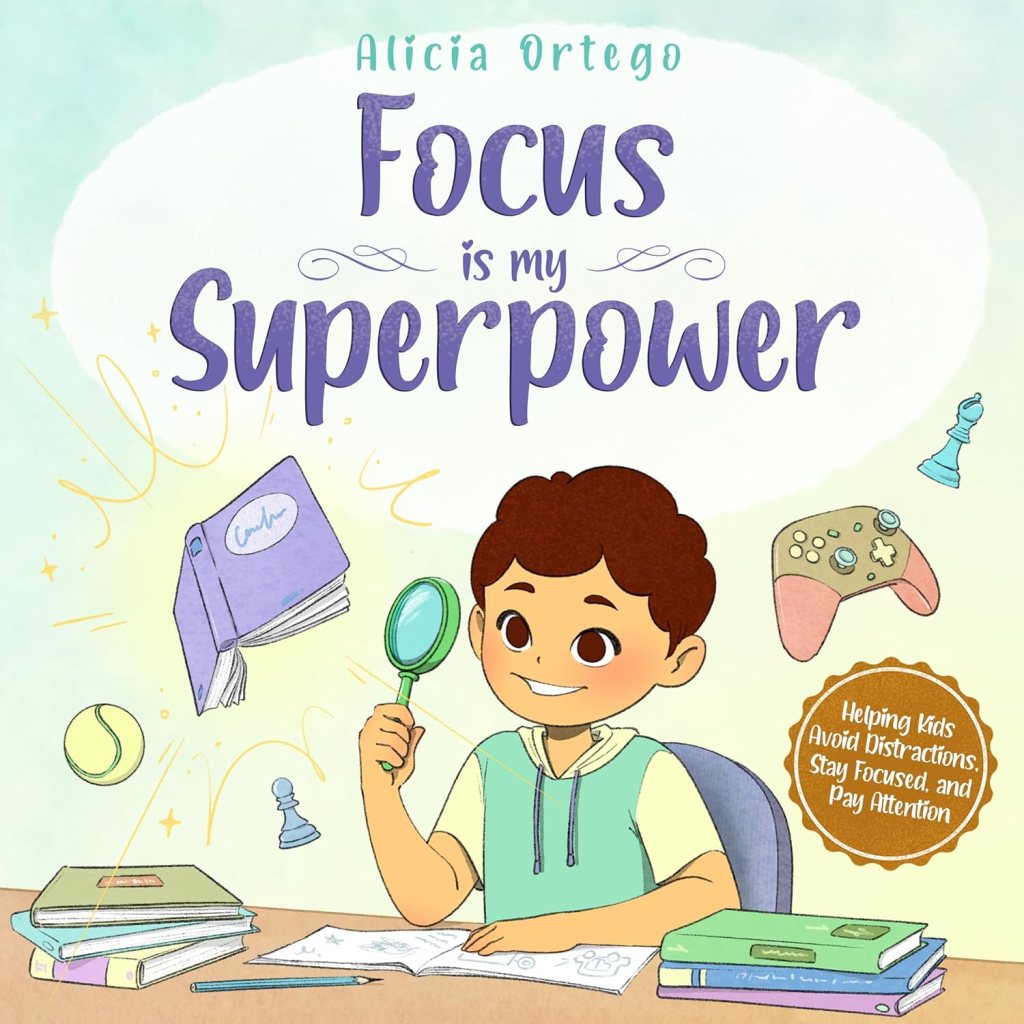
Focus Is My Superpower: An Inspiring Story to Help Kids Pay Attention, Avoid Distractions, and Improve Concentration for Ages 4–8 (My Superpower Books Book 15)
Written and illustrated by Alicia Ortego
This book is a wonderful resource for elementary-age children who have difficulty focusing.
The protagonist is a young boy who has difficulty staying focused and completing tasks. His grandfather brings the boy to the garage and shows him a magnifying glass. Grandpa explains how the glass focuses the rays of the sun to one point on the glass. His grandson should practice this method.
Grandpa also teaches him the five-finger step method for remaining on task. In the book, the author lays out this pathway and provides examples of how the boy achieved successful completion. In addition, Ortega provides a letter of encouragement and an interactive task for readers to follow the example.
A sequence of clever rhymes and charming illustrations draws readers, making this book an excellent choice for children and adults.
SUBSCRIBE TO THIS BLOG FOR NEW BOOK REVIEWS EVERY WEDNESDAY AND SUNDAY.
115 World Biographies: Famous Figures Who Shaped Human History
Written by Lic. Patricia Montana Duran
Illustrated by Renee Rojas Navarro
An enormous amount of research went into the writing of this series. There is a remarkable amount of detail in each biography. While each selection is short, the reader learns a lot of information that may become the basis of a detailed research project.
In Volume One, the author begins in ancient Egypt and then proceeds to research historical figures in medieval times. Examples include Nefertiti, Charlemagne, Genghis Khan, and Niccolo Machiavelli. The writing style is pleasant, combining facts in a easy to digest reading format. This facilitates appeal to a wide range of ages, from middle-grade students to curious adults.
As a fellow historian and retired educator, I would not hesitate recommending this book to any reader seeking a peek into dynamic figures of history.
FOLLOW THIS BLOG FOR NEW BOOK REVIEWS EVERY WEDNESDAY AND SUNDAY.
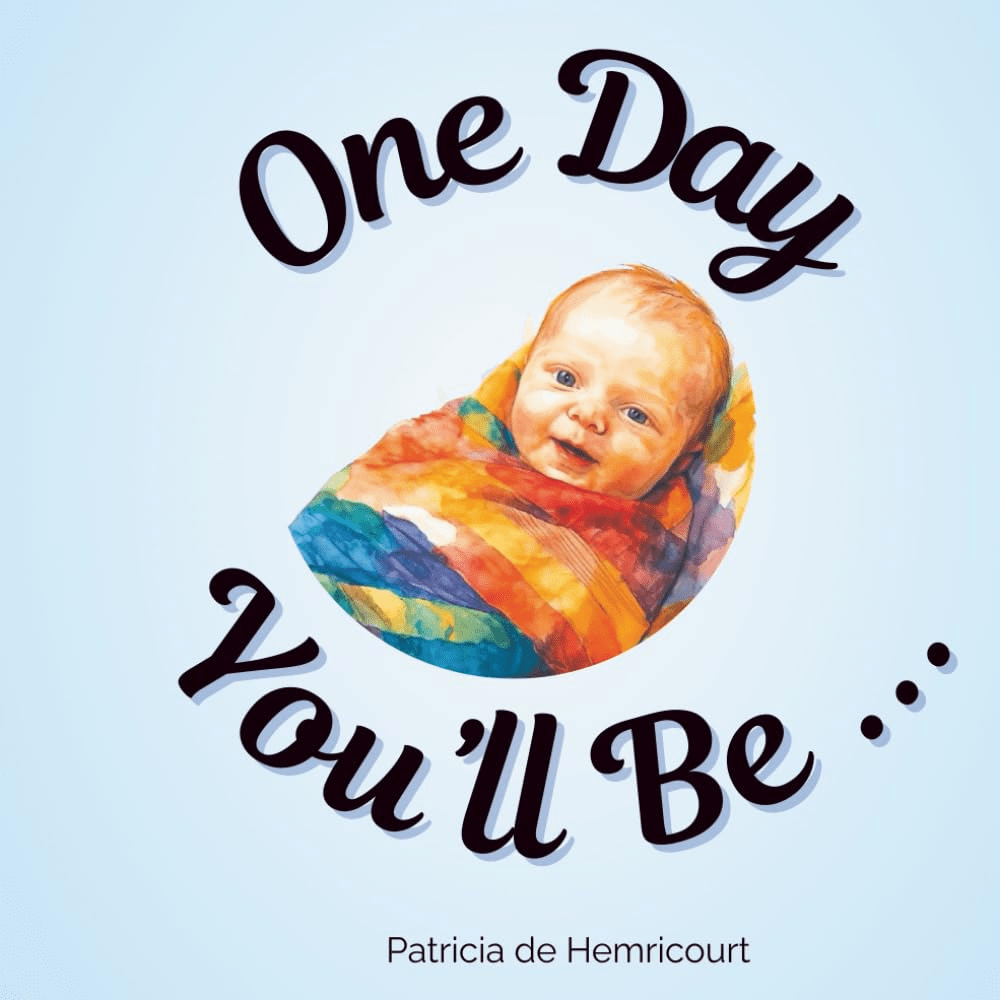
One Day You’ll Be …: Boy babies and toddlers version – A Children’s Read-Aloud Picture Book About Growing Up and New Babies
Written and Illustrated by Patricia de Hemricourt
A simple picture book that explores the developmental stages of birth through adulthood for boys. It begins with birth. Each spread contains a beautiful illustration and a sentence. The cycle moves through toddler, preschool, youth, and teenage years to adulthood. The last stage will likely lead to marriage, pregnancy, and the head of a new family.
It makes an ideal gift for a baby shower or a new family. Parents and grandparents can enjoy and reminisce.
SUBSCRIBE TO THIS BLOG FOR BOOK REVIEWS ON WEDNESDAYS AND SUNDAYS.
This adulting thing can be hard, very hard. That’s true whether you’re raising a family or just yourself. In some cases, we were warned by our parents. For the most part, though, becoming an adult looked amazing, with little to no downside.
As a child, you saw your parents doing what you thought was whatever they liked. Little did you know that their efforts were driven by a desire for you to have the best possible life. While that was the case, all you saw were people who got to stay up late and make the rules.
Wouldn’t that be awesome when you were finally able to do it? It’s something you begin to look forward to … growing up.
Your parents and other grown-ups jumped into their cars whenever they wanted and drove anywhere. They could go shopping or to a restaurant. They always had money to buy things. You never had money and certainly weren’t able to drive a car.
That desire for adult-like independence was the reason you couldn’t wait to learn to ride a bicycle. You felt like a grown-up because you had a sense of being able to get up and go and explore. You could jump on your bike and take off! The end of the block, or “just down the road,” felt like it was a million miles away. This was, to you, your first taste of grown-up freedom.
Fast-forward a few years, and you’re leaving high school. You’ve heard as long as you remember that you can become whatever you want to become. You can’t wait to officially enter adulthood. It’s going to be so sweet!
Then you get out on your own at 18 or 20, or 25 years of age. What are all these responsibilities? There’s so much to do. Where is all the freedom and independence you thought your parents had when you were a kid? Why is life so tough?
Then the truth of the situation hits you. This grown-up thing isn’t very fun, and being a kid definitely was.
Ask any grown-up if they have enough leisure time, and they’ll look at you like you’re speaking a language from another planet. Of course, they don’t have enough time to do what they want? Why ask such a crazy question?
There’s never enough time for fun and playful activities. Only the independently wealthy can truly enjoy their lives, spending as much time as possible doing what they want rather than what they have to do.
That’s the number one reason grown-ups will give you if you ask why they don’t spend more time on enjoyable activities. They’ll tell you their job, family responsibilities, social commitments, and other “have to do” activities keep them from having any downtime. They have to be serious 24/7. There simply isn’t any time for humor and fun, and play.
Then there’s the fact that adults constantly worry.
Kids don’t. A child just does what he does for the sake of doing it. He’s not too concerned about consequences. He chases a butterfly or goes out of his way to splash in a rain puddle just because. It’s fun. So he does it.
What is it that adults worry about most of the time? According to Inc. Magazine, in a blog post titled “The Top 10 Fears That Hold People Back in Life, According to a Psychotherapist”, here’s what your adult mind is stressing over most of the time. (They are listed in no particular order.)
Change (Good or Bad)
Being Lonely
Failing
Being Rejected
Uncertainty
The Results Are Going to Be Bad
Being Hurt
Judgment
Feelings of Inadequacy
A Loss of Freedom
As an adult, you need to understand that change is inevitable. Sometimes it’s good, sometimes bad, but it is guaranteed to happen. Many changes are out of your control. Instead of worrying and fretting over change coming into your life and wreaking havoc, accept that it will appear and stop stressing about it.
If you worry about being lonely, guess what’s going to happen? We often create self-fulfilling prophecies. This means that concerning yourself with loneliness can lead to that reality. The fear of loneliness can also keep you in less than healthy relationships rather than going it alone.
Look, everyone hates failing. Sometimes we adults would rather simply not try because we’re scared of what will happen if we fail. This mindset will always fill you with stress and anxiety, which means less fun and happiness in your life.
Adults are constantly worried about being rejected in relationships and on the job. They don’t attempt new things or reach out to connect with others because they’re uncertain about what’s going to happen. The result could be bad.
Adults fear getting their feelings hurt, especially by loved ones. If they reach out to others for a little fun or just less seriousness, what if they’re judged poorly? They might feel inadequate to those around them.
Finally, adults are often fearful of a loss of freedom. Be careful that this doesn’t lead you into a bad situation. Someone who embraces freedom may avoid getting a steady job, which can lead to financial issues.
If these and other grown-up worries are constantly rolling around in your head, force yourself to take a break. Call your friends for a night out on the town. Take a walk, cycle with your BFF, or watch a funny movie.
Play, laugh, and smile like a child again. Enjoying the present moment without expectations can help remove yourself from these bothersome adult worries that can cause physical and mental stress.
You Probably Have More Free Time Than You Think You Do
By the way, the common excuse that adults don’t have much free time for playing around and goofing off might not be correct. Consider this.
NBC News reported in September of 2021 that the “… sweet spot for free time is about 3 or 3.5 hours per day.”
Life satisfaction was at its highest when people “had in the neighborhood of 2.5 hours of free time a day.”
[American Psychology Association – Having Too Little or Too Much Time Is Linked to Lower Subjective Well-Being – Sharif, Mogilner, Hershfield]
Adults will tell you they don’t have anywhere near that amount of free time. They might agree that they would have a much better life if they could enjoy their hobbies or other playful activities for a few hours each day. As it turns out, most adult Americans have more free time than they think they do (or will admit to having).
As reported by the Centers for Disease Control and Prevention (CDC), research from doctors Roland Sturm, Ph.D., and Deborah A Cohen, MD, reveals that you might have more leisure time than you realize. Here’s one big takeaway from that study.
“Americans averaged more than 5 hours of free time per day; no subgroup reported having less than 4.5 hours of free time per day.”
[Sturm R, Cohen, DA – Free Time and Physical Activity among Americans 15 Years or Older: Cross-Sectional Analysis of the American Time Use Survey]
Notice that no subset of the data had less than 4.5 hours of free time each day. This means people in their late teen years and twenties, thirties and forties, fifties, sixties, seventies, and older all had a minimum of 4.5 hours of leisure time.
Take an honest look at your life. How many 10 or 15 or 20-minute blocks of free time do you have? You don’t have to have fun in large doses. You can fill those small sections of your day with playtime and laughter rather than worry and stress.
We know that engaging in fun and enjoyable activities just for the sake of the activity itself, not for a specific result or achievement, is a great stress reliever. It can also put your life in perspective and help you learn not to take life too seriously all of the time.
It means that adults, including you, probably have a good bit of time to stop and smell the roses.
Prioritize play in your life. You never know when your number will be called, so why not have some fun? You know how good you feel when you laugh and smile. Schedule time for those activities that put a smile on your face. Hang out with that friend that makes you laugh.
Go out of your way to schedule more play and less seriousness. You can live a happier, healthier, and longer life. You can also find a lot more appreciation of your life, yourself, and the people in it.
Here’s to you smiling and laughing more and stressing out less.
SUBSCRIBE TO THIS BLOG TO RECEIVE NEWS YOU CAN USE.
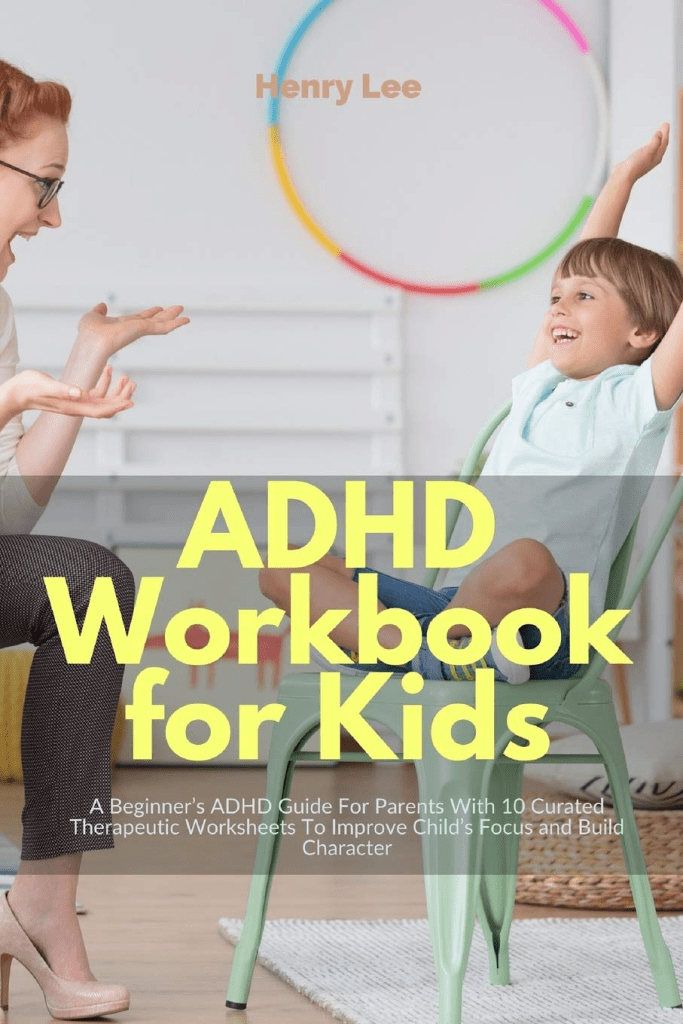
ADHD Workbook for Kids: A Beginner’s ADHD Guide For Parents With 10 Curated Therapeutic Worksheets To Improve Child’s Focus and Build Character
Written by Henry Lee
This workbook is a good place to start for a parent investigating ADHD or for anyone seeking general knowledge about this disorder.
Lee addresses the symptoms, causes, and different types. He explores how to handle ADHD in different environments such as home, school, and social situations. The author explores different types of behavioral management plans, academic instruction plans, medications, meal plans, and the need for parents to join support groups.
While the book cannot address all the possible variations, medications, educational interventions or behavioral symptoms, it does provide a good starting point for parents facing a diagnosis or an educator seeking effective ways to deal with children in their classroom who have been diagnosed.
SUBSCRIBE TO THIS BLOG TO RECEIVE BOOK REVIEWS EVERY WEDNESDAY AND SUNDAY.
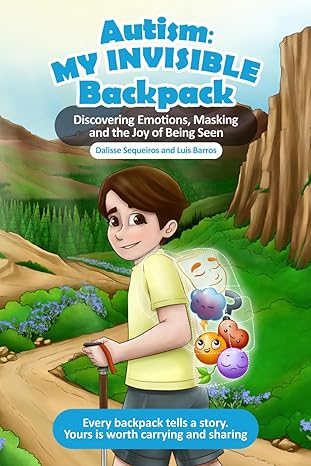
Publisher’s Book Summary: Autism: My Invisible Backpack is a heartwarming story that follows two autistic brothers, Adrián and Guillermo, on a mountain hike. Along the way, children discover that everyone carries an invisible backpack filled with feelings and thoughts, sometimes light, sometimes too heavy to carry alone.
Through this powerful metaphor, kids explore four common challenges —masking, hyper-empathy, literal thinking, and emotional overload —while also learning that therapy can be a safe place to unpack and rest.
With simple language, hand-drawn illustrations, and practical tools, this book helps children and families:
✔️ Recognize emotional overload and name feelings ✔️ Create mask-free zones to feel safe and authentic ✔️ See therapy as a trusted space to share openly ✔️ Celebrate moments of being truly seen and valued
A supportive resource for families, educators, and therapists, this story brings comfort, connection, and real strategies to make the autism journey feel lighter.
Dalisse Sequeiros is a devoted mom raising two incredible autistic boys. As a passionate autism advocate, she understands both the joys and challenges that come with parenting autistic children. Dalisse thoughtfully creates books for children ages 6–12, offering stories that celebrate their strengths, differences, and unique ways of connecting with the world.
Her mission is to offer resources that foster understanding, empathy, and confidence, helping autistic children feel seen, valued, and empowered. With every story, Dalisse hopes to create meaningful moments of connection for families navigating the world of autism.
She cherishes every milestone and dedicates herself to promoting acceptance and belonging through her writing.
Inspired by their own parenting journeys, authors Dalisse Sequeiros and Luis Barros have created a touching and practical story that opens a window into the world of a neurodivergent child. Told through the eyes of young Adrián, Autism: My Invisible Backpack follows a family hike that becomes a powerful lesson in understanding emotions and self-acceptance.
As Adrián struggles up the mountain, he learns about the “invisible backpack” we all carry—filled with our thoughts and feelings. The story gently shows how carrying too much emotional weight, or trying to “act normal,” can overwhelm a child on the spectrum. With the loving support of his parents, Adrián learns to unpack that weight and embrace his true self.
Vivid illustrations and easy-to-understand metaphors make complex emotional concepts come alive for young readers. The authors also include helpful notes and strategies for parents, offering guidance on emotional regulation, self-care, and creating safe spaces for every family member.
Autism: My Invisible Backpack is both heartwarming and practical. It is a story that encourages empathy, celebrates differences, and reminds readers that every child deserves to shine in their own way.
GIVEAWAY
Enter for the chance to win one of 10 paperback copies of Autism: My Invisible Backpack by Dalisse Sequeiros. Plus, one lucky grand prize winner will receive a complete set of books from Loving Pieces Books!
CLICK THE LINK BELOW TO SEE THE BOOKS AND ENTER THE GIVEAWAY
November 14, 2025 bamauthorComments Off on EXPLORING THE WORLD OF A NEURODIVERGENT CHILD, Autism: My Invisible Backpack, VIRTUAL BOOK TOUR AND GIVEAWAY
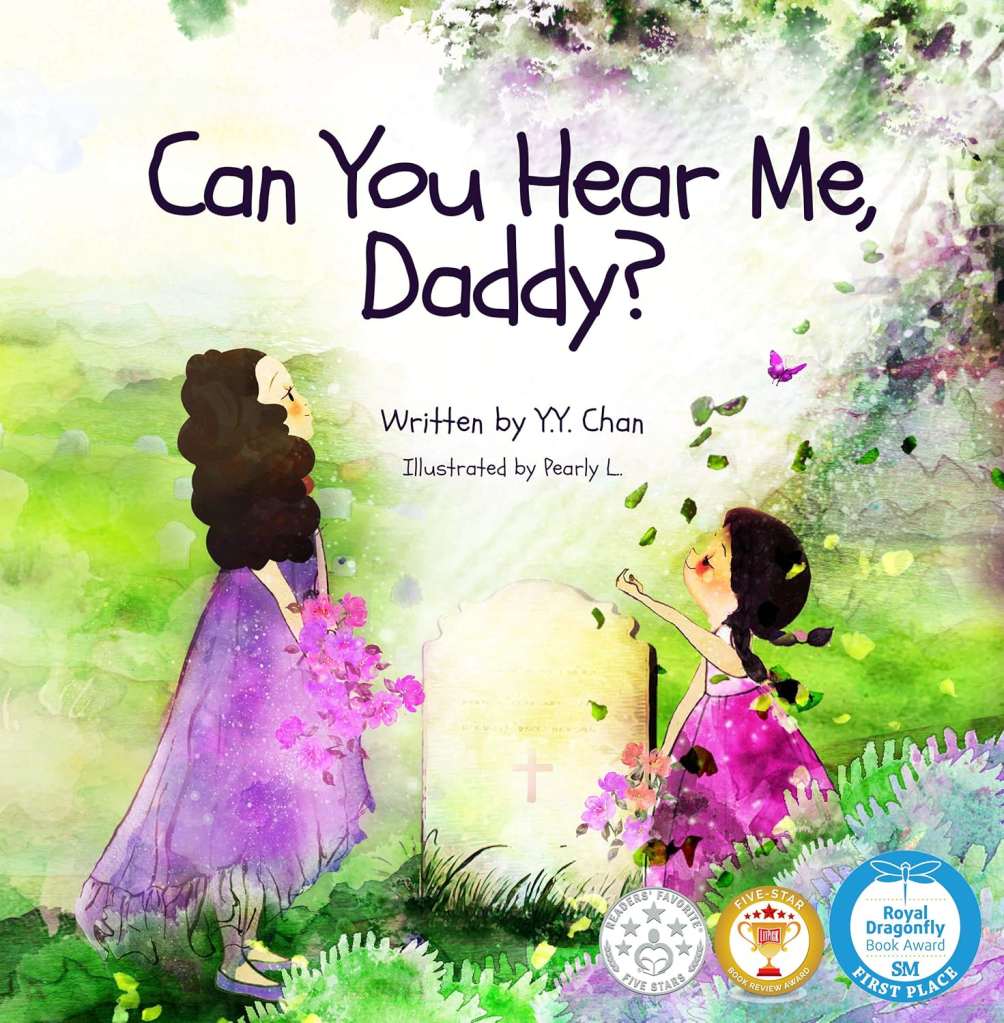
Can You Hear Me, Daddy?: A Heartwarming Children’s Book About Loss and Grief
Written by Y.Y. Chan
Illustrated by Pearly L.
This book explores how cancer affects children in a family. It is written in first person from the point of view of a young daughter whose father has been diagnosed with cancer.
Written in the calendar format of a diary, the daughter explores the ups and downs of cancer. There is surgery, then hope, and then despair. The dying father tenderly explains that his daughter will always be able to talk to him in her heart.
While the book discusses a sad topic, the author presents the topic with empathy and hope. I would recommend the book for families who face cancer and would like an approach to opening up the topic with their children.
SUBSCRIBE TO THIS BLOG TO RECEIVE NEW BOOK REVIEWS EVERY WEDNESDAY AND SUNDAY.
Magical Stories: A Collection of Short Stories for Children Aged 3-103
Written by Píaras Ó Cíonnaoíth
A collection of ten short stories that stimulate the imagination. While I would not classify this book as a picture book, each story starts with an illustration of the main character.
The characters include many favorite types such as dragons, elves, fairies, tigers, and mermaids. It is equally appealing to male or female readers. The average length of the tales is approximately five pages, making it ideal as a bedtime story or classroom read-aloud. Each includes a moral lesson for young minds to ponder and appreciate.
Adults may enjoy reading them along with their children.
SUBSCRIBE TO THIS BLOG TO RECEIVE NEW BOOK REVIEWS EVERY WEDNESDAY AND SUNDAY.
Since it is widely agreed upon in the educational and child development communities that early recognition of the characteristics of a gifted child, is a key factory in successfully developing the child, it is important for the parent to have at least a general understanding of these gifted characteristics. First of all in order to be classified as a gifted child, the child must have the ability to perform at a level that is significantly beyond other children of like age. O.K. So, for a parent, what might this look like or what should I look for in my child?
Of course, every child is endowed with unique capabilities and has the potential for maximizing these qualities.
The following are some guidelines to help your awareness when it comes to recognizing the characteristics of a gifted child. Keep in mind that there are varying levels of giftedness, as you view the guidelines.
Cognitive Skills (thinking or though processing)
Ability to master new skills with extraordinary speed. A deeper knowledge than other children the same age. Extraordinary memory and recall of events, facts, and/or figures. Advanced creativity and ability to improvise. Acute alertness to their surroundings. Advanced or more complex sense of humor.
Learning Patterns
Great and constant curiosity along with high level of motivation to learn. As a result of the previous, being bored easily if not challenged Advanced ability to stay focused or lengthy attention span. Even with more difficult topics. Advance organizational or planning skills. Advance logic and problem solving skills.
Speech and Language
Well developed word vocabulary and language compared to children of the same age. Creative uses of words and sentence structure and again, sense of humor. Ability to adapt their use of the language to a given level to fit the situation. Ability to understand and carry out complex instructions. General advanced ability in reading, writing, and working with numbers.
Social
Sensitivity to other s feelings Use of their advance language skills to resolve conflict or debate. Organize and direct behavior of other children (may seem bossy to other children). Many times will feel more at home with older children. May have high expectations of themselves (and others) that can lead to frustration and even anger.
Other
A generally high aptitude for logical problems, games, puzzles, or any type of problem solving or activity that requires creative thinking and reaction.
Final Note: Although these characteristics of a gifted child may provide you with some initial insight and understanding, it is important to seek a formal assessment of your child in this area if you feel that your child exhibits several of these characteristics.
 February 18, 2026
 bamauthor
 Comments Off on LET YOUR FINGERS DO THE WALKING











 Barbara Ann Mojica's BLOG
You must be logged in to post a comment.