Posts tagged ‘science’

LET YOUR FINGERS DO THE WALKING

                                                      HAPPY NEW YEAR!

Kindle Fire Apps For Kids: 22 Kick-Ass Apps Parents Should Buy and Why

Written by Elaine Donato

KindleFireAppsWhile I am not crazy about the name chosen for the subtitle, this short guide is an informative and useful one for parents trying to navigate the world of apps for their children.

Donato begins by talking about recommended ages and the benefits of iPad use for children. She reminds parents that it is important to set and enforce limitations and know that apps are a supplement not a substitution to a child’s education. Subsequent chapters highlight games for kids like Curious George’s Town and Toca Hair Salon. Donato moves on to preview traditional story book apps like Little Red Riding Hood as well as those that explore geography and science such as Barefoot World Atlas and Bobo Explores Light. In her chapter on art, writing, and music the author includes apps for comics, playing piano and creating your own book. Then there are educational apps for learning the alphabet, phonics, counting, and common object recognition.

Donato urges all parents to test the waters with these apps and share the experience with their children. These apps provide an excellent opportunity for both generations to grow and learn together.

If you enjoyed reading this post, please subscribe by clicking on the word Follow or by hitting the orange RSS Feed button in the upper right hand corner of this page.

THE DIRT ON DINGOES

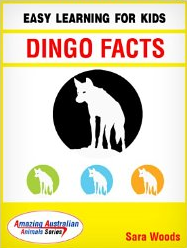
Dingo Facts: Easy Learning For Kids (Amazing Australian Animals)

Written by Sara Woods

DingoFacts,pic

This book is one of the amazing Australian animal series. It will enlighten the reader about what kind of animal a dingo is, where it lives, what it eats, how it moves and breeds, how it is threatened, and why it is important. The book packs a lot of information in thirty-four pages. While the author targets the book as a read aloud for younger children as well as an independent reader for older children, I think it more appropriate for the latter group.

Unfortunately, my travels have not yet taken me to Australian so I am unfamiliar with this animal. Looking at the photos, I immediately thought of a gray wolf and later learned from the author that the dingo is a subspecies of that animal introduced to Australia by seamen about 4,000years ago. I was fascinated to learn that dingoes are double jointed at all their joints, and that they use their paws as we do our hands. They can even open door knobs. Their ears stand straight up and can rotate backwards; they can rotate their heads 180 degrees for better vision. Most dingoes are monogamous and will mate yearly averaging four to six pups for about ten years. The mother will eat, swallow and regurgitate food to feed young much like a bird.

Landowners and hunters are the biggest threat to the dingoes, but crocodiles, snakes, and lack of food and water also factor in their survival. More contact with domestic dogs as urban sprawl progresses could eventually lead to extinction. Farmers who see them as a threat have engineered the world’s largest fence (3,488 miles) to protect sheep and farm lands. But dingoes are special animals because as the only native dog to Australia, they are apex predators at the top of the food chain who protect many smaller mammals and the native natural grasses. Some areas of Australia have set up sanctuaries to protect the dingoes.

This series will eventually include eighteen books about Australian animals. It certainly makes an excellent, well-organized reference source for classrooms in the elementary grades and libraries. Teachers could also use many of these books in science units comparing and contrasting with other animals. Highly recommended for children age seven and up. Adults who read these books to children will find themselves being entertained and informed as well.

If  you enjoyed reading this post, please subscribe by clicking on the word Follow or by hitting the orange RSS FEED button in the upper right hand corner of this page.

FROG FEST

Frogs for Kids: The Amazing and Wonderful World of Frogs Book (Reptiles and Amphibians)

Written by Betty Olsen

Frogsforkids,pic

Did you realize that there are many species of frogs and that each of them has unique characteristics? In this kindle book, children and adults will have the opportunity to learn about every aspect of their lives. Olsen defines the word amphibian and traces the life cycle of the frog, the food they eat, their anatomy and skin characteristics, how they use camouflage, how they move and communicate, where they live, and how they can be dangerous to humans. Each description is accompanied by a photograph of that frog.

Most people know that frogs develop from eggs laid in the water and later develop lungs and breathe air on land. Are you aware that the age of a frog can be determined by the rings in its bones, and that some frogs live as long as forty years? I learned that not all frogs croak but some chirp, ribbit, whistle, bark or grunt. Their calls have been heard as far as a mile away from their location. The Golden Poison Frog can kill as many as twenty humans or one thousand mice! Olsen mentions toads, but does not go into detail about how they are different from frogs. She also reminds us that we need to keep our waterways clean so that frogs will have a place to lay eggs and prosper.

This book is an ideal beginning tool for a child who is interested in frogs or wants to learn basic information for a science project. As such, it is a good resource for elementary school science bookshelves or libraries. I thought the book failed to elaborate on the topics of environment and toads, but perhaps the author plans to expand these subjects at a later date. Overall, the book is well done and the photographs enhance the details. I would recommend reading it on the cloud or in PDF format.

If you enjoyed reading this post, please subscribe by clicking on the word Follow or by hitting the orange RSS FEED button in the upper right hand corner of this page.

HAUNTED HOUSE?

Junior Ghost Hunters – Case of the Chadwick Ghost

Written by Sam Grasdin

JuniorGhostHuntersClub,pic

The adventure originates as four friends are hanging out in Nate’s room. Nate is twelve years old and an admitted nerd who loves science and comic books. Lanie Talbot, the only female, has recently emigrated from England. Pete, the athlete, rescued Nate from a bully last year. Greg is an electronic genius with the nickname Gadget because he is always inventing things. Greg has just burst into the room with the news that he has seen a ghost in the upstairs window of the abandoned Chadwick house. Initially the group is skeptical, but Nate convinces them that they should investigate. They decide to form a Junior Ghost Hunters Club; their mission to prove or disprove what Gadget claims to have witnessed.

When Nate’s father convinces the real estate agent to allow the group to view the house in question on the next Saturday, their exploration begins. Mrs. Davenport allows them a couple of hours to “do research for a school report.” They are equipped with a digital recorder, flashlight and video camera, the tools of modern ghost hunters. At first, they fail to uncover evidence until Nate picks up a faint voice on the recorder, saying, “Get out of my house.” They are now determined to make a nighttime visit. Coincidentally, the four friends discover that a couple named Barnes are interested in buying the house. Mr. Barnes is undeterred by the childrens’ revelations that the house may be haunted. He invites them to spend the next Saturday night camping out in the living room of his new house.

The courageous group share pizza and then settle down for their adventure. They appear to be at a standstill until Nate remembers something. His computer research will lead him on a trail to uncover the final clues in solving the mystery. Is there a ghost? Who is it? Will the ghost hunters continue their career as sleuths of the paranormal. Tune in for the next book in the series.

The author is targeting his writing toward children nine to twelve. I believe the text is appropriate and readable for that group. Plot and characters are likable and modern detectives who are equipped with the technology expertise twenty-first children expertly employ. As an adult, I was entertained, amused and convinced that the characters are real. They are multicultural and cover both genders. Looks like the beginning of a good middle grade detective series that will possess wide appeal.

If you enjoyed reading this post, please subscribe by clicking on the word Follow or by hitting the orange RSS Feed button in the upper right hand corner of the page.

EARTH, OUR PLANET

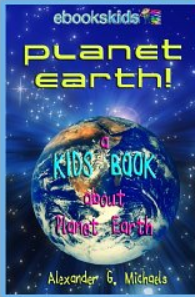
Planet Earth! A Kids Book About Planet Earth-Fun Facts & Pictures About Our Oceans, Mountains, Rivers,Deserts, Endangered Species & More

Written by Alexander G. Michaels

PlanetEarth,pic

The title of this post is much shorter than the name of the book, but in fact the author provides a concise guide to all those things in an e book of less than fifty pages. Targeted for children in the early elementary grades and written in fairly simple language, this guide sets forth basic information combined with beautiful photographs. It can be a asset to the science section of the classroom as well as serve as a quick reference book or starting point for more research. The author might consider releasing a paper edition for libraries and print book lovers.

Michaels begins with the planet’s history, characteristics, composition, and place in solar system. He next outlines the geographic regions of land and water and gives details about well known examples. The section on fun facts is sure to be a favorite among children; it provides a vast compendium of information in sentence form. For example, each winter approximately one septillion snow crystals drop from the sky or that 75% of the earth’s animals could be extinct within the next three hundred years. Michaels concludes with some ideas on how we can preserve the planet for our descendants.

I have to admit that I learned quite a few things from this book. While I knew that most of the Earth’s surface is water, I was not aware that only 3% of the water on earth is fresh water. Did you know that the largest desert in the world is in Antarctica? Where can you find most of the Earth’s gold? How are mountains, volcanoes and rivers formed? There are lots of surprises for adults as well as the children who pick up this book.

Take a look at this beautiful guide to our planet and share it with your children. Michaels has written a whole series of books, including one on the solar system, endangered species, and dinosaurs. I plan on taking a look at those as well.

If you enjoyed this post, please subscribe by clicking on the word Follow or by hitting the orange RSS Feed button in the upper right hand corner of this page.

DEEP FREEZE

Arctic Fox: Animals Knowledge Series

Written by Deutsche Don Juan

ArcticFoxpic

The author has written several books with the intent to inform the reader about animals and their environments. He writes well in an easy to read format that will appeal to both children and adults. Gorgeous pictures illustrate each of the major points. As is the case with previous books in the series, Don Juan covers every aspect of the arctic fox’s life. You will learn about appearance, feeding, geography, mating, behavior, habitat, predators, and dangers to humans. Near the end of this short sixty page book, the author provides a summary of fun facts with questions and answers. This makes the book perfect for a unit study or cooperative learning project in the classroom.

Without giving away all the wonderful details that the author provides, I will provide a short summary about this amazing animal. The arctic fox ( Vulpes lagopus ) has many common names. These include polar fox, white fox, and snow fox. This animal lives in the alpine tundra or arctic regions. Despite its name, this animal is not always white. It is born a darker brown color which gradually becomes white over time, while in summer its color actually returns to brown providing camouflage. Its body is round and fat with short legs and a thick tail preventing loss of heat; adaptations that evolved over time so that it could survive in this harsh environment. The arctic fox preys on smaller animals, the lemming being its favorite when available. In spring it will attack baby ringed seals. Fish found beneath the ice are also a food staple. Arctic foxes live in caves or burrow in the sides of cliffs. They are generally monogamous and choose one lifelong mate. The mother’s litter of kits generally ranges from seven to fifteen. Their average life span is only three to four years.  Polar bears are their biggest enemy, but wolves, snowy owls and humans also hunt them. They have keen senses especially in the area of smell and hearing. Arctic foxes carry diseases like rabies and encephalitis and may be affected by mercury poisoning from the fish that they eat.

Readers will learn much more by studying in detail the text and photographs in this unique book. Just the thing to stretch your mind and remind you of the wonders and beauties of nature.

If you enjoyed reading this post, please subscribe by clicking on the word Follow or by hitting the orange RSS feed button in the upper right hand corner.

TURTLE TRUTHS

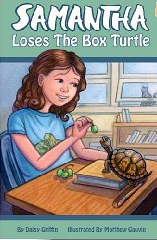
Samantha Loses The Box Turtle

Written by Daisy Griffin
Illustrated by Matthew Gauvin
SamanthaLosesTheBoxTurtlepic
This book is a fictional story about a girl named Samantha who is traveling with her grandparents and two younger sisters when a box turtle suddenly crosses the road. She pleads with them to stop, and to her surprise grandpa not only rescues the turtle but hands it to her. Once they return home, the girls plead with their parents to keep it, but mom explains that a box turtle needs to live in the wild. She agrees that they can keep it until the next day. Samantha also gets her teacher’s permission to bring the turtle to school.

Many adventures ensue as the turtle they have named Gayzer manages to escape both at home and in the classroom. Samantha introduces us to several of her friends and their reactions to her turtle. Because they are studying the food chain in science, their teacher, Mrs. Klutz, has devised a very clever “answer the question and pass the turtle” game to teach the children. At the same time, the reader is learning a lot of facts about turtles, nature and ecosystems. An element of suspense is introduced when the turtle goes missing and the neighborhood cat somehow gets into the classroom. This causes the entire student body to go into an uproar as everyone in the room desperately searches for Gayzer Samantha is supposed to protect and return her turtle to the nature preserve after school. Now she feels guilty that she may have caused it harm.

This chapter book with beautiful black and white illustrations is just over one hundred pages. The charming way the story is told will entertain children in first grade and up if read in chapters. Older children will amass a great deal of information about reptiles and nature; such as, how to tell the sex of a turtle, what they eat, how they survive in their habitats, and how long they live. The adult characters guide the children, but do not preach or make decisions for them. There is just the right amount of humor like naming the teacher Mrs. Klutz, and the toddler sister placing stickers on the turtle so that she could identify it when searching for it in the nature preserve. I thought the questions based on the book at the end were well done and an excellent resource for teachers to test comprehension. In the conclusion, the author reveals that the story is based on the real life experience of a family with three daughters and grandparents who rescue a box turtle named Gayzer and release it to a nature preserve. She also provides additional fun facts about box turtles and includes her website www.samsanimals.info. I am looking forward to many more animal adventure stories with Samantha and her family.

If you enjoyed this post, please subscribe by clicking on the word Follow or hit the orange RSS feed button in the upper right hand corner.

SLIPPING AND SLIDING AWAY

Leaf and the Long Ice: Volume 3 of Twig Stories

Written by Jo Marshall

Illustrated by D.W. Murray

LeafandlongicepicThis book is volume three of the twig stories. Jo Marshall writes them to develop an understanding of the natural world. She successfully combines adventure storytelling with accurate science in an attempt to encourage an appreciation for the earth and preservation of our environment.. Her target audience is fourth grade through the elementary school years though adults will enjoy them just as much.

The twigs live in a forest at the base of an old volcano which is topped by a glacier. At the beginning of the story we meet Leaf who has been placed in charge of his younger twig brothers while his parents and older sister Fern are away.  The twins named Buddy and Burka plead for a story. Leaf tells them about one of their father’s adventures which inspires them to sneak away so that they can play in the snow. When Leaf  falls asleep, they make their break and the adventure begins.

Along the way the twins encounter many forest creatures, beaver, rabbits, goats, foxes, pike, insects, eagles and caribou among them. Some are friendly and supportive; others are natural predators. The moth provides a ride, while the eagle looks at them as a tasty meal. Leaf ventures after his brothers so the author is really describing two separate fantasy adventures. The twins  slip and slide, hide in caves, and  are attacked by natural enemies, while Leaf frets about them and experiences his own adventures. The author shows the harmony of nature and how the creatures of earth need to support and aid each other for mutual benefit.

At the end of the book, Marshall gives cameos of the types of wildlife that she features as her characters and sketches what their needs are and how they are endangered today. Murray, who has worked with Disney and Universal Studios as an illustrator and screenwriter, supplies beautiful hand drawn illustrations. Marshall donates a portion of sales to wildlife causes and provides additional learning materials on her website www.twigstories.com.

This series furnishes reading entertainment for children and adults as well as accurate scientific environmental information that teachers and parents will find valuable. Read this volume to get started.

If you enjoyed this post, please consider subscribing by hitting Follow at the lower right or clicking on the orange RSS feed button on the top right hand corner.

GNIT-WIT GNOME

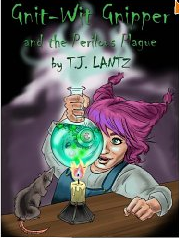
Gnit-Wit Gnipper and the Perilous Plague Rosehaven:The Hidden City

by A.J. Lantz
Gnit-WitGnomepic

A.J. Lantz is a new and talented writer. The reader quickly understands the characters and plot because they are so well depicted and rapidly developed. In this first book we meet Gnipper an eight year old gnome who has developed the unfortunate distinction of bringing trouble wherever she goes. Gnipper’s father is a science professor who is also the Lord of the Board of Gnomes.

Poor Gnipper lost her mother at the age of four. She has no friends for two reasons. First, she is considered bad luck, and secondly, she has failed to secure her pileus. The pileus is the tall pointed hat that a gnome earns by displaying intellectual prowess. At first the pileus was an honor earned by a few distinguished gnomes. As time went on the cap was no longer an honor but considered a badge of shame if not earned by age seven.  Those unfortunates who failed to achieve it were considered stunted and derisively called gnit-wits.

Gnipper is desperate to please her father and achieve status as a learned gnome. All of her previous scientific experiments have failed. Finally, she thinks that she has an ingenious idea. While serving her father, Professor Tallhat his morning tea, she casually suggests that she has a brilliant new idea which will earn her the pileus. He presses her for information, but she tells him that it will be a surprise. Suddenly, the professor collapses. Gnipper struggles to get her father’s body down to her basement laboratory. It seems that her experiment has gone terribly wrong!

Gnipper races to the doctor, Kelda Pearlhorn, who just happens to be a unicorn. Unlike most of the island’s inhabitants, she has always been kind to Gnipper. When Gnipper describes the situation, the doctor becomes alarmed and races to the lab with Gnipper on her back, knocking over anything or anyone in her path. The doctor diagnoses the illness and is at a loss to treat it, until Gnipper comes up with a brilliant solution. However, this will require a great sacrifice from the doctor. Gnipper learns an important lesson about the pileus, while Kelda models an important lesson that Gnipper needs to learn.

At the end of the story, we are given a glimpse into Lantz’s new novel. In Rise of the Retics  we meet Tyranna, an eleven year old orphan who is being raised at Lipkos Monastery near the Baltic Sea. She is the only female orphan, but she doesn’t like to restrict herself to female pursuits. While writing her letters in her room, she hears nonresident her door. Some knights appear outside her room and drag her down to the gate. On the way, she is terrified to see that the monks have been murdered. She anxiously awaits her fate as she is torn from her the only place she has ever called home.

The only criticism I have is that there are no pictures to go along with the wonderful language, pathos and humor in this story. I would love to see some of these exquisitely defined characters and scenery displayed as illustrations. Tweens and teens will love this new series of fantasy adventures. They are so well written that adults will enjoy them as well.


WEIRD AND WONDERFUL

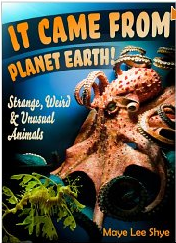
Weird Animals: It Came From Planet Earth! Strange, Weird and Unusual Animals

By: Maya Lee Shye

 Weird Animals

This book is a fascinating study of the habitat and behavior of strange animals living on land, in the sea and up in the air on planet earth. Also unusual is its appeal to all ages from younger children through adults. The author describes more than thirty animals and provides a photograph of each. Some of these have been on earth for millions of years. That’s right, the Coelacanth is the oldest jawed fish still alive on our planet. This fish with eight hollow spine fins covered by tough scales acting like a coat of armor can grow up the six feet long and existed on earth 410 million years ago! The Tuatara is the last reptile that lived on earth as a contemporary of the dinosaurs 225 million years ago. They still exist on remote islands in the Pacific Ocean and some wildlife sanctuaries. The Tarsiers are primates with huge eyes that leap from tree to tree. They are carnivores who are probably the ancestors of two legged primates. The slow loris is a primitive monkey with a very large round head and eyes. Their arms and legs are of equal size. This southeastern Asia native also bites with a poisonous venom lethal to many humans.

Many animals have evolved with adaptations needed for their environment. There is an African Penguin native to the warm coast of Africa. These animals burrow in the ground to keep cool. Glands above the eyes high on their heads help them cool their bodies. The North Island Brown Kiwi is a bird that does not fly because its wings are tiny. The animal is the size of a chicken. Like a dog the kiwi bird uses its nose to find food. These animals live in underground burrows. The male sits on eggs in the nest, while the female goes out to hunt for food. Their eggs are the largest known bird eggs. New Zealand has adopted this bird as their national symbol. Giant Tortoises living in the Galapagos Islands can weigh up to 600 pounds so their bodies have been adapted to move slowly and burn few calories. In fact, they can go as long as one year without eating or drinking anything!

There are many animals with adaptations that make them look strange. The Glass Frog  lives in Venezuela and central America. Its body is translucent so that it is totally invisible to predators. The Shoebill is a bird that lives in the swamps of east Africa. It is related to the stork, but its bill looks like a giant shoe. This cartoon like character spends most of its time standing silently along the water, but can fly at low altitude. When it does fly, it usually flies in a group that chatters. Archaeologists have found drawings of this bird in ancient Egyptian art. The Okapi is a forest giraffe that has black and white legs like a zebra. Its tongue is so long that it can wash its ears! One animal may someday help us find a cure for cancer. The Naked Mole Rat lives in tunnels on the desert coast of East Africa. This animal uses little oxygen and has no hair. It does not feel pain and appears to be resistant to cancer. Its life span is longer than any other mammal of comparable size. Another oddity is that these animals are eusocial like bees. One female is designated queen; all the other rats will work to sustain the colony.

More than thirty animals are discussed in this book. The work may serve as a springboard for analysis, discussion, comparison and evaluation of topics in  life science, geography, evolution and environment. I recommend it as a valuable learning reference tool for adults and children of all ages.