Posts tagged ‘animals’

CATOPEDIA

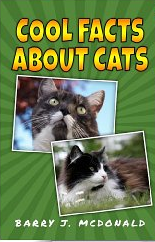
Cat Books for Children-Cool Facts about Cats

Written by Barry J. McDonald
CoolCatFactspic

The author claims to have written this book for children but I am fairly sure that any one reading it will be astonished by the number of facts you did not know about cats. It really does not matter whether you a cat lover or not, you will be pleasantly surprised. There are beautiful photographs accompanying the text which is presented clearly and succinctly so that even beginning readers will have no trouble handling it. My only criticism is that perhaps the presentation of facts could have been better categorized.

Cats have  lived in human homes half the amount of time dogs have, yet their appearance and behavior have not changed in the last 35 million years! Depictions of cats are drawn on ancient walls. Archaelogists have found more than 300,000 mummies in ancient tombs and many of these had embalmed mice to prevent them from going hungry in the afterlife. When a family cat died, the members shaved their eyebrows as a sign of mourning. The Japanese believed that cats had the power to change into super spirits, and Buddhist spirituals used them as surrogates.

In many ways cats are similar to humans. Every human has a set of unique fingerprints; every cat posseses a unique nosepad. The organization of a cat’s brain is similar to that of a human as it is the center for processing emotions. Cats dream like humans do, they lose their baby teeth, and they can be blood donors for other cats.  They have good memories and may hold something in memory as long as sixteen hours. If you spend time talking to a cat, it is more likely that the cat will talk back to you. Like humans, they may give you the silent treatment if you ignore them!

Yet, there are many differences as well. Cats move the left front and back leg together as they walk. The only other two animals in nature that do that are the giraffe and the camel. Cats’ vision is better than that of a human, but their color sensitivity is poor. A cat’s whiskers are controlled by muscles in its face and are used for balance. The average cat has twelve whiskers on each side. When a cat is blind, it can actually move the whiskers in front of its face to prevent bumping into objects using its whiskers like a human would use a cane.

You might think that I have already presented most of the information in this book, but that is far from the truth. The reader will find out how cats were used in war and as spies. McDonald explores the senses of the cat and how they work, how they hunt, gender differences, the classifications of cats, and social behavior. The reader learns how to tell if your cat is too fat, if he is in danger of being poisoned, and what you can do to keep your cat safe and happy. Parents, teachers, children and  anyone interested in animal behavior will benefit by reading this book and keeping it on hand for reference.

If you enjoyed this post, please subscribe by clicking on the word Follow or hit the orange RSS feed button in the upper right hand corner.

SLIPPING AND SLIDING AWAY

Leaf and the Long Ice: Volume 3 of Twig Stories

Written by Jo Marshall

Illustrated by D.W. Murray

LeafandlongicepicThis book is volume three of the twig stories. Jo Marshall writes them to develop an understanding of the natural world. She successfully combines adventure storytelling with accurate science in an attempt to encourage an appreciation for the earth and preservation of our environment.. Her target audience is fourth grade through the elementary school years though adults will enjoy them just as much.

The twigs live in a forest at the base of an old volcano which is topped by a glacier. At the beginning of the story we meet Leaf who has been placed in charge of his younger twig brothers while his parents and older sister Fern are away.  The twins named Buddy and Burka plead for a story. Leaf tells them about one of their father’s adventures which inspires them to sneak away so that they can play in the snow. When Leaf  falls asleep, they make their break and the adventure begins.

Along the way the twins encounter many forest creatures, beaver, rabbits, goats, foxes, pike, insects, eagles and caribou among them. Some are friendly and supportive; others are natural predators. The moth provides a ride, while the eagle looks at them as a tasty meal. Leaf ventures after his brothers so the author is really describing two separate fantasy adventures. The twins  slip and slide, hide in caves, and  are attacked by natural enemies, while Leaf frets about them and experiences his own adventures. The author shows the harmony of nature and how the creatures of earth need to support and aid each other for mutual benefit.

At the end of the book, Marshall gives cameos of the types of wildlife that she features as her characters and sketches what their needs are and how they are endangered today. Murray, who has worked with Disney and Universal Studios as an illustrator and screenwriter, supplies beautiful hand drawn illustrations. Marshall donates a portion of sales to wildlife causes and provides additional learning materials on her website www.twigstories.com.

This series furnishes reading entertainment for children and adults as well as accurate scientific environmental information that teachers and parents will find valuable. Read this volume to get started.

If you enjoyed this post, please consider subscribing by hitting Follow at the lower right or clicking on the orange RSS feed button on the top right hand corner.

EARTH’S AMAZING ANIMALS

Animals for Kids: 20 Exciting Animal Pictures with Animal Facts for Kids

by Nabila Owens

AmazingAnimalsThis is a nonfiction book which taught me some interesting facts about animals. A giraffe has the highest blood pressure of any animal, turtles have been on earth for more than two million years, and you can tell the mood of a zebra by looking at its ears! Owens points out that scientists are continuing to research  and investigate. They will undoubtedly discover new species on land, in air and under the sea. The author discusses their patterns of behavior, what they eat, the climates they live in, and how they survive. Many of them are as afraid of us as we are of them. There are many animals that are endangered because humans have taken over their native habitats. The author urges the young reader to learn about conservation and how to protect them from extinction. All of us must share the planet earth together!

This book features twenty animals. Some of them like dogs, cats and turtles have been largely domesticated and may be our pets. Others like elephants, cheetahs, lions and zebras might be visited in a zoo. An aquarium visit could allow us to visit dolphins, whales and sharks. There are animals who may be seen all over the world like the many species of birds and spiders, and others like the kangaroo which are only found in Australia and New Guinea.  Animals like some spiders and snakes have the ability to harm humans with one bite! Animals may make wonderful pets, or interesting creatures to visit in a man-made controlled habitat, but they can be dangerous. Each of them have unique qualities to their species. Always ask an adult before approaching an animal you do not know.

The author provides actual photographs of the animals. I think a little more illustration would have been beneficial to the kindle edition which I reviewed.  Photographs are limited to one small picture per animal making it is difficult to see details. Teachers might want to choose this book as a read aloud introduction for one animal which will be further researched. Parents would not want to attempt to read this book in one setting to a younger child. The text is aimed toward a middle grade and up reader. All in all it is a good book to introduce children to animal life on planet earth! If you would like to get information on more books for children, please subscribe to this biweekly blog by clicking on the Follow + icon in the lower right or the orange RSS feed icon in the upper right hand corner,

HAPPY EARTH DAY EVERYONE