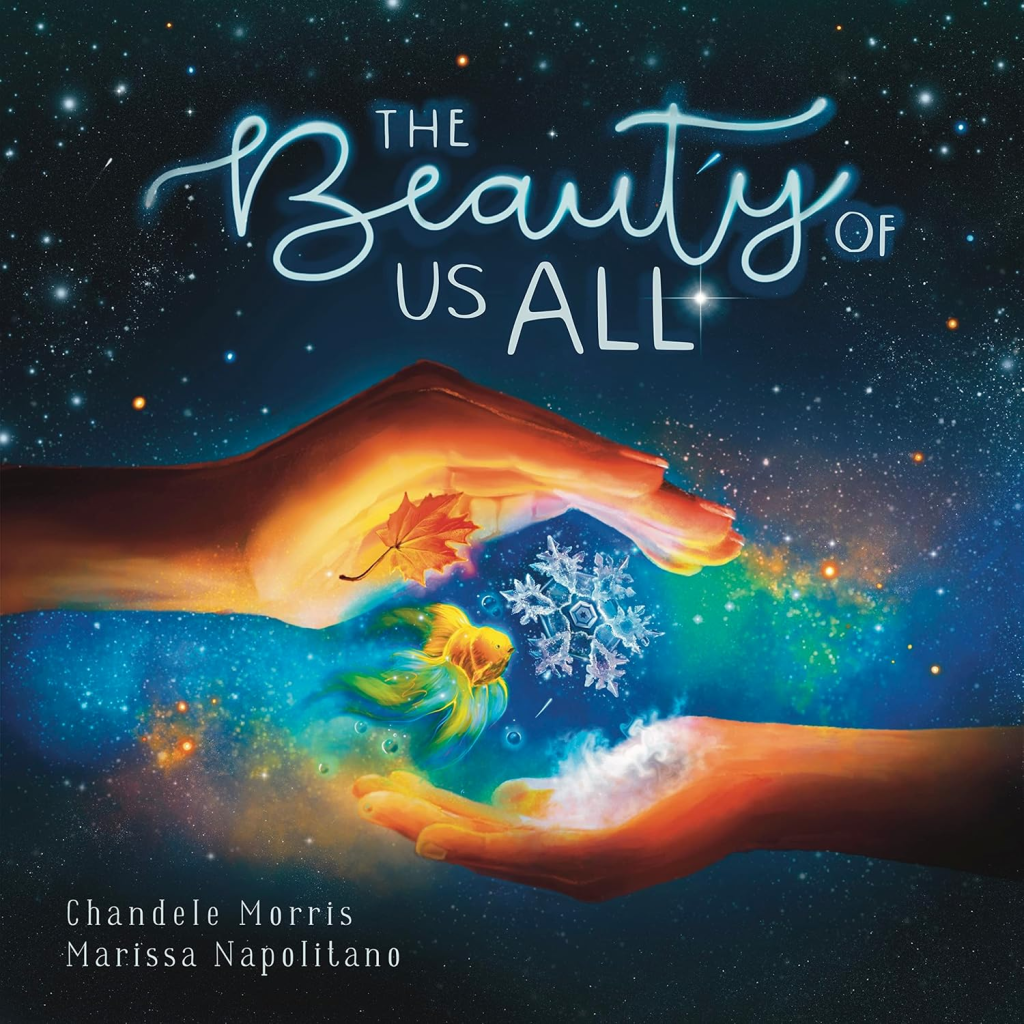
The Beauty of Us All: Celebrating The Diversity of The World
Written by Chandele Morris
Illustrated by Marissa Napolitano
A beautifully illustrated picture book to remind us of the simple beauty in objects and creatures all around us. The author reflects on the diversity and beauty of leaves, stars, fish, clouds, and the color of our skin. Each is beautiful, unique and loved.
Beautiful multicultural images enhance the message. Recommended for ages five and older.
SUBSCRIBE TO THIS BLOG FOR NEW BOOK REVIEWS EVERY WEDNESDAY AND SUNDAY.
Curly Crow’s Family Feast: A Children’s Picture Book for Kids Ages 4-8 about Finding Strength in Challenges, Wisdom in Problem Solving, and Thanksgiving for Family (Curly Crow Children’s Book Series)
Written by Nicholas Aragon
Illustrated by Natalie Junqueira
An innovative picture book that teaches about problem solving and teamwork. In addition young readers receive knowledge about many species of birds along with the story about Curly Crow and her family.
Curly and her family are scavengers. When the dumpster outside the restaurant where they live is closed for Thanksgiving, the family has no food. Curly decides to visit the Rio Grande nearby to observe how other birds gather their food.
After much frustration, she observes similarities and differences and figures out a solution. Readers learn a lot about bird species and how to problem solve.
The book is highly recommended for preschoolers and primary grade readers.
SUBSCRIBE TO THIS BLOG TO RECEIVE NEW BOOK REVIEWS EVERY WEDNESDAY AND SUNDAY.
Rooger and Loki Learn Manners: Sit, Boy, Sit. A Children’s Story About Dogs, Kindness and Family (The Curly Crow Pawprints Collection Book 1)
Written by Nicholas Aragon
Illustrated by Remesh Ram
When Dad decides to take his twins, Quinn and Finn to the park, they are delighted to find two playful Boston Terriers wrestling in the park. After striking up a coversation, the twins learn tat the twin pups named Rooger and Loki are homeless. The children decide they will need to learn manners and discipline before anyone will adopt them so the twins begin that task. At first, the job seems hopeless. Readers will laugh at the mayhem. Will the twins succeed with their good intentions?
The cute picture book teaches kindness and patience. Appropriate for animal lovers ages four and older.
SUBSCRIBE TO THIS BLOG TO RECEIVE NEW BOOK REVIEWS EVERY WEDNESDAY AND SUNDAY.
Adventures of a Pangopup (Endangered and Misunderstood Animals (Book 2)
Written by Terri Tatchell
Illustrated by Ivan Sulima
A charming picture book written in rhyme that teaches readers to heed their mother’s advice, while also educating them about endangered animals.
The book is part of a series about endangered animals. In this one readers learn about the pangalong and the dik-dik deer. When Pangopup decides to sneak away from his mom, he meets the deer who persuades him to go on an adventure. Will the two new friends survive?
The soft colors and exquisite rhymes teach without being preachy. Preschoolers and primary grade readers will delight in reading the book over and over. Lots of bonuses include drawing activities and information about these two unique animals.
Highly recommended for both home and school libraries.
SUBSCRIBE TO THIS BLOG FOR NEW BOOK REVIEWS EVERY WEDNESDAY AND SUNDAY.
Meatball’s Adventurous Appetite: A Pet Cat’s Funny, Entertaining, and Engaging Read Aloud Thanksgiving Story Picture Book for Kids 3-8
Written by Dr. Feng Zheng-Ward
Illustrated by Roka Studio
This book is part of a series about Meatball and his family. When Mrs. Jones needs to run to the store, she leaves their Thanksgiving turkey on the counter. The cat sees his chance, but fails to foresee the danger.
What follows is a hilarious adventure that creates havoc for the entire family and the fire department.
Will Meatball learn his lesson? What happens to Thanksgiving dinner?
The picture book is a delight for young cat lovers and fans of humorous stories. It includes fun to read highlighted words and story questions.
SUBSCRIBE TO THIS BLOG FOR NEW BOOK REVIEWS EVERY WEDNESDAY AND SUNDAY.
It’s a difficult choice, but here’s what you need to consider in a nutshell.
Benefits of Homeschooling that outweigh Public Schools
Homeschooling Strengthens Values & Beliefs
Homeschooling allows families to intentionally instill values that are important to them and the freedom to share and practice their faith without restrictions.
Public schools promote a fixed set of values, often without room for critical thought or diverse perspectives.
Self-Disciplineis required in homeschooling.
In homeschool, discipline comes from within, not from peer pressure or performance competition.
Learning to do the work even when it’s hard or boring = real growth.
Contrast this with the high-achieving public-school students often running on OCD-like habits.
Early Intervention
Problems—academic, behavioral, learning disabilities—are often caught early in homeschool.
Public school systems often miss these issues until it’s too late or harder to reverse unhealthy habits.
Social Struggles and safety
Homeschooling minimizes exposure to toxic social games: popularity, fashion, peer pressure.
Public school culture tends to push conformity over individuality.
There has been a rise in school shootings and safety concerns over the years.
Bullying
It exists in public school, period—even the good ones.
Homeschool environments naturally reduce bullying due to smaller, safer social dynamics where adults are present.
Independent Thought
Public school tends to promote conformity through standard curriculum and groupthink dynamics.
Access to Certified Teachers & Specialists Public schools employ trained educators, special education professionals, counselors, and support staff who are equipped to handle a wide range of academic and emotional needs.
Built-in Socialization Students interact daily with a variety of peers, helping them develop essential social skills, emotional intelligence, and teamwork—sometimes these skills are hard to replicate in smaller settings.
Diversity of Perspectives & Experiences Public school classrooms often reflect broader society, exposing students to different cultures, beliefs, socioeconomic backgrounds, and worldviews.
Extracurricular Opportunities Sports teams, music programs, theater, clubs, and leadership organizations are often more accessible and varied and are often offered free of cost to students.
Support for Working Families Public schools provide consistent, structured schedules and resources like transportation and school meals, offering vital support for dual-income or single-parent households.
Challenges and Trade-offs
While both homeschooling and public schooling offer unique benefits, they also come with their share of challenges and trade-offs. Homeschooling requires a significant time and energy investment from parents, who are also juggling teaching with their other responsibilities. And while most homeschoolers are tired of hearing about “socialization” it can also be a concern if families aren’t intentional about creating community connections.
On the other hand, public school students may face larger class sizes, less individualized attention, and exposure to bullying or peer pressure. While public schools offer a more structured environment and access to trained educators, they also come with curriculum constraints and limited flexibility.
What It Really Comes Down To
It’s a big decision to decide on your child’s educational path. But you are the best person to make that choice. Consider what is truly important to you and what is best for your child and your family then move forward in that direction. Homeschooling has changed a lot over the years. You don’t have to do it alone. There is a plethora of online classes, support groups, co-ops, and people that are around you if you just look.
Every child is different—and so is the way they respond to discipline. How you parent impacts how your child learns boundaries, responsibility, and emotional control. Here’s a simple guide to how parenting styles shape discipline and how you can adjust to better support your child.
4 Parenting Styles and Their Discipline Approaches
Authoritative (Balanced and supportive) o Sets clear rules and explains them. o Focuses on guiding, not punishing. o Try this: Help your child make a plan after a mistake instead of just punishing them.
Authoritarian (Strict and controlling) o Enforces rules without discussion. o Often uses punishment. o Watch for: Anxiety or rebellion in sensitive kids.
Permissive (Lenient and avoidant) o Rarely sets rules or follows through. o May avoid conflict. o Risk: Kids lack structure and may push limits.
Uninvolved (Detached or inconsistent) o Few rules or expectations. o Minimal supervision or guidance. o Consequence: Kids may feel insecure or unsupported
How to Adjust Based on Your Child’s Needs
• For Anxious Kids: Use calm tones, predictable routines, and gentle corrections. • For Strong-Willed Kids: Offer choices within limits and enforce consistent boundaries. • For Independent Teens: Let them help set rules and learn through natural consequences.
5 Smart Discipline Tips for Any Style
✅ Watch how your child reacts—adjust when needed. ✅ Stay connected and respectful. ✅ Set clear limits, but allow flexibility. ✅ Model calm, respectful behavior. ✅ Evolve your approach as your child grows.
Final Thought
Discipline isn’t just about control—it’s about teaching. The best approach grows with your child, helping them become confident and capable.
Pip the Bird: For Early Speech & Language Development
Written by Rachel Florence Meyer
Illustrated by Kathy Lee
A wonderful picture book collaboration by a mom and a speech therapist. The protagonist is a little bird named Pip, who assists his fellow animal friends to avoid danger when a gardener comes in the yard with a lawnmower,
The rhymes are crisp and sharp with lots of action words in bold print. Children are encouraged to read aloud. I appreciate the interactive guide for parents and teachers up front before the story begins. Illustrations contain wonderful details and facial expressions.
Highly recommended for parents and teachers of toddlers and preschoolers.
SUBSCRIBE TO THIS BLOG FOR NEW BOOK REVIEWS EVERY WEDNESDAY AND SUNDAY.
Guinness the Good Girl Goes to School(G3 BOOK SERIES)
Written by Matthew Gillmann
Illustrated by Penny Weber
When Dottie brings her rambunctios dalmation, Guinness to school, all chaos breaks loose. It seems that Guinness cannot contain her friendliness, curiosity, or eagerness to participate.
Readers learn and follow her adventures in the multicultural classroom and community. Nice illustrations and story. One suggestion, the print size might be a bit larger for younger readers.
Reccommended for ages three through eight.
SUBSCRIBE TO THIS BLOG FOR NEW BOOK REVIEWS EVERY WEDNESDAY AND SUNDAY.
The Mosquito Burrito: A Hilarious, Spanish Sprinkled, Rhyming Children’s Book
Written by Didi Dragon
Illustrated byLenaska Ti
What a fun bilingual read! Dragon cleverly rhymes Spanish and English short phrases that roll off the tongue.
The plot centers around a mosquito who finds himself stuck inside a burrito. After taking a bite, he simply cannot resist eating his way through it. I love the humorous play on words. This book has enthralling illustrations that enhance the plot.
I highly recommend the book as a read aloud for primary grade English and Spanish speakers to promote reading and language skills.
SUBSCRIBE TO THIS BLOG FOR NEW BOOK REVIEWS EVERY WEDNESDAY AND SUNDAY.
You must be logged in to post a comment.