The Adventures of Pookie: Home is Where the Heart is
Written and Illustrated by Rebecca Yee
A story about animal adoption from the point of view of the dog being adopted.
Children meet Pookie, who is excited to meet her new owner. Readers follow her journey as she explores her new surroundings and the loving care of Pookie’s new human family.
The illustrations are simple yet expressive and evocative of the appropriate emotions. I would recommend this book to young children who want to adopt, and as a teaching tool to explain the shelter adoption system.
This book is recommended for toddlers, preschoolers, and primary-grade readers.
SUBSCRIBE TO THIS BLOG TO RECEIVE NEW BOOK REVIEWS EVERY WEDNESDAY AND SUNDAY.
Our Hearts: A children’s book about how we navigate all of our feelings together with the ones we love.
Written by Kathleen Davis
Illustrated by Martyna Nejman
This beautifully illustrated rhyming picture book imparts a beautiful message for any age. The feelings we hold in our hearts belong not only to us but to those around us who love and care for us.
Our parents and friends experience the joys and sorrows, successes and failures we hold in our hearts. As we grow older our hearts expand as does the ability of others to share in those feelings. Our ability to love always outshines the feelings of fear and sadness.
I especially enjoyed the multicultural illustrations and the interactive feature, which encourages young readers to find and identify scenes and objects in the book.
Highly recommended for elementary and middle school readers, but a joyful message for all ages.
SUBSCRIBE TO THIS BLOG TO RECEIVE NEW BOOK REVIEWS EVERY WEDNESDAY AND SUNDAY.
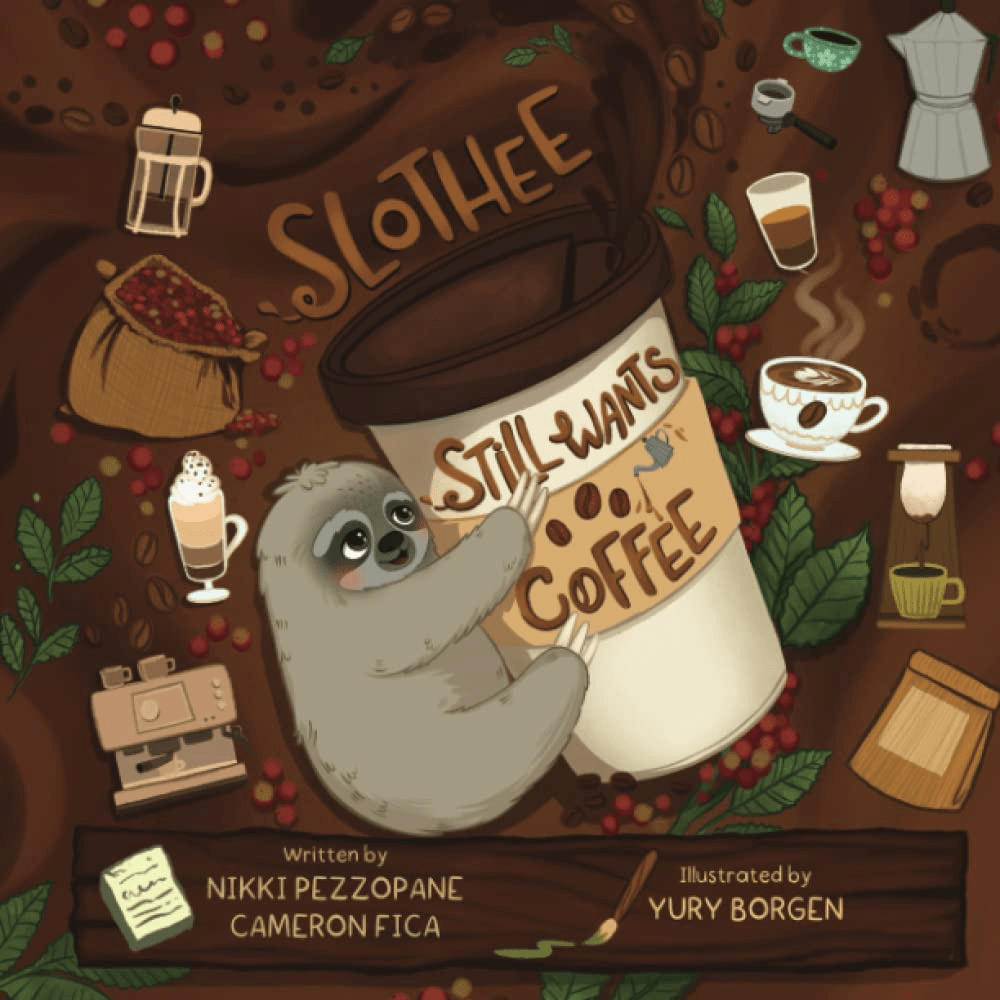
Slothee is off on another exciting adventure. He is determined to find the best coffee in the world. This adventure includes several countries notable for their coffee.
Slothee begins the journey in Peru, where he meets Lucia Llama and explores Machu Picchu. He introduces readers to the Mayan ruins in Mexico. Then he lands in Jamaica, before jetting off to far-away Uganda in Africa and Vietnam in Southeast Asia. Children learn about the types of coffee grown in each country, meet local animals, and sample local culture.
A good choice for elementary age readers to learn about local cultures, coffee, and the culture of several countries.
SUBSCRIBE TO THIS BLOG TO GET NEW BOOK REVIEWS EVERY WEDNESDAY AND SUNDAY.
Mrs. Wiggles and the Numbers Patterns: Discover Patterns for Ages 3-6
Written and illustrated by Lisa Konkol
Patterns and numbers are everywhere! Teacher, Mrs. Wiggles, summons her pupils to the schoolyard to play an I Spy Game. They will be searching for patterns among flowers, farms, animals, ponds, and gardens. Poor number zero is confused, but soon catches up with the other numbers.
At the end of the book, children find a number chart including numbers one through zero, and a useful tool to help them count by tens. The rhymes are crisp and sharp, enticing children to learn while not even realizing they are doing work.
SUBSCRIBE TO THIS BLOG FOR NEW BOOK REVIEWS EVERY WEDNESDAY AND SUNDAY.
Teachers should add this resource to preschool and kindergarten libraries.
A charming legend from Kenya relates the tale of an elephant who cooperates with the humans and animals of his village by watering the crops.
One day, a cabbage is missing from the fields. On subsequent days, more crops are missing. Elephant becomes distressed as do the other animals and humans of the village. The members of the beehive community invent a clever solution.
Readers discover the problem and the innovative solution after reading this book. They also learn facts about elephants, honeybees, the environment, and conservation.
A good choice for the classroom or home bookshelf for children who enjoy learning about animals, problem-solving, and conservation.
Recommended for ages six through twelve.
SUBSCRIBE TO THIS BLOG FOR NEW BOOK REVIEWS EVERY WEDNESDAY AND SUNDAY.
Franklin The Firefly: The Glow Within (A young, un-glowing firefly finds out that anything is possible when you believe in yourself)
Written and Illustrated by Thomas J. Penisten
Franklin is a firefly lovingly raised by his family. He tries to be kind to his fellow community. As Franklin matures, he realizes that his light is not as bright as the others. While his family reassures Franklin, his peers begin to tease him. Soon, Franklin feels ostracized and seeks the company of less desirable friends.
One day, Franklin learns that his former firefly community is in trouble. They are in danger. Franklin makes a decision that will change his life and the fate of many others.
This clever picture book is written in catchy rhymes with vocabulary that challenges and enriches the reader. It is suitable for a kindergarten through sixth-grade audience.
SUBSCRIBE TO THIS BLOG FOR NEW BOOK REVIEWS EVERY WEDNESDAY AND SUNDAY.
Greta is ready to earn her Wilderness Badge. She is excited to go on an overnight camping experience with the Girl Scouts. One thing troubles her, she is unsure whether she can leave behind her stuffed sleeping pal. Her puppy, Peek also suffers from separation anxiety and decides to do something about it.
Alone at night, Greta cries but is met with a surprise guest who has also been experiencing a new adventure. A surprise visitor wrecks a birthday party for one of the campers. The plot comes with an unexpected ending.
This nicely illustrated multicultural picture book teaches children not to be afraid to try new things and how to cope with separation anxiety. A nice choice for children headed to camp or for any preschool or primary grade reader who struggles with fear of the unknown.
SUBSCRIBE TO THIS BLOG FOR NEW BOOK REVIEWS EVERY WEDNESDAY AND SUNDAY.
This adulting thing can be hard, very hard. That’s true whether you’re raising a family or just yourself. In some cases, we were warned by our parents. For the most part, though, becoming an adult looked amazing, with little to no downside.
As a child, you saw your parents doing what you thought was whatever they liked. Little did you know that their efforts were driven by a desire for you to have the best possible life. While that was the case, all you saw were people who got to stay up late and make the rules.
Wouldn’t that be awesome when you were finally able to do it? It’s something you begin to look forward to … growing up.
Your parents and other grown-ups jumped into their cars whenever they wanted and drove anywhere. They could go shopping or to a restaurant. They always had money to buy things. You never had money and certainly weren’t able to drive a car.
That desire for adult-like independence was the reason you couldn’t wait to learn to ride a bicycle. You felt like a grown-up because you had a sense of being able to get up and go and explore. You could jump on your bike and take off! The end of the block, or “just down the road,” felt like it was a million miles away. This was, to you, your first taste of grown-up freedom.
Fast-forward a few years, and you’re leaving high school. You’ve heard as long as you remember that you can become whatever you want to become. You can’t wait to officially enter adulthood. It’s going to be so sweet! Then you get out on your own at 18 or 20, or 25 years of age. What are all these responsibilities? There’s so much to do. Where is all the freedom and independence you thought your parents had when you were a kid? Why is life so tough?
Then the truth of the situation hits you. This grown-up thing isn’t very fun, and being a kid definitely was.
Ask any grown-up if they have enough leisure time, and they’ll look at you like you’re speaking a language from another planet. Of course, they don’t have enough time to do what they want? Why ask such a crazy question?
There’s never enough time for fun and playful activities. Only the independently wealthy can truly enjoy their lives, spending as much time as possible doing what they want rather than what they have to do.
That’s the number one reason grown-ups will give you if you ask why they don’t spend more time on enjoyable activities. They’ll tell you their job, family responsibilities, social commitments, and other “have to do” activities keep them from having any downtime. They have to be serious 24/7. There simply isn’t any time for humor and fun, and play.
Then there’s the fact that adults constantly worry.
Kids don’t. A child just does what he does for the sake of doing it. He’s not too concerned about consequences. He chases a butterfly or goes out of his way to splash in a rain puddle just because. It’s fun. So he does it.
The Top 10 Fears That Hold Adults Back
What is it that adults worry about most of the time? According to Inc. Magazine, in a blog post titled “The Top 10 Fears That Hold People Back in Life, According to a Psychotherapist”, here’s what your adult mind is stressing over most of the time. (They are listed in no particular order.)
Change (Good or Bad)
Being Lonely
Failing
Being Rejected
Uncertainty
The Results Are Going to Be Bad
Being Hurt
Judgment
Feelings of Inadequacy
A Loss of Freedom
As an adult, you need to understand that change is inevitable. Sometimes it’s good, sometimes bad, but it is guaranteed to happen. Many changes are out of your control. Instead of worrying and fretting over change coming into your life and wreaking havoc, accept that it will appear and stop stressing about it.
If you worry about being lonely, guess what’s going to happen? We often create self-fulfilling prophecies. This means that concerning yourself with loneliness can lead to that reality. The fear of loneliness can also keep you in less than healthy relationships rather than going it alone.
Look, everyone hates failing. Sometimes we adults would rather simply not try because we’re scared of what will happen if we fail. This mindset will always fill you with stress and anxiety, which means less fun and happiness in your life.
Adults are constantly worried about being rejected in relationships and on the job. They don’t attempt new things or reach out to connect with others because they’re uncertain about what’s going to happen. The result could be bad.
Adults fear getting their feelings hurt, especially by loved ones. If they reach out to others for a little fun or just less seriousness, what if they’re judged poorly? They might feel inadequate to those around them.
Finally, adults are often fearful of a loss of freedom. Be careful that this doesn’t lead you into a bad situation. Someone who embraces freedom may avoid getting a steady job, which can lead to financial issues.
If these and other grown-up worries are constantly rolling around in your head, force yourself to take a break. Call your friends for a night out on the town. Take a walk, cycle with your BFF, or watch a funny movie.
Play, laugh, and smile like a child again. Enjoying the present moment without expectations can help remove yourself from these bothersome adult worries that can cause physical and mental stress.
You Probably Have More Free Time Than You Think You Do
By the way, the common excuse that adults don’t have much free time for playing around and goofing off might not be correct. Consider this.
NBC News reported in September of 2021 that the “… sweet spot for free time is about 3 or 3.5 hours per day.”
Life satisfaction was at its highest when people “had in the neighborhood of 2.5 hours of free time a day.”
[American Psychology Association – Having Too Little or Too Much Time Is Linked to Lower Subjective Well-Being – Sharif, Mogilner, Hershfield]
Adults will tell you they don’t have anywhere near that amount of free time. They might agree that they would have a much better life if they could enjoy their hobbies or other playful activities for a few hours each day. As it turns out, most adult Americans have more free time than they think they do (or will admit to having).
As reported by the Centers for Disease Control and Prevention (CDC), research from doctors Roland Sturm, Ph.D., and Deborah A Cohen, MD, reveals that you might have more leisure time than you realize. Here’s one big takeaway from that study.
“Americans averaged more than 5 hours of free time per day; no subgroup reported having less than 4.5 hours of free time per day.”
[Sturm R, Cohen, DA – Free Time and Physical Activity among Americans 15 Years or Older: Cross-Sectional Analysis of the American Time Use Survey]
No subset of the data had less than 4.5 hours of free time each day. This means people in their late teen years and twenties, thirties and forties, fifties, sixties, seventies, and older all had a minimum of 4.5 hours of leisure time.
CONCLUSION
Take an honest look at your life. How many 10 or 15 or 20-minute blocks of free time do you have? You don’t have to have fun in large doses. You can fill those small sections of your day with playtime and laughter rather than worry and stress.
We know that engaging in fun and enjoyable activities just for the sake of the activity itself, not for a specific result or achievement, is a great stress reliever. It can also put your life in perspective and help you learn not to take life too seriously all of the time.
It means that adults, including you, probably have a good bit of time to stop and smell the roses.
Prioritize play in your life. You never know when your number will be called, so why not have some fun? You know how good you feel when you laugh and smile. Schedule time for those activities that put a smile on your face. Hang out with that friend that makes you laugh.
Go out of your way to schedule more play and less seriousness. You can live a happier, healthier, and longer life. You can also find a lot more appreciation of your life, yourself, and the people in it.
Here’s to you smiling and laughing more and stressing out less.
The Fairies – Petal & Nettle and The Best Story Ever: A magical picture book celebrating friendship, imagination and the joys of storytelling!
Written by Kirstie Watson
Illustrated by Tilia Rand-Bell
A cute picture book about two friends who are fairies. When Nettle decides he will write the best story ever, he soon gets stuck.
Enter his friend Petal. She coaxes Nettle not to give up by revealing one at a time the elements necessary to a good story. Characters, setting, plot, and a problem to solve.
Together these two friends, along with others that they meet during their adventure, inspire young readers to persevere and never give up on their dreams. They also teach children the qualities and value of true friendship.
This book is appropriate for elementary and middle grade readers.
SUBSCRIBE TO THIS BLOG TO RECEIVE NEW BOOK REVIEWS EVERY WEDNESDAY AND SUNDAY.
The Fish and his Puffy Temper – A Marine Life Story Book for Kids (Waves and Tales 3)
Written by Barbara Pinke
Illustrated by Alvin Adhi
Puffy is a fish who has difficulty containing his anger. He desperately wants to make friends and play but his anger keeps getting in the way.
Puffy meets a seahorse who wants to help but over and over Puffy fails to control his temper. Then he meets a crab and shark who also teach him techniques. Finally his mother gives Puffy something to remind him of the three ways he has to squash his anger. Can Puffy succeed in his quest to stop his anger and make friends?
This book provides three practical and simple techniques to control temper. Even preschoolers can learn them. The book is recommended to parents, teachers, and counselors for children ages three through seven.
SUBSCRIBE TO THIS BLOG FOR NEW BOOK REVIEWS EVERY WEDNESDAY AND SUNDAY.

 August 31, 2025
 bamauthor
 Comments Off on A HOME AT LAST



 Barbara Ann Mojica's BLOG
You must be logged in to post a comment.