Posts tagged ‘snakes’

GOT THE MESSAGE?

Roar Like Me: Safari Animals (Join in)

Written by Sonia Maria

Illustrated by Winda Mulyasari

A charming picture book with simple but colorful illustrations that features animals that would be found on a safari adventure trip to Africa.

Toddlers and preschoolers are introduced to animals like lions, elephants, hyenas, snakes, parrots, and zebras. Each animal makes a distinctive sound to communicate their messages. The young readers are encouraged to imitate the sounds

Rhymes are short and easy to understand. This interactive book transports its readers to the jungle.

Recommended for the youngest readers from infants to preschoolers.

SUBSCRIBE TO THIS BLOG TO GET NEW BOOK REVIEWS EVERY WEDNESDAY AND SUNDAY.

Go back

Your message has been sent

Warning

ARIZONA ADVENTURE

Lola and Mia’s Adventures: The Desert Jitters

Written and Illustrated by Megan JL Dudley

This picture book is part of a series that features two sibling pups searching for adventure in new places. Lola is an experienced traveler, but her sister Mia longs to follow in her footsteps.

This time, the duo travels to the Arizona desert to view its beautiful sunsets. Along the way, the pair encounter snakes, reptiles, dust storms, cacti, and beautiful vistas. Young readers will enjoy the funny “dogisms” shared by the siblings and the illustrations that capture their rapidly changing emotions as they experience their adventure.

I would especially recommend the book to animal and nature lovers who are early elementary school age readers.

SUBSCRIBE TO THIS BLOG FOR NEW BOOK REVIEWS EVERY WEDNESDAY AND SUNDAY.

Go back

Your message has been sent

Warning

CLEVER AND CREATIVE

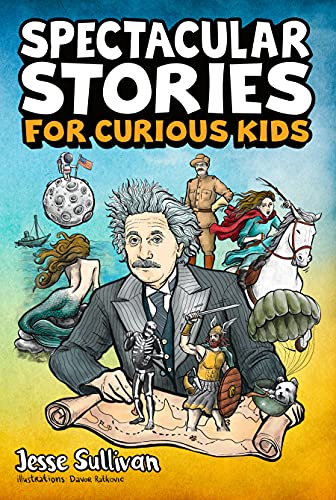
Spectacular Stories for Creative Kids

Written by Jesse Sullivan

The author has a way with words. Sullivan has succeeded in telling 100 stories about history, science, art, and culture and with wit and charm. Young readers will be intrigued by topics like ghosts, curses, snakes, space, and vampires. Each story reveals an adventure and interesting facts. Black and white illustrations accompany many of the chapters. Young readers unwittingly learn a lot while they are laughing and having a great time reading.

This is a book they will want to share with friends and family. Targeting the middle-grade audience ages nine through fourteen, but any age reader will enjoy and appreciate these gems.

If you enjoyed reading this post, please subscribe by clicking on the word Follow or by hitting the RSS FEED button in the upper right-hand corner of this page.

Check out lots more for the whole family at http://www.LittleMissHISTORY.com

#HAPPYEASTER Tea-time Travel Adventure

The Further Adventures of Mrs. Trimble’s Magic Teapot!

Written and illustrated by Steven-Watson Morris

So delighted that the author is giving us a sequel. Book Two contains seven more magical adventures. Readers meet a one-eyed giant, a silver snake, a naughty goblin, the Easter bunny, an alien planet, some bubbles, and a castle of dreams. Children learn that we should be kind and understanding toward others even when others are angry with us. Mrs. Trimble teaches us that when we are naughty like the goblin, we need to undo the harm we have done to others. Then apologize, and make restitution for our mistakes. When Mrs. Trimble meets the Dream Maker, she learns how sweets can turn into healthy fruits. What child would not like to have a bubble adventure!

When the Easter bunny oversleeps one year, our heroes must rescue him.  In their last adventure, our friends land on the Teapot planet where everything is shaped like a teapot. Here they meet Earl Grey, who will restore the magic to their teapot. To return his kindness, Mrs. Trimble leaves him a special gift.

As in the first book, there are delightful pencil drawings. The book ends with coloring pages that feature all the characters in the book’s stories. I recommend the book for elementary and middle-grade readers and anyone who likes to let their imagination soar.

If you enjoyed reading this post, please subscribe by clicking on the word Follow or by hitting the orange RSS FEED button in the upper right-hand corner of this page.

THE DIRT ON DINGOES

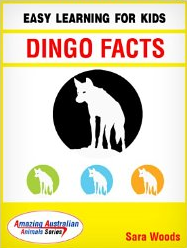
Dingo Facts: Easy Learning For Kids (Amazing Australian Animals)

Written by Sara Woods
DingoFacts,pic

This book is one of the amazing Australian animal series. It will enlighten the reader about what kind of animal a dingo is, where it lives, what it eats, how it moves and breeds, how it is threatened, and why it is important. The book packs a lot of information in thirty-four pages. While the author targets the book as a read aloud for younger children as well as an independent reader for older children, I think it more appropriate for the latter group.

Unfortunately, my travels have not yet taken me to Australian so I am unfamiliar with this animal. Looking at the photos, I immediately thought of a gray wolf and later learned from the author that the dingo is a subspecies of that animal introduced to Australia by seamen about 4,000years ago. I was fascinated to learn that dingoes are double jointed at all their joints, and that they use their paws as we do our hands. They can even open door knobs. Their ears stand straight up and can rotate backwards; they can rotate their heads 180 degrees for better vision. Most dingoes are monogamous and will mate yearly averaging four to six pups for about ten years. The mother will eat, swallow and regurgitate food to feed young much like a bird.

Landowners and hunters are the biggest threat to the dingoes, but crocodiles, snakes, and lack of food and water also factor in their survival. More contact with domestic dogs as urban sprawl progresses could eventually lead to extinction. Farmers who see them as a threat have engineered the world’s largest fence (3,488 miles) to protect sheep and farm lands. But dingoes are special animals because as the only native dog to Australia, they are apex predators at the top of the food chain who protect many smaller mammals and the native natural grasses. Some areas of Australia have set up sanctuaries to protect the dingoes.

This series will eventually include eighteen books about Australian animals. It certainly makes an excellent, well-organized reference source for classrooms in the elementary grades and libraries. Teachers could also use many of these books in science units comparing and contrasting with other animals. Highly recommended for children age seven and up. Adults who read these books to children will find themselves being entertained and informed as well.

If  you enjoyed reading this post, please subscribe by clicking on the word Follow or by hitting the orange RSS FEED button in the upper right hand corner of this page.

RUMBLE IN THE JUNGLE

Riki, Tikki-Tavi

Written by Rudyard Kipling in 1894

Illustrated by Jerry Pinkney

Riki Tiki Tavipic

This is a story taken from The Jungle Book with which many adults are familiar. It involves a young boy named Teddy and his family who rescue a mongoose named Riki Tiki-Tavi. This poor creature has nearly drowned near their bungalow in Segowlee. The mongoose is an animal known for its tenacity, and Riki will prove his worth to the family who has adopted him.

The reader first learns of Riki’s rescue and the reluctance of Teddy’s mother to keep him. Riki proves a friend to the Tailorbird named Darzee who screams that the cobra snake Nag has stolen an egg from their nest. The snake’s wife Nagaina tries to ambush Riki and nearly kills him. More danger befalls him as a smaller snake named Karait attacks him. The family is impressed with Riki’s bravery. The young boy named Teddy brings Riki everywhere. At night Riki goes exploring and Chuchundra, the muskrat, tells Riki that the snakes plan to kill the humans so that they will have the garden to themselves again. It will be up to the fearless mongoose to protect the family and marshal all the animals of the garden together to defeat these nefarious snakes. Will Riki be successful in rallying this disparate group to protect the family and their habitat?

The digital edition was produced by Gere Donovan Press in 2012. It is also available in hardcover and print, which I would recommend to the fact that it includes the award winning illustrations of Pinkney. The Jungle Book is now in the public domain. In this edition the original language has been simplified, and I believe that children aged eight and up will not find it too difficult. Of course this does mean that some of the beauty of the Kipling’s writing is sacrificed. The lessons of fearlessness, loyalty and devotion to family as well as the local culture that the story imparts remain treasures to be shared by future generations. Adults should note that Kipling does display some violence in his descriptions.

If you enjoyed this post, please subscribe by clicking on the word Follow or by hitting the orange RSS feed button in the upper right hand corner of this post.