Posts tagged ‘history’

TIME TRAVELING

The Imagination Station: Voyage with the Vikings Volume 1

Written by Marianne Herring and Paul McCusker

ImaginationStationpic

This is the first book in a series combining fantasy, history, adventure with Christian values. The books are sponsored by Focus on the Family based on the Adventures in Odyssey radio broadcasts. They are early chapter books marketed for ages seven and up, but the text is large font and vocabulary not too difficult making them easily understood by a child a bit younger. There are a few black and white simple illustrations assisting a younger reader to grasp story references and providing more incentive for reluctant readers.  At the end of the tale, there is a secret puzzle to solve based on the text adding to the aura of a detective story.  Additional information is available on the website that is included. This is an added incentive for homeschooling parents and classroom teachers who wish to use the book as a springboard for discussion to other historical figures, events or geography of the period.

Beth and her cousin Patrick are at a soda house named Whit’s End. Curiously, it is located in a rambling old house described as a kid’s museum. Beth introduces Patrick to the Imagination Station, which is a kind of time machine.  It’s owner, Mr. Whittaker, invents things. He suggests that the children use his time machine to go on an adventure to visit a Viking ship. He outfits them with Viking costumes. Then he asks a favor. Mr. Whittaker found a note in the Station asking that the traveler bring back a sun stone from a Viking to save someone named Albert. Off they go hurtling into space landing in an open field in front of a herd of reindeer.

The children meet Erik the Red and his son Leif Erickson. Leif has recently returned from his travels.  He has recently introduced Christianity to the land. Leif brings the children back to the Church for their own protection, while he prepares to embark on another voyage. Erik is mystified when Beth challenges him to a game of chess. Unfortunately, the children have still not been able to accomplish their mission to find the sun stone. Will they be trapped back in time in this village or will they stow away on the Viking ship with Leif?  Will they be successful in finding the sun stone and wending their way back to the Imagination Station or are they doomed to remain in the past?

If you enjoyed this post, please subscribe by clicking on the word Follow or by hitting the orange RSS feed button in the upper right hand corner of the page.

NIFTY FIFTY

Nifty Fifty State Facts for Fun! (Book 2)

Written by Wyatt Michaels

NiftyFiftyStatespic

This is the second in a series making learning about the fifty states fun and informative. Rather than presenting a list of state capitols, symbols and associations, Michaels assembles trivia and facts in game format. In each case, the question is posed with three possible choices. The reader is asked to choose the correct answer. If you are wrong, you are given the opportunity to make another choice. In many cases, the reader is given a hint to help make a decision.

There are many where questions. For example: Where is Mount Rushmore?; Where did the sundae begin?;Where was the birthplace of the first TV?  A lot of questions involve firsts: the first state to vote for independence, the first National Park, the first state to make laws for cars, the first celebration of Memorial Day, and  the location of the first public zoo. Another group of questions deal with the longest and the largest. These include the longest running radio station, longest floating bridge, longest sky way bridge, the largest gold producing state, and largest cable bridge. Then there are the facts dealing with unique situations. Which state was the birthplace of four presidents? Which state holds the world record for most rainfall in a 24 hour period? What is the name of the state which turned down hosting the Olympics? Name the state that has a floating post office. From which state do the names on the Monopoly game board originate? Whose state flag was designed by a teenager? What governor has a state named after him even though he never set foot in that state?

This book makes a great activity for children on a long car ride. Much better than name the license plate. Children and adults will also learn some useful information to use as conversation starters. The game provides a quick reference source. There are maps and photographs that will enhance geographical knowledge as well. So if you are going on a road trip or want a new book to place on your coffee table, you might want to consider this quick read.

If you enjoyed reading this post, please subscribe by clicking on the word Follow or hit the orange RSS feed button in the top right hand corner.

FREEDOM RIDE

SOLCover_2

Award winning author Barbara Ann Mojica brings you her second book of the Little Miss HISTORY series titled Little Miss HISTORY Travels to The Statue of Liberty.

Since her last trip to Mount Rushmore, Little Miss HISTORY has journeyed more than 1700 miles over land, sea and air to reach her second destination, The Statue of Liberty. This national treasure stands proudly in New York Harbor welcoming all people to the land of freedom and opportunity. In this second book of the series, Little Miss HISTORY will help you discover who thought of the statue in the first place, the values she symbolizes, the architects and engineers who built Lady Liberty, and the little known individuals who contributed their pennies to make her debut in New York’s harbor possible. You will learn about why she remains a promise and symbol of the hopes and aspirations of many people around the world and not just to immigrants coming to America. Come now and follow Little Miss HISTORY as she enlightens you about The Statue of Liberty!

THE BOOK IS AVAILABLE IMMEDIATELY AT https://www.createspace.com/4409159

http://www.amazon.com/Little-HISTORY-Travels-Statue-Liberty/dp/1492211842/ref=sr_1_1?s=books&ie=UTF8&qid=1377553785&sr=1-1&keywords=Little+Miss+History+Travels+to+the+Statue+of+Liberty

http://www.barnesandnoble.com/w/little-miss-history-travels-to-the-statue-of-liberty-mrs-barbara-ann-mojica/1116744014?ean=9781492211846

MomGiveawaySummer2013I’LL BE GIVING AWAY A COPY OF
MY SECOND BOOK FEATURED ABOVE!

Powered by Linky Tools

Click here to enter your link and view this Linky Tools list…

NEW BOOK IN LITTLE MISS HISTORY SERIES COMING SOON!

Little Miss History Travels to the Statue of Liberty
By: Barbara Ann Mojica
Ilustrated by Victor Ramon Mojica

SOLcoverI am so excited to announce that the second book in the Little Miss History nonfiction travel series will be released in a few weeks! This time around you will find Little Miss History “hanging around” The Statue of Liberty. She will be your guide to learning about the creators, the builders, the contributors, her journey, and the events connected to her history.


Here is a sneak preview of the cover. Looking forward to having you on the journey!

THE FIRST SUPERPOWER

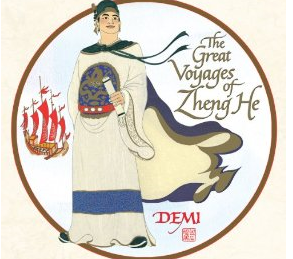
The Great Voyages of Zheng He

Written and illustrated by Demi

TheGreatVoyagesofZhengMapic


Ma Ze was born in 1371. Ma was born into a Muslim family whose ancestors came from Persia and fought with the Mongols and Genghis Khan. Ma’s father was  a general who told his son of his pilgrimage to Mecca and his military battles. But he was killed in battle when Ma was only ten so Ma was taken to be raised in the imperial palace. Ma was a brilliant scholar who appeared to be skilled at everything he tried to do. Like his father, Ma enjoyed adventure, but he especially loved the sea. When Prince Zhu Di became emperor in 1402, he spread his empire and the power of the Ming Dynasty. He expanded the borders of the Forbidden City of Beijing and strengthened the Great Wall against his enemies. He built a large army and made Ma, who was now known as Zheng Ma,  Admiral of the Navy. One year later Ma had built 525 ships, ten times the number of ships that Portuguese explorer Vasco da Gama possessed, and a navy consisting of more than 30,000 sailors.

Zheng Ma set sail with a new more accurate compass, better maps and a good knowledge of astronomy. He journeyed south to Java and Sumatra reaching out to the people with a policy of peace and religious tolerance. Ma destroyed the Cantonese pirate fleet let by Chen Zuyi which resulted in free trade. Eventually thirty foreign  states would  pay tribute and acknowledge the supremacy of China. Emperor Zhu was so pleased that he ordered another voyage in 1407. When Ma found civil war between the Muslims and Buddhists, he proclaimed religious freedom for all. This was unheard of in the time of the Inquisition and Crusades. Subsequent voyages added precious metals, porcelain and more exotic animals to China as a result of forays into the Arabian peninsula and Africa. In 1417 there were so many exotic animals that the emperor built the first zoo to house them all. He was especially fond of his pet giraffe. By 1421 China could rightly be called the first world superpower. Unfortunately, later near the end of that year, lightning struck three imperial buildings creating a conflagration that killed thousands of people. Then a drought caused a grain shortage. When Zhu Gaozhi ascended the throne, he retreated within his borders and ended outside exploration. Ma was relieved of his duties, the ships rotted, and the navy disbanded.

Later in 1425 Zhu Zhangji came into power. He wanted to reestablish trade. In 1431 Ma was again put in charge of the fleet. This was the largest of all voyages. Ma made it a successful peacekeeping mission, but he died suddenly at the age of 62. No man could replace the knowledge and vision of Zheng Ma.  He envisioned a world of peace, intellectual growth, and religious tolerance in a time of war, ignorance and religious strife.

The book is beautifully illustrated by the award winning artist Demi. Adults and children eight and over will appreciate the adventure story and learning about a part of Chinese history and culture that is not widely known. This is a well written, informative and fascinating book for parents and teachers to add to their collection.


WEIRD AND WONDERFUL

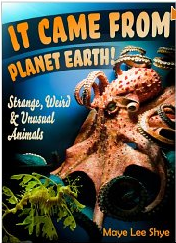
Weird Animals: It Came From Planet Earth! Strange, Weird and Unusual Animals

By: Maya Lee Shye

 Weird Animals

This book is a fascinating study of the habitat and behavior of strange animals living on land, in the sea and up in the air on planet earth. Also unusual is its appeal to all ages from younger children through adults. The author describes more than thirty animals and provides a photograph of each. Some of these have been on earth for millions of years. That’s right, the Coelacanth is the oldest jawed fish still alive on our planet. This fish with eight hollow spine fins covered by tough scales acting like a coat of armor can grow up the six feet long and existed on earth 410 million years ago! The Tuatara is the last reptile that lived on earth as a contemporary of the dinosaurs 225 million years ago. They still exist on remote islands in the Pacific Ocean and some wildlife sanctuaries. The Tarsiers are primates with huge eyes that leap from tree to tree. They are carnivores who are probably the ancestors of two legged primates. The slow loris is a primitive monkey with a very large round head and eyes. Their arms and legs are of equal size. This southeastern Asia native also bites with a poisonous venom lethal to many humans.

Many animals have evolved with adaptations needed for their environment. There is an African Penguin native to the warm coast of Africa. These animals burrow in the ground to keep cool. Glands above the eyes high on their heads help them cool their bodies. The North Island Brown Kiwi is a bird that does not fly because its wings are tiny. The animal is the size of a chicken. Like a dog the kiwi bird uses its nose to find food. These animals live in underground burrows. The male sits on eggs in the nest, while the female goes out to hunt for food. Their eggs are the largest known bird eggs. New Zealand has adopted this bird as their national symbol. Giant Tortoises living in the Galapagos Islands can weigh up to 600 pounds so their bodies have been adapted to move slowly and burn few calories. In fact, they can go as long as one year without eating or drinking anything!

There are many animals with adaptations that make them look strange. The Glass Frog  lives in Venezuela and central America. Its body is translucent so that it is totally invisible to predators. The Shoebill is a bird that lives in the swamps of east Africa. It is related to the stork, but its bill looks like a giant shoe. This cartoon like character spends most of its time standing silently along the water, but can fly at low altitude. When it does fly, it usually flies in a group that chatters. Archaeologists have found drawings of this bird in ancient Egyptian art. The Okapi is a forest giraffe that has black and white legs like a zebra. Its tongue is so long that it can wash its ears! One animal may someday help us find a cure for cancer. The Naked Mole Rat lives in tunnels on the desert coast of East Africa. This animal uses little oxygen and has no hair. It does not feel pain and appears to be resistant to cancer. Its life span is longer than any other mammal of comparable size. Another oddity is that these animals are eusocial like bees. One female is designated queen; all the other rats will work to sustain the colony.

More than thirty animals are discussed in this book. The work may serve as a springboard for analysis, discussion, comparison and evaluation of topics in  life science, geography, evolution and environment. I recommend it as a valuable learning reference tool for adults and children of all ages.

AN UNFAMILIAR CULTURE

EskmosandIntuitpicHistory for Kids: The Eskimos And The Inuit

By: Charles River Editions

This is another excellent selection in the Charles River Editions providing comprehensive knowledge in a concise and enjoyable format. Most of us use the terms Eskimo to uniformly refer to the people who live in the harshest climates of Canada, America, Russia and Greenland, but many of them are Inuit. They are descendants of the travelers who crossed the land bridge that once connected Russia and Alaska. The editors use the term Eskimo to simplify. The Eskimos are associated with igloos, sleds, seals and dogs. This book briefly covers their origin, their history and legacy.

The word Eskimo translates to “eaters of raw meat.” Historical records prove that they traded with the Vikings in the 1100’s. By the 1500’s Europeans traded with the Eskimos living in the Arctic parts of America. In the 1800’s they traded the furs from the animals they hunted with the Europeans. But those same Europeans brought many diseases which reduced the Eskimo population. As late as the 1950’s many Eskimos continued to move from place to place, surviving by fishing and hunting and trading for things they could not make from animal bones like needles and wood. Utensils and plates were made from the bones of animals and clothing from seal and caribou. The Eskimos traveled by sled over the frozen ice and in warmer weather used boats made of caribou skin stretched over a wood frame. Some Eskimos lived in igloos during the winter but more often lived in small homes made of sod or tents made from animal skins. They lived in small family units with no formal government. Their family law was called maligait. Each member of the community was asked to think of others before himself. Each family felt it their responsibility to take care of members of the community and would be punished severely if they did not. Eskimos believe that people, animals and things all have magic powers. The sea goddess Sedna lives at the bottom of the ocean. Burial customs often involved a person laid on the ground and left face up surrounded by a ring of stones so the soul could return to nature.

After World War II, most Eskimos gave up  hunting and took government jobs. Today many Eskimos work for the government in both the US and Canada. They now live in modern homes that have, radio TV and electricity. The villages are still small with a school and church. They rely on airplanes to transport food and supplies. About 50,000 Eskimos live in North America. Most speak English, though some Canadians speak French. Those Eskimos living in Greenland speak Danish and in Russia, they speak Russian. But the Eskimos still pass down the native language and customs to their children.

Children from age seven up will enjoy learning about this unique culture. There are maps, photographs and drawings which bring out the unique characteristics of these peoples. This particular edition is very well written. Children will become immersed in the story and forget that they are learning. Adults will learn a few things as well.

SAILING THE SEVEN SEAS

SAILING THE SEVEN SEAS

The Illustrated Life of Blackbeard

by: Charles River Editions

Blackbeardpiccover

This book is part of  History For Kids series aimed at children in the middle grades. As is the case with other books in the series there are engravings, drawings and paintings. There are no maps of the voyages which would have been helpful. The editors attempt to separate the facts from the myth which is difficult to do because of the paucity of information.

Chapter One begins by telling us Blackbeard’s real name, Edward Teach, and how he might have been born in either Jamaica or Bristol, England around 1680. Teach learned how to become a sailor by serving in the British Navy during Queen Anne’s War. He attacked French ships and soon discovered how  to become a pirate. Later when the war was over, he moved to the island of New Providence on the Atlantic Ocean and worked for the pirate leader, Benjamin Hornigold. Together they attacked Spanish and Portuguese ships for  bounty of wine and flour. They then met a pirate named Stede Bonet who allowed Teach to captain a ship called the Revenge. These two men later broke with Hornigold because he would not attack the British. When the pirates captured a French slave ship that had 40 cannons, Teach assumed command of 150 pirates. Shortly after they attacked a ship named Margaret, its captain, Henry Bostock,  told the governor about Teach describing his long black beard. That is how he got the name, Blackbeard.

Legends about Teach continued to grow and by 1718, the British Royal Navy actively hunted him. Blackbeard feigned repentance and asked for the governor’s protection. His ship ran aground; but many think he wanted to sink his ship to split up the pirates and keep more treasure for himself. Blackbeard did not give up being a pirate as he had promised. He sailed up and down the Atlantic coast searching for ships to plunder. The governor of Virginia, Robert Maynard, chased him up and down the coastal seas. Would Blackbeard finally be caught or would he continue to plunder?

This book is not as well written as the others in this series. At times it appears as if the writers are stringing together information rather than telling a life story. The book does its job in introducing students to the real Edward Teach.

If you enjoyed reading this post, please subscribe by clicking on the word Follow at the lower right or hit the orange RSS button on the upper right.

FUN, FACTS AND FANTASY BOOK REVIEW

Matilda Falls into a Doughnut Hole

Nibolene Falls in a Doughnut Hole
by Maria Calanchini


This book is one of the collection of Goop tales based on 52 imaginary creatures called Goops who represent the bad habits of children. Does that make them horrible creatures? You will see that they are charming and adventurous as each of them finds a way to visit an exciting destination. They teach you new vocabulary words and introduce you to fun facts about foreign places. In this particular adventure, Nibolene is a little girl Goop who likes to eat too much.

The author introduces her in a poem:


Ah, Nibolene, Sweet Nibolene,
Was neat and spic and span and clean!
She told the truth, indeed, she did,
And always did as she was bid
Yet, she nibbled like a bull
And soon she felt far too full!

Nibolene’s favorite food  is doughnuts. One day while eating one, she fell into the doughnut hole and found herself in a French bakery shop. Reminds me of Alice in Wonderland. Here she meets Esmeralda, a little French dog who wears a beret and speaks with a French accent. Esmeralda tells Nibolene that she was named after a character in the Hunchback of Notre Dame story. She offers to show Nibolene the famous cathedral, but cautions her to beware of the gargoyles who can come to life if they see something that they don’t like. You might be able to guess what happens when Nibolene falls asleep in the cathedral. She has quite a scary adventure which allows the reader to experience more of the sights of Paris. Will Nibolene ever find her way back to the patisserie and climb back into the doughnut hole that will transport her back to Goop land?

Calanchini delights and entertains her readers, but also provides them with a glossary of French and English vocabulary to help them understand the language and culture. There are beautiful photographs of  Parisian foods and landmarks. Younger children will enjoy the silliness of the story, while and older child will appreciate learning about the language, culture and history of Paris, I feel the book would be appropriate for ages 5-12. Calanchini has a website GoopTales.com and a Facebook Goop Tales page. Children are encouraged to watch and listen to Goop Tales or download a partially finished tale and write their own ending. I heartily recommend this highly entertaining and informative series.