Posts tagged ‘historical fiction’

TORN BETWEEN TWO SIDES

Fields of the Fatherless

Written by Elaine Marie Cooper

fieldsfatherless

Short novel of Christian historical fiction based on a true historical account of the 1775 conflict in the village of Mentonomy, Massachusetts. Betsy Russell is an eighteen year old girl living in a Patriot family near colonial Boston. Her village is busy preparing a militia for the inevitable battle looming on the horizon with the British. Betsy feels slighted that her younger brother Noah is taught how to fire a musket, while she is expected to stay home and play a support role. When Betsy confides her feelings to the blacksmith, he gives her a small knife to defend herself and protect her family. Betsy could never imagine what role that knife would play in her future.

The battle brings both joy and tragedy to the Russell family. Betsy will grapple with grief, struggle with her Christian faith, assume heavy family responsibilities, become a nurse, and find out about love in many unexpected ways. This novel is based on actual historical events; the fictional characterizations and quotes from the Bible add a humanistic element to the narrative. Some of the battle details are a bit graphic, which is the reason I would suggest the target audience to be age thirteen and older.

If you enjoyed reading this post, please subscribe by clicking on the word Follow or by hitting the orange RSS FEED button in the upper right hand corner of this page.

WAGONS HO!

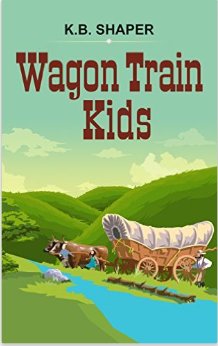
Wagon Train Kids Headed West for Gold

Written by K.B. Shaper

Wagontrainkids,pic

Middle grade historical fiction tale focusing on Jack and his younger sister Mary. The family lives on a farm in Connecticut. One day the children are shocked to learn that their parents are selling everything and heading West on a wagon train in the hopes of finding gold in the California hills. The author traces the journey as the family heads north to Albany and then west to Missouri. There they meet Mr. Booth, the wagon master who will guide them to California.

Shaper goes into detail about the supplies and the preparation needed to prepare for the journey. I do think more time should have been spent describing in detail what the children saw on the journey. In that respect the plot is a bit uneven. One night the members of the wagon train observe someone watching them. Jack and Mary are warned to run if their father signals them. The adventure begins when the children become separated from their parents and are left on their own. A kindly stranger rescues them and brings them into San Francisco, where they work to earn their keep. Will the children be reunited with their parents and what happened to the rest of the members of the wagon train?

The story ends abruptly, if satisfactorily. Some readers may question whether telling the children to run and hide and that they will be found when the danger is past is a realistic scenario. The plot features a traditional nuclear family story with a bit of history about the mid nineteenth century, but may be short of adventure for some 21st century readers. I would still recommend it as an easy chapter book for early middle grade readers. Teachers might use it as a read aloud to supplement this period of American history.

If you enjoyed reading this post, please subscribe by clicking on the word Follow or by hitting the orange RSS FEED button in the upper right hand corner of this page.


STRUGGLE TO SURVIVE

Sara: A Canadian Saga

Written by Audrey Austin

Sara,acanadiansaga,pic

This novel of historical fiction begins in the maritime provinces in Canada in 1916. It features two protagonists Sara and Roy, who are both age ten at the time. The reader experiences their struggles as children determined to succeed in troubled families whose lives are complicated further by the Depression years. Roy vows to “make something of himself”: Sara works hard to be an independent woman able to support herself.

When Sara and Roy meet and fall in love, circumstances will force them into the same unhappy lives that plagued their parents. Sara’s father is broken by the loss of his business; Luke loses his mother and detests his father’s remarriage. After Roy and Sara marry, the economy will turn sour, Luke loses one job after another. Sara gives up her good secretarial job to follow Luke. Not long after children are born who turn out to be much like their bickering parents. Eventually, Sara and Roy will be separated as he is forced to move to the city of Toronto to find employment. Finally things seem to be improving economically, but their personal struggles intensify.

Despite the turmoil, their family seems to be able to overcome one obstacle after the other. Luke and Sara both have conflicting personalities which are mirrored in their offspring, yet the family always manages to survive, The novel ends in 1942 with Sara rediscovering her childhood journal and reflecting upon her life.

I enjoyed learning about the history of Canada during this time period. The characters are well developed and true to life. This novel is a wonderful coming of age book for children age twelve and older. It is realistic family fiction that is an engaging quick read. If you enjoy historical fiction with strong compelling characters, this book is a good choice.

If you enjoyed this post, please subscribe by clicking on the word Follow or by hitting the orange RSS Feed button in the upper right hand corner of this page. PLEASE VOTE FOR THIS BLOG IN THE CHILDREN’S/KIDS CATEGORY ON NOVEMBER 15! https://mnmmariam.files.wordpress.com/2014/09/bestofbookawardsbanner.jpg


FREE OR SLAVE?

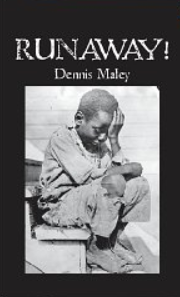
Runaway

Written by Dennis Maley

Runaway,pic

This work of historical fiction which stretches nearly two hundred pages is a fascinating study of white and black characters struggling with each other not in the North and South but in the new western territories caught in the battle between slave and free. Maley’s protagonist is a fourteen year old black boy named Blanche Bruce who begins life as a slave in Virginia, but later struggles to assert his independence in Missouri after his current master’s death. Here he is owned by a printer who relies on him to set type for his newspaper. Bruce had secretly learned to read and write as a young boy. The author admits that Blanche is a composite character, but his thoughts and actions are very believable as the intricate plot unfolds.

Bruce will take a journey along the Underground Railroad, while he is pursued by the pro-slavery forces he left behind in Missouri. They consist of an unlikely alliance of preachers, lawmen, politicians and citizens. Butler reveals himself as a clever young man struggling to differentiate between exactly who are his friends and enemies. The pro-slavers found opposition in the abolitionists and free soil settlers who hoped to make the new territories a land of new opportunity. There are lots of twists and turns in the plot as Blanche struggles to find a safe haven. At the end of the tale, which has a surprise ending, the author provides an epilogue illuminating what facts are real and which are fiction. This section is instrumental in understanding the plot; the reader might wish she had it earlier as sometimes the story line becomes complicated to follow.

I still recommend the book as an interesting one appropriate for adults and children age twelve and older. It presents a good psychological study of the pre-civil war era that is a lot less widely known and understood. Students of mid-nineteenth history can use it as a vehicle for examining the personal, moral and political conflict occurring in America’s new territories at that time.

If you enjoyed reading this post, please subscribe by clicking on the word Follow or by clicking on the RSS feed button in the upper right hand corner of the page.

FINDING ONE’S WAY


The Candle Star (Divided Decade Trilogy)

Written by Michelle Isenhoff

TheCandleStarpic

This is the first book in a trilogy examining the Civil War through the Underground railroad setting in Michigan in 1858. In this first volume, the protagonist is fourteen year old Emily whose petulant personality and insolent behavior has resulted in her parents’ shipping her off to stay with an uncle in Michigan. Emily has never been off the Ella Wood plantation in the Carolinas. She presumes her life will be much the same, and her faithful slave Zeke tries to make her comfortable.

Things turn out very differently. Emily will not have a tutor, she will have to walk to a school, do chores in her Uncle Issac’s inn, and learn to deal with free slaves who are her equal. Emily rebels at once, she steals a neighbor’s horse, skips school, and treats the household members as if they were “her slaves.” Her uncle refuses to give in to her; he cringes when she befriends slave bounty hunters from Virginia as her equals. Emily is curious to find out what her uncle writes in a small book hidden in a secret compartment. But gradually she must learn to respect another way of thinking, her black friend Malachi makes her realize that her way of thinking may be jaded. He encourages her to pursue her dreams of painting and not to limit her goals to become a proper Southern plantation wife.

Isenhoff has done her research. She introduces characters based on real prototypes like Frederick Douglass and George deBaptiste. Her language is smooth and polished. Take the following excerpt: “Emily looked the boy over. He had skin the color of strong tea before the cream was added, and his eyes were as dark as the midnight sky.” The reader quickly assimilates himself into the character. Only complaint I have is that the story line sometimes seems to move too slowly, but it is certainly not predictable. There are many twists and turns and lots of surprises before Emily is ready to return home to her plantation. Changes are on the horizon for the country. Will Emily be successful in acclimating herself to a changed order? What will happen to her uncle and staff at the River Inn?

I would recommend this book to children and adults age ten and up. There are lots of issues that middle grade students are facing that are addressed in the book irrespective of the difference in time period. Any reader who enjoys history, character study and good writing will enjoy this book series. Classroom teachers and librarians should consider it a good resource to a study of the pre-Civil War period from a humanistic point of view.

If you enjoyed this post, please subscribe by clicking on the word Follow or by hitting the orange RSS Feed button in the upper right hand corner of this page.

POIGNANT AND POWERFUL

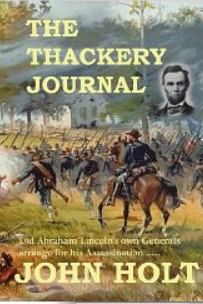
The Thackery Journal

Written by John Holt
TheThackeryJournal,pic

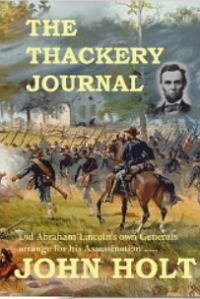
This well-written book of historical fiction is divided into three parts: the first part sets the stage for the personal tragedy the looming civil war will impose on friends and family; the second part begins in 1864 when the South is on the brink of defeat and engages in plot to buy weapons from the French government, and the third part delineates the intricate plot of Northern generals to carry out the assassination of President Abraham Lincoln using John Wilkes-Booth as their instrument. Holt informs the reader that only three of his characters are genuine, Grant, Lincoln and Booth. The reader will be hard pressed to believe that statement because Holt does such a good job of making all his characters realistic and seamlessly weaves them together with both the historical and the fictional.

At the outset the reader meets Aaron Thackery, an old man who sits before the fire in the remains of his Southern home reading the journal of his deceased son who has been implicated in some sort of plot. Thackery thinks back upon his own arrest and his wife’s death. After the flashbacks, the author shifts to the town of Larkspur in Virginia introducing us to Jacob Thackery and his friend, Miles Drew. When war is declared, Miles, who does not believe in slavery nor the fact that the South can win, flees to join the Union forces. He quarrels with his best friend Jacob, who will join the Confederacy. Their paths will cross again during the war.

In the second part of the book, the scene shifts to 1864. Jacob realizes that the South will lose, but he becomes involved with the plot of the Confederacy to buy weapons from the French government. When a Mexican agent finds out about the plot, he hatches a new plan to steal the gold needed from the Mexican government, which Thackery will be responsible for delivering to the French in Canada. After the weapons destined for the Confederacy are blown up, he must decided what to do with the gold.

The third part of the book is the crux of the plot. Holt creates a character named Jarvis who will enlist Lincoln’s most trusted generals in a plot to wrest power from him and replace him with Grant. The plan goes awry, so Booth is enlisted to carry out the plan. How will Miles and Jacob be involved and how will it affect the rest of their lives and the future of the new restored Union government?

Holt does a magnificent job of transporting the characters into the minds of the reader. His research is carefully done and the descriptions of battle, angst, and raw emotion are outstanding. I had to finish the entire book in one setting, and by the end of the read was totally convinced that the story was plausible.

As a historian, I liked the fact that Holt gave citations to his research to permit further exploration of the topics. The cover is a painting from the Battle of Antietam and the period photographs add another dimension of personality to the work. There is no graphic violence or sexuality so the book is suitable for young adults. This book sheds light on the psychological, historical and moral aspects of the American Civil War much better than any historical text and is highly recommended.

If you enjoyed this post, please subscribe by clicking on the word Follow or by hitting the orange RSS feed button in the upper right hand corner of this page.
A FAMILY DIVIDED

Hazardous Unions:Two Tales Of A Civil War Christmas

Written by Alison Bruce and Kat Flannery

HazardousUnions,pic

This book is an unusual combination that works well in this instance. Two different authors have teamed up to write two separate stories about twin sisters, Maggie and Matty, who find themselves separated by circumstance on opposite sides of the border during the Civil War. Due to their father’s death, these two sixteen year old sisters feel compelled to help support their mother and brother, whom they love dearly. The setting of both tales begins in the Fall of 1862. Both protagonists encounter physical and emotional trauma; both sisters succeed in rising to the occasion to assume control. They will each need to solve a mystery, navigate through romantic attachments, and survive the war.

In the first novella focusing on Maggie, we meet the twin who has traveled with her employer to a southern plantation in Tennessee. She is a servant girl employed by the Hamilton family. Soon the Union army comes to occupy the plantation; Maggie is the only person who has the strength of character to assume control. But the story does not so much revolve around the events of the war as much as the personal struggles of all the characters on both sides. It deals with their hopes and fears, racism, and family ties as well as the divide between the rich and poor. Maggie hopes to survive and someday be reunited with her own family.

The second story centers on Matty, a servant girl whose employer, General Worthington, has been sent to a fort in Illinois to train soldiers to fight for the Union. Her story rapidly switches to a mysterious piece of paper and Matty’s trickery to deceive a disabled bachelor named Colonel Cole Black into marrying her. The reader learns that she is remorseful for the deceit, but that she is determined that this letter and its information get into the right hands. This is the only way she could find to do so. There is danger for both of them now, and she fears that her solution might come about too late. Still, like her sister, Matty possesses a strong will and a determination to do the right thing, regardless of personal cost. The matter comes to a head at her father -in-law’s Christmas party resulting in lots of unexpected events and consequences.

The first of these stories about Maggie is more leisurely, filled with lots of well defined characters facing complex issues in treacherous times. Matty’s story is shorter; more intense with fewer characters, but a powerful, tighter knit plot. Even though the characters’ struggles and not the events of the Civil War are the focus of each story, the stories are well researched and documented in historical details. In less than one hundred fifty pages, the reader is treated to two tales of mystery, romance and historical fiction. I recommend this highly enjoyable work to young adults and adults who are interested in any of these genres.

If you enjoyed this post, please subscribe by clicking on the word Follow or by hitting the orange RSS feed button in the upper right hand corner of the page.

NEOLITHIC NIGHTMARES

Angel Bones (Angel Cats)

Written by Linda Deane

Angel Bones,pic

This is the second book in a series exploring the somewhat mystical and supernatural powers of cats. But make no mistake, this book is not a fantasy novel. It is set in the neolithic age on the island of Cyprus on which recent archaeological excavation has revealed, cats were present in the neolithic period, about six thousand years before their domestication in Egypt.

It is a short novella, yet the plot explores characters in depth and there are many twists and turns in the adventurous life of Melita, Yannis and their three children. They have been driven from their home on the mainland to flee in a makeshift boat in the dark of night due to the jealousy and superstition of their peers. A trader named Andros attempted to woo Melita and when she refused him, he spread rumors implicating her as a sorceress because of her gift in communicating with animals, especially the strange creatures later known as cats. He was also jealous of Melita’s husband, who was a gifted tool maker and pottery artisan. Their terror escalated until the family feared for their lives.

Eventually they land on an island only to find a strange people who had never seen cats. Over a period of time, the family earns the trust and respect of the village. However, as they settle into a peaceful existence, trouble looms on the horizon once more as a hunting party from the mainland arrives to stir up trouble in the tranquil settlement. Melita and her daughter called Eleni will have to summon all their strength and powerful connections with Tammy, their cat, in a desperate effort to survive and save the community.

The author develops the characters well; the reader quickly identifies with the personalities of each and the conflicts each must face, whether they be good or evil in intent. There are many twists and turns in this short read. One senses the overwhelming hardships and difficulties early humans faced in their daily existence in the face of the powerful forces of nature and the brute force of a “might makes right” philosophy. Tweens, teens and adults will all enjoy this carefully researched historical fiction story with just a tinge of the supernatural. I am looking forward to more in the series.

WISHFUL THINKING

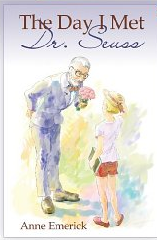
The Day I Met Dr. Seuss

Written by Anne Emerick

The Day I Met Dr. Seuss pic

Most readers do not find themselves standing on middle ground when it comes to the work of Dr. Seuss; they either love it or hate it. This work of historical fiction is based on the author’s real experience in attempting to visit Dr. Seuss (Theodor Seuss Geisel). In 1989, she wrote him a letter requesting an interview. His secretary politely declined. Emerick persisted  in her admiration for the author by writing an imaginary tale reminiscent of Geisel’s work.. She mailed him the manuscript in 1990 to ask if he objected to it. Geisel gave her permission to publish it.

In her story Emerick makes a long journey to the home of Dr. Seuss. She meets Mister Hupp who tells her that Ted is quite normal, but no one understands the thoughts in his head. The author is determined to see Dr. Seuss and continues to wait outside. She keeps knocking at the door, but no one will let her in. Then she converses with an old man who informs her that Dr. Seuss might be in. Soon after he ushers her inside the house. He shows her the author’s workroom and says that when he is really stuck he tries on one of his thinking caps because writers must imagine worlds. “When people work hard at what they do best, we often think of them as unlike the rest. But they aren’t really different than others you meet, just every day people who accomplished some feat.”

I think that this quote exemplifies Emerick’s experience. Like Theodor Geisel she worked long and hard to make her book successful. Publishers rejected this work until she decided to publish it on her own recently. Many writers find themselves in her position. Emerick includes copies of the original letters that she wrote to Geisel though she places the setting of this story a few years earlier in 1985. She includes authentic characters like his neighbor, Burt Hupp, and secretary, Claudia Prescott. While Ermerick’s verse is sometimes a bit off in cadence, it is written well and cleverly.

Who is the real Dr. Seuss? An answer may be found in his own words about the way children perceived him. “When I show up, they look at me and say, “ What are you doing here? Where’s Dr. Seuss?” The children expect him to be just like one of his characters.  My conclusion is that Dr. Seuss is all of us; he exists in everything that we can imagine. Children and adults who are fans of Dr. Seuss will thoroughly enjoy this book as a fitting tribute to the author who passed away in 1991 but lives on in the hearts and minds of millions of readers.

If you enjoyed this post, please subscribe by hitting Follow or the orange RSS feed button in the upper right hand corner.

DIFFICULT DECISIONS

Widow of Gettysburg:Heroines behind the Lines Series

Written by Jocelyn Green

widowofgettysburgpic

This is the second book in the heroines behind the lines series. The characters are well developed; you will feel their emotions and the enormous difficulty grappling with the decisions that they were forced to make. Plot lines are mostly well developed; there are many twists and turns that will surprise you. One commonality all the characters face is that they were placed in situations under which they had no control forcing them to make immediate choices and sacrifices. It can be argued that some handled them better than others, but all of them were victims of circumstances they could not control. Historical details are carefully researched and annotated in the bibliography. The book is based on the diaries and writings left behind by women who lived in Gettysburg though the characters are fictional.

The story opens at the end of June, 1863 shortly before the Battle of Gettysburg begins in this quiet town with approximately 2400 residents. Many fled as the troops advanced. Those left behind were mostly women and children. We meet the protagonist Liberty Holloway who is a young nineteen year old widow whose husband died in the Battle of Bull Run two years earlier. Libby is left to run the farm and large house. She has help from Bella Jamison, a freed mulatto slave., who proves to be a true friend in time of need. Liberty never knew her mother; she was raised by a mean aunt who told her that she was an unwanted child.

One day, a stranger who calls himself Johnny, though his real name is Silas Ford, knocks on Liberty’s door asking for something to eat. She knows the soldiers are coming soon. There is something so familiar about him. She will find out that he has a dark secret. Johnny encourages her to stop mourning and start living again. For some strange reason, she feels compelled to listen. While the rest of the town is appalled, she resists them. Her mother in law, Amelia Sanger, arrives with her husband’s body to bury him in the town cemetery next to her  son.. Liberty does not want her to stay, but Amelia insists that she will invest money to help fulfill Liberty’s dream to open a guest house.

Then tragedy strikes. First Confederates overrun the town. Blacks are forced back into slavery. Bella and her friends must hide. Harrison Ford, a reporter, arrives to report on the battle as well as the happenings behind the scenes. He thinks that he recognizes Bella, and suspects that she is hiding something. During the three day battle, the lives of  Gettysburg residents are changed forever. More than 163,000 soldiers and 15,000 animals virtually destroy everything in site. A Confederate doctor seizes Liberty’s home. She makes the decision to stay and becomes a nurse to more than 500 seriously wounded enemy soldiers. Harrison Ford and Bella Jamison find their way back to the Holloway farm as well as Silas and Amelia, but they have experienced turmoil in their personal lives.  Liberty’s property is in shambles. The many twists and turns in the lives of the characters are almost as compelling as the horror and mutilation of the battle.

This is an adult novel, but there is no overt sex or profanity so it would be a valuable resource to young adult students studying the Civil War period and the moral conflict and aftermath engendered by the slavery issue. The writing is well done though a few of the minor characters like Myrtle Henderson are not fully developed. This novel is not one for the faint hearted. You will become fully immersed in the lives of those trapped in the war between brothers.