Posts tagged ‘culture’

PINT-SIZED MYTHOLOGY

Greek Mythology: The complete guide to Greek Mythology, Ancient Greece, Greek Gods, Zeus, Hercules, Titans, and more!

Written by Nick Plesiotis

GreekMythology,pic

That title is quite a mouthful! This kindle book will give the reader a bird’s eye view of Greek mythology, its history, and a few examples. Greek myths have been around since approximately 900 B.C. They played an extraordinary role in the growth of politics, religion, and social life of the ancient world. Much of our modern day literature reflects their influence.

The author divides the Greek mythological world into three periods: the age of the Gods, the age of Gods and Mortals, and the Age of Heroes. He explains the ancient Greek religion and gives a brief summary of the gods and their equivalents in later Roman mythology. Then Plesiotis goes into detail about some of the more popular heroes like Hercules and the twelve labors he was forced to perform. One chapter explores the Trojan War and the famous Trojan horse ploy used to defeat the Spartans. Prometheus is a Titan who was particularly close to mankind. The author describes how this Titan bestowed the gifts of fire, husbandry, and metalwork upon man.

This twenty some odd page digital book is my no means a definitive guide, but is a great reference for a middle grade school report or introduction to further exploration of Greek and Roman mythology. It would have benefited from a few illustrations to accompany the stories, but I would still recommend this book as a well-written clear reference guide for children and adults age eight and up who have an interest in the subject.

If you enjoyed reading this post, please subscribe by clicking on the word Follow or by hitting the orange RSS FEED button in the right hand corner of this page.

SITTING ROUND THE CAMPFIRE

HAPPY FATHER’S DAY TO ALL THE DADS OUT THERE….This one is dedicated to my dad, who loved to tell stories.

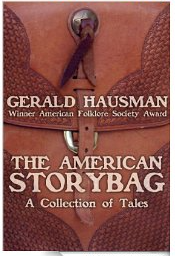
The American StoryBag: A Collection of Tales

Written by Gerald Hausman

Americanstorybag,pc

This author has been collecting stories since 1965. He loved to listen to stories which he scribbled down and later retold on paper. These tales focus on every aspect of American life. As I was reading them, I had the distinct feeling that I was sitting around a campfire listening to a storytelling master. Hausman has won numerous awards for his yarns, which speak of ghosts, demons, fantasy, humor, truths, and everyday life.

The author divides his tales into sections like Heroes, On the Road, Humor, Reflections, Out of this World, Moments of Truth, and Yarns. He has been compared to Mark Twain. The reader feels as if he is there in the story. Some stories will inspire you like the tale about an autistic child who survived a struggle in the swamp, some of them portray the legends of Native Americans as in The Horse of the Navajo or the bravery of a father and son in A Real Life Goliath.

The Discussion Questions that Hausman suggests are a wonderful beginning for students or book groups to use as a jumping off point for further exploration of the subject matter in individual stories. These questions could also be the basis of interesting essays on many topics. Teachers might want to use them in connection with other curriculum areas. The questions also assist in understanding the deeper layers of culture surrounding them. Finally, the author interview included at the end of the collection provides insight into why the author is so successful as a storyteller, lecturer and writer.

Recommended for readers age eight and older, all those who love to tell stories or listen to them!

JOURNEYING THROUGH ALASKA’S HISTORY

NRCFAUNTPHILSTRUNKSERIESLC

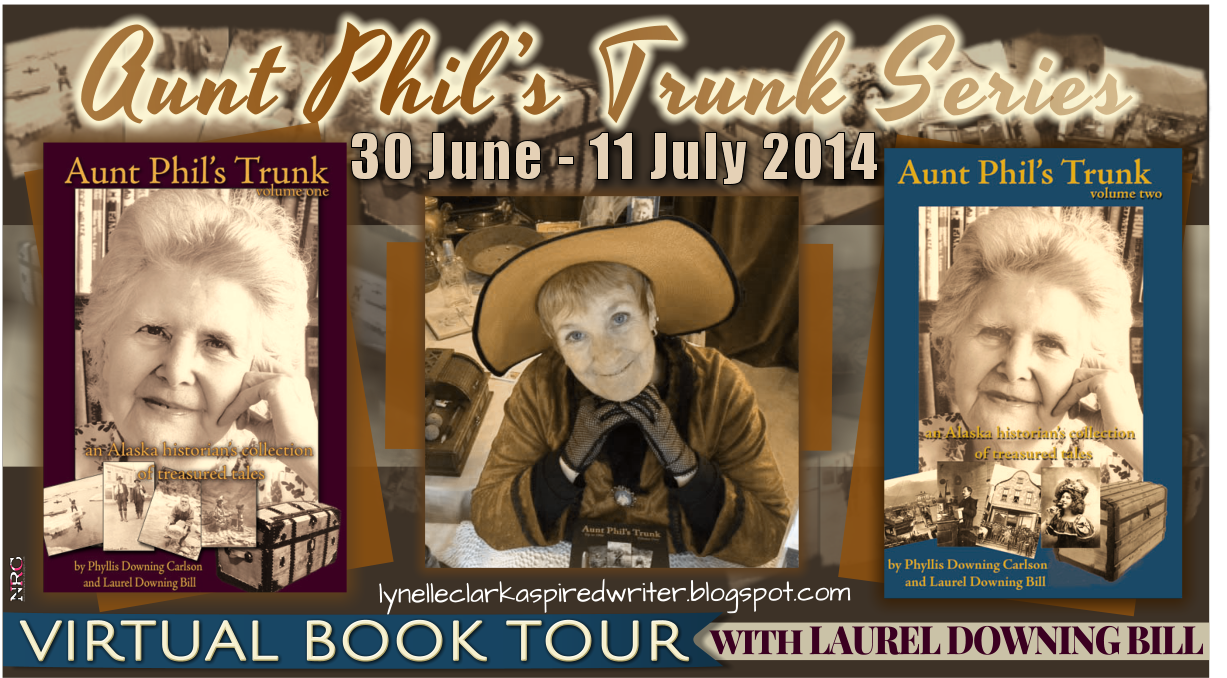
Aunt Phil’s Trunk: Volume One

Written by Laurel Downing Bill

Vol 1 Cover Aunt Phil

This first book in this series like all the others are based on the writings and research of the author’s aunt, Phyllis Downing Carlson. In the first volume, the reader is treated to thousands of years of Alaska’s history from the time the first humans crossed the Bering Sea land bridge to the Klondike Gold Rush in the nineteenth century. The photograph of a mastodon graveyard is most impressive. Readers learn how the native Eskimos coped with the unknown with the magic of their shamans and the legends of the gods. An influx of Russian fur traders changed Native life forever. They brought illness and destruction to their hunting grounds and forests. Eventually Natives adapted by becoming guides for the newcomers exploration of the seas and the mining operations that later followed.

One of the short stories relates how the last gun shot of the American Civil War was fired from the Confederate ship Shenandoah off the coast of Alaska in June, 1865, two months after the war actually ended. These ships fired on whalers near St. Lawrence Island. The Shenandoah had previously captured thirty-eight Yankee warships. Not willing to surrender to Union authorities in the States, the Shenandoah sailed to England to surrender that November.

Bill traces the history of opposition to William Seward’s purchase of Alaska for the United States and the change of opinion once gold was discovered. Several stories detail singular individuals in Alaska’ s history. Readers learn about Captain James Cook, the explorer, Bishop William Carpenter Bompas, the missionary, Ivan Petroff, the census taker, and Old John Bonner’s murder mystery. One of Alaska’s most educated early citizens was George Washington Carmack who wrote beautiful poetry. Not only do the short stories cover all these areas, but the photographs, maps and drawings provide a feast for the eyes!

Aunt Phil’s Trunk: Volume Two

Written by Laurel Downing Bill

Vol 2 Cover Aunt Phil

Volume Two portrays the history of Alaska for a much shorter period, the end of the nineteenth century through the year 1912. Nevertheless, it packs quite a punch with more than 350 photographs and a saga of interesting characters and developments.

The Klondike Gold Rush brought the ongoing boundary dispute with Canada to a head. Stampeders from Canada walked freely across the border in an attempt to make their fortunes. Crime and robberies became rampart. Miners sometimes took justice into their own hands. One criminal was named “The Blue Parker Bandit.” A small group sailed from Seattle to steal one of the native totem poles for its city. Reportedly, Wyatt Earp and John Clum fled from Arizona to Alaska after the demise of Tombstone.

But as more settlers flooded the area and stayed, order needed to be restored. Leroy Napoleon McQuesten set up supply stations in the wilderness. Clum often traveled by mule and set up Post Offices. Frank Canton set up a court and became the first law officer. As towns sprung up and the area became more stable, the people demanded entertainment and culture. The Black Prince Boxer was listed as a popular attraction. The Monte Carlo Theater came to the town of Dawson. Poet Robert Service wrote his poem “The Call of the Wild.” Estace Ziegler painted scenes of Alaska’s rugged landscapes. The Iditarod trail was blazed;soon railroads and schools followed. Prosperity reigned until suddenly the Katmai Crater Volcano eruption created such a wasteland in 1912 that President Woodrow Wilson called it the largest national monument in the United States. As with volume one, these people and events are richly documented with photographs and drawings. Lots of changes were on the horizon which will be explored in volume three.

These books are highly recommended for anyone with an interest in Alaskan history, geography, and culture. Children age nine and above should be able to handle reading the text independently. All the volumes are a wonderful addition to the bookshelves of teachers, librarians, historians and the the general reader. Well-written comprehensive portrait of America’s forty-ninth state,
Laurel Bill headshot

Contact: Laurel Downing Bill

Email: auntphilstrunk@gmail.com

Website: http://www.AuntPhilsTrunk.com

Facebook: http://www.Facebook.com/LaurelBillAuthor

Twitter: http://www.Twitter.com/LaurelBill

Google +: http://www.plus.Google.com/LaurelBill

YouTube: https://www.youtube.com/channel/UCmh0wCifvbXYsVg5IkawkyQ


Aunt Phil’s Trunk volumes 1 through 4 are available through http://www.AuntPhilsTrunk.com and Amazon.com.

Volume 1: http://j.mp/SSiIKX

Volume 2: http://j.mp/SSiOT1

WORLD-WIDE TOUR

50 Places To See Before You Die:A List of the Earth’s Most Beautiful, Captivating, & Eye-Capturing Wonders of the World

Written by Matt Morris

50placestosee,pic

This book is by no means a tour guide, but rather a compilation of the author’s suggestions as to some of the most interesting places the Earth has to offer. Children and adults who are interested in geography, culture, history, archeology or nature will all find something of interest in this book. Morris organizes the book by continents. He then chooses some very well known sites as well as some that are obscure. Unfortunately, there are no pictures, but the author offers a link to investigate pictures of those sites that most interest the reader. This work is a great reference book and a good place to look for interesting ideas and places to explore.

I will give a few examples to whet your appetite. On the continent of Asia, one of the largest wonders is The Great Wall of China. The two thousand year old wall served as military protection as well as a means of transportation of trade known as the Silk Wall. I had never heard of Panjin Red Beach which is covered with thousands of red sea weeds and is a home to hundreds of species of animals and birds. In Europe, you can visit the popular tourist sites like the Eiffel Tower in Paris, the Leaning Tower of Pisa or the ruins in Athens. Then there is the little known Sedlec Ossuary or Bone Chapel in the Czech Republic which is made of forty to seventy thousand sets of human bones or the Ice Hotel in Sweden which is built from ice harvested from the Torne River and reconstructed every year between December and April. In North America millions of tourists have visited the Grand Canyon and Disney World, but fewer have traveled to Antelope Canyon opened in 1997. South America s noted for the ruins of Machu Picchu and Angel Falls, but not many have visited the Enchanted Well or The Swing at the End of the World. In Oceania tourists visit the Sydney Opera House and the Great Barrier Reef, but fewer numbers venture to the Glow Worm Beach. The continent of Africa offers the Pyramids of Giza, Victoria Falls and Table Mountain.

For those not satisfied with keeping their feet firmly planted on the ground, The Virgin Galactic is a space craft offering suborbital travel for the price of $250,000. Whatever your time or budget, this guide will allow you to be an armchair traveler to some of the most interesting sites on the planet!

If you enjoyed reading this post, please subscribe by clicking on the word Follow or by hitting the orange RSS Feed button in the upper right hand corner of this page.


JAMAICAN ADVENTURES

Essie’s Kids and The Rolling Calf -3:Island Style Ghost Story

Written by Dr. & Mrs. Luke Brown

Essie'sKids3pic

I came across this e book as a promotion. I had not read the first two books in the planned five book series. This third short story is a strange combination of Jamaican folklore, adventures, and moral lessons that pleasantly surprised me. It makes a good addition to a classroom multicultural library. The book is well written with lots of colorful verbs, analogies and descriptive language though I did find one typo in which the word joint was used for the verb join. A smattering of Jamaican lingo like the word, “mon” also provides an authentic touch.

At the outset, the reader meets Karl who is tossing in his bed because he is haunted by the memory of the dreadful beast known as a rolling calf , a large swift running creature with dragon like eyes who voices terrifying sounds. Karl has met this creature in previous stories and now is anxiously awaiting to confront him once and for all. When he finally succumbs to sleep, he dreams that he is tiptoeing down the ghost-like streets at night. Suddenly, his brother Leonard shakes him; Karl realizes it is all a nightmare.

Karl’s family has journeyed from the city of Montego Bay to their country home in Clear Mont for the summer. His sisters, Myrtle, Geena and Betty play hopscotch and jump rope, while the boys play tag in the front yard. The author contrasts nicely the differences between the “city” and “country” folks. The country children wear plain clothes and no shoes. City kids are teased for being cowardly and not willing to get dirty. In the end, both learn to give and take and respect each others skills and differences.

Junior’s best friend here is named Ben. He encourages Junior to come to the river and fish. Junior realizes his mother will probably say no, so he hesitantly decides to slip away without asking permission. Ben meets up with his friends, Johnny, Dave and Jasper, who he calls “bad company” because they always manage to get him in trouble. The girls, on the other hand, get their mother’s permission to go to the river and enjoy their day without worries.

Karl had not been himself since the nightmare. He sat by himself most of the day. Karl continued to believe that this strange beast had a message for him. Then he decides to go to the river by himself. As night is about to fall, he sees a bolt of lightning flash before him and feels the swaying of the ground beneath him. Will Karl find his way home? Does he succeed in his quest to confront the beast?

The story abruptly shifts back home to the children listening to their mom, Essie, relating one of her nightly stories. She talks of two men locked in a prison cell. The innocent prisoner sees the possibility of being set free someday even though he has no money to defend himself, but the other guilty prisoner is unhappy and mean. Essie’s lesson is that the mean prisoner continued to see only bad things, but the innocent prisoner continued to see promise and beauty outside his window. Before sending the children to bed, they are reminded to look for the good in every situation.

Boys and girls age seven and up will each find elements in the story to their liking. Adults will enjoy the clever interweaving of sound moral lessons intertwined with the charming setting and folklore of Jamaica and the familiar antics of children everywhere.

If you enjoyed this post, please subscribe by clicking on the word Follow or by hitting the orange RSS feed button in the upper right hand corner of this post.

FRIENDS OR FOES

The Jade Dragon

Written by Carolyn Marsden and Virginia Shin-Mui Loh

theJadeDragonpic

This is the story of two second grade Chinese girls struggling to find their identity. Ginny was born in America and is being raised by Chinese parents who follow traditional customs and live out their Chinese culture. Stephanie, on the other hand, was born in China and has been adopted by white, Anglo-Saxon parents and does everything possible to avoid anything that associates her with being Chinese.

When Ginny arrives at school for the new year, she is delighted to find that this year there is another Chinese girl in her all white school. Stephanie tries to avoid her because she does not like being “different.” Ginny tries her best to make friends and finally succeeds because Stephanie’s mother would like her daughter to be exposed to her Chinese culture. When Stephanie visits Ginny, her mother is insulted because Stephanie won’t even try to eat Chinese food. Stephanie wants to play with blonde haired dolls and American toys. She makes fun of Ginny for wearing a traditional Chinese dress, and makes Ginny feel bad that her mother refuses to allow her to wear a party dress like that of Stephanie. As the girls get to know each other better, they exchange secrets. Ginny admits that she does not always like eating Chinese food, learning Chinese calligraphy and eating traditional Chinese foods. Stephanie admits that sometimes she wishes that she were not adopted and that she lived in China so that her parents would look like her. It is so hard to deal with the stares of people who see her walking with her American parents. The two girls trade gifts. Ginny is terrified that her mother will discover she has given her jade good luck dragon to Stephanie. At one point the girls become so close that they wear matching friendship necklaces, but that friendship is threatened when Stephanie becomes jealous of Ginny’s new talents learned in Chinese school. Will these two girls who seem to have so much in common find a common bond to develop and nurture their friendship?

This story is set in the 1980’s which does make some of the variables a bit different. I do believe the conflicts and struggles do present many similar challenges in the twenty first century, even though the times present us with more diversification in schools and communities. The story still speaks to immigrant and adopted children who are coping with similar situations. Targeted reading audience is age seven through ten. The one hundred sixty page book might present an independent reading challenge for children at the lower end of that range even though it is written fairly well and the vocabulary is generally not too difficult. Dialogue seems appropriate and flows well. There is a glossary with Chinese language expressions at the end for interested readers. This book will make a great addition to elementary classroom multicultural libraries.

If you enjoyed this post, please subscribe by clicking on the word Follow or by hitting the orange RSS feed button in the upper right hand corner of this page.

AFRICAN ADVENTURES

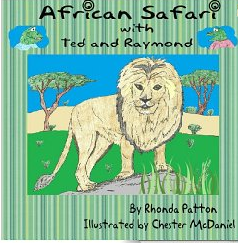
African Safari with Ted and Raymond

By: Rhonda Patton

Illustrated by Chester McDaniel

African Safaripic

For those who are not familiar with the series, Ted and Raymond are two frog friends who share many adventures. In this latest book, which I read in Kindle version, the friends are about to embark on an African safari. They create a list and pack supplies; Ted makes sure to include a safety kit! They find their way to the airport, pass security, and board the plane where a map is shown to indicate Africa’s location. The reader is introduced to African culture by pictures and explanations of African dress and musical instruments. An African frog named Adebayo, which means “born in a joyful time” is to be their guide. Their jeep passes native Umbrella Thorn trees as they make their way to camp. But the friends are surprised that they will be sleeping in tents outside! They meet other tourists and natives and are introduced to native foods like steamed green bananas and flax bread. The next day they board the jeep and see native animals like the Kingfisher, flamingos, lions and zebras. After observing dozens more animals and taking lots of pictures, Ted and Raymond are sad that their safari is coming to a close. Our two frog friends promise that there will be many more adventures with new friends.

I enjoyed the way the author introduced a wealth of information about the culture, animals, food and customs of Africa. The whole travel experience was portrayed realistically from the preparation and packing to the landing and tour itself. Ted and Raymond are drawn as very stylized characters, but the images in the latter part of the book are good representations of the actual animals. Children are given a few facts about each of them. Hopefully they will be enticed to do more research and exploring on their own. Teachers may want to use this book as a read aloud introduction to a science unit on animals or as an opportunity to study African culture. Parents can employ the book as an introduction to what will happen when the family travels by air. I believe that this book is an excellent addition to the Ted and Raymond series of adventures.