Posts from the ‘Uncategorized’ Category

THE FIRST SUPERPOWER

The Great Voyages of Zheng He

Written and illustrated by Demi
TheGreatVoyagesofZhengMapic


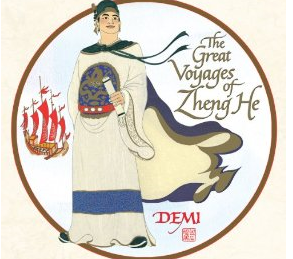
Ma Ze was born in 1371. Ma was born into a Muslim family whose ancestors came from Persia and fought with the Mongols and Genghis Khan. Ma’s father was  a general who told his son of his pilgrimage to Mecca and his military battles. But he was killed in battle when Ma was only ten so Ma was taken to be raised in the imperial palace. Ma was a brilliant scholar who appeared to be skilled at everything he tried to do. Like his father, Ma enjoyed adventure, but he especially loved the sea. When Prince Zhu Di became emperor in 1402, he spread his empire and the power of the Ming Dynasty. He expanded the borders of the Forbidden City of Beijing and strengthened the Great Wall against his enemies. He built a large army and made Ma, who was now known as Zheng Ma,  Admiral of the Navy. One year later Ma had built 525 ships, ten times the number of ships that Portuguese explorer Vasco da Gama possessed, and a navy consisting of more than 30,000 sailors.

Zheng Ma set sail with a new more accurate compass, better maps and a good knowledge of astronomy. He journeyed south to Java and Sumatra reaching out to the people with a policy of peace and religious tolerance. Ma destroyed the Cantonese pirate fleet let by Chen Zuyi which resulted in free trade. Eventually thirty foreign  states would  pay tribute and acknowledge the supremacy of China. Emperor Zhu was so pleased that he ordered another voyage in 1407. When Ma found civil war between the Muslims and Buddhists, he proclaimed religious freedom for all. This was unheard of in the time of the Inquisition and Crusades. Subsequent voyages added precious metals, porcelain and more exotic animals to China as a result of forays into the Arabian peninsula and Africa. In 1417 there were so many exotic animals that the emperor built the first zoo to house them all. He was especially fond of his pet giraffe. By 1421 China could rightly be called the first world superpower. Unfortunately, later near the end of that year, lightning struck three imperial buildings creating a conflagration that killed thousands of people. Then a drought caused a grain shortage. When Zhu Gaozhi ascended the throne, he retreated within his borders and ended outside exploration. Ma was relieved of his duties, the ships rotted, and the navy disbanded.

Later in 1425 Zhu Zhangji came into power. He wanted to reestablish trade. In 1431 Ma was again put in charge of the fleet. This was the largest of all voyages. Ma made it a successful peacekeeping mission, but he died suddenly at the age of 62. No man could replace the knowledge and vision of Zheng Ma.  He envisioned a world of peace, intellectual growth, and religious tolerance in a time of war, ignorance and religious strife.

The book is beautifully illustrated by the award winning artist Demi. Adults and children eight and over will appreciate the adventure story and learning about a part of Chinese history and culture that is not widely known. This is a well written, informative and fascinating book for parents and teachers to add to their collection.


PINT SIZED PEACEMAKERS

Peace in My World

By: Syeda Mleeha Shah

Peaceinmyworldpic

This book is dedicated to all displaced children in refugee and survival camps waiting for peace. The author pays tribute to every child for making our world beautiful by being a part of it.

Multicultural children are dressed in native costumes and placed in different scenarios. They are seen in farm scenes with barns, roosters and sunflowers, playing on the ice with penguins and singing in the rain while the wind chimes blow. The images coincide with symbols of peace like the dove and moods of tranquility like a little girl sitting on the grass while fish swim in the pond beside her. In the valleys and mountains trees stand tall, the sun shines brightly, and birds fly over the rainbow.

The text is written in simple verse. The same two lines are repeated on the pages. “This is a place where I want to go. I am in peace from head to toe.” A simple message that adults find  so difficult to accept. In the second part of the book Shah spells out the word  PEACE  assigning special significance to each letter.


P stands for people of the world

E stands for empathy they feel for one another

A stands for accepting others differences

C stands for cooperating and working in harmony

E  stands for the extra mile needed to reach out to those in need


In the final part of the book, the author selects five countries from various parts of the world: Pakistan, Egypt, America, China and Ethiopia. For each of these she presents the flag, names the capitol, its language and the word for peace. There is a rather abrupt shift from the ideal world to the real world. My only criticism is that no reason is given for choosing these five countries and there is no tie in to the rest of the story. Nevertheless, this book is truly worthwhile for teaching even very young children the value of using diversity as a unifying force and letting our strengths bind us together rather than tear us apart.


AFRICAN ADVENTURES

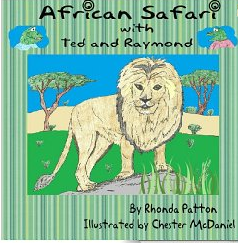
African Safari with Ted and Raymond

By: Rhonda Patton

Illustrated by Chester McDaniel

African Safaripic

For those who are not familiar with the series, Ted and Raymond are two frog friends who share many adventures. In this latest book, which I read in Kindle version, the friends are about to embark on an African safari. They create a list and pack supplies; Ted makes sure to include a safety kit! They find their way to the airport, pass security, and board the plane where a map is shown to indicate Africa’s location. The reader is introduced to African culture by pictures and explanations of African dress and musical instruments. An African frog named Adebayo, which means “born in a joyful time” is to be their guide. Their jeep passes native Umbrella Thorn trees as they make their way to camp. But the friends are surprised that they will be sleeping in tents outside! They meet other tourists and natives and are introduced to native foods like steamed green bananas and flax bread. The next day they board the jeep and see native animals like the Kingfisher, flamingos, lions and zebras. After observing dozens more animals and taking lots of pictures, Ted and Raymond are sad that their safari is coming to a close. Our two frog friends promise that there will be many more adventures with new friends.

I enjoyed the way the author introduced a wealth of information about the culture, animals, food and customs of Africa. The whole travel experience was portrayed realistically from the preparation and packing to the landing and tour itself. Ted and Raymond are drawn as very stylized characters, but the images in the latter part of the book are good representations of the actual animals. Children are given a few facts about each of them. Hopefully they will be enticed to do more research and exploring on their own. Teachers may want to use this book as a read aloud introduction to a science unit on animals or as an opportunity to study African culture. Parents can employ the book as an introduction to what will happen when the family travels by air. I believe that this book is an excellent addition to the Ted and Raymond series of adventures.

THE PAMPERED PET

Errol Come Home

By: Harvey Rooster

ErrolComeHomepic

Harvey Rooster is a pseudonym for a crime writer, who has taken time to foray into the world of children’s books. Errol Come Home is the first in a new series featuring Errol the Cat. At the beginning of the tale, we are introduced to Errol who is a sleek, black cat with green eyes the color of emeralds. He lives a magnificent life as he is adored by the couple who own him. Errol was born on a farm, but one day his fortunes changed when he was adopted by a man and wife who gave him meals with gravy, milk and his favorite, tuna. The only bad times happened when he had to go to the vet or his owners vacationed. Then he was put in a cage and placed in the “box on wheels” Soon he was home again snuggling up with his owners on the couch, and those bad times were easily forgotten,

One day something strange happened. He returned home to find two children with small hands who promptly yanked his tail. Errol yelped, stuck out his claws and ran. He had cut his master’s arm. So he spent the next few days outside hoping that those little hands would go away and that his masters would forgive him. After a few days Errol decided he could no longer bear to be away. So he jumped on the settee. But the little one was sitting there and he scratched her leg. Errol’s master threw him into the air and out the door. The next day, Errol was still despondent and very hungry! He heard his master and two little ones calling his name, but he thought it might be a trap. So when a kitten crept through the neighbor’s door, Errol decided to follow. He found a lady with red fingernails who caressed him gently. What will Errol decide to do? Should he stay at his new home or take a chance with his former masters? How will those little ones treat him? So many choices…Errol will need to make up his mind.

This story is very well written; it flows nicely. The book makes a wonderful read aloud for younger children. Jacoba Dorothy does a good job of illustrating and the paw prints on the pages are a nice touch. Children older than six may attempt to read the story independently, but vocabulary words like monotony and confronted will need adult explanation. I am looking forward to Errol’s Christmas and Errol’s Tuna Mystery, the next books in the series.


WEIRD AND WONDERFUL

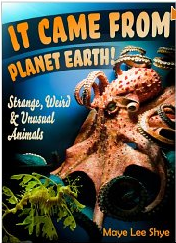
Weird Animals: It Came From Planet Earth! Strange, Weird and Unusual Animals

By: Maya Lee Shye

 Weird Animals

This book is a fascinating study of the habitat and behavior of strange animals living on land, in the sea and up in the air on planet earth. Also unusual is its appeal to all ages from younger children through adults. The author describes more than thirty animals and provides a photograph of each. Some of these have been on earth for millions of years. That’s right, the Coelacanth is the oldest jawed fish still alive on our planet. This fish with eight hollow spine fins covered by tough scales acting like a coat of armor can grow up the six feet long and existed on earth 410 million years ago! The Tuatara is the last reptile that lived on earth as a contemporary of the dinosaurs 225 million years ago. They still exist on remote islands in the Pacific Ocean and some wildlife sanctuaries. The Tarsiers are primates with huge eyes that leap from tree to tree. They are carnivores who are probably the ancestors of two legged primates. The slow loris is a primitive monkey with a very large round head and eyes. Their arms and legs are of equal size. This southeastern Asia native also bites with a poisonous venom lethal to many humans.

Many animals have evolved with adaptations needed for their environment. There is an African Penguin native to the warm coast of Africa. These animals burrow in the ground to keep cool. Glands above the eyes high on their heads help them cool their bodies. The North Island Brown Kiwi is a bird that does not fly because its wings are tiny. The animal is the size of a chicken. Like a dog the kiwi bird uses its nose to find food. These animals live in underground burrows. The male sits on eggs in the nest, while the female goes out to hunt for food. Their eggs are the largest known bird eggs. New Zealand has adopted this bird as their national symbol. Giant Tortoises living in the Galapagos Islands can weigh up to 600 pounds so their bodies have been adapted to move slowly and burn few calories. In fact, they can go as long as one year without eating or drinking anything!

There are many animals with adaptations that make them look strange. The Glass Frog  lives in Venezuela and central America. Its body is translucent so that it is totally invisible to predators. The Shoebill is a bird that lives in the swamps of east Africa. It is related to the stork, but its bill looks like a giant shoe. This cartoon like character spends most of its time standing silently along the water, but can fly at low altitude. When it does fly, it usually flies in a group that chatters. Archaeologists have found drawings of this bird in ancient Egyptian art. The Okapi is a forest giraffe that has black and white legs like a zebra. Its tongue is so long that it can wash its ears! One animal may someday help us find a cure for cancer. The Naked Mole Rat lives in tunnels on the desert coast of East Africa. This animal uses little oxygen and has no hair. It does not feel pain and appears to be resistant to cancer. Its life span is longer than any other mammal of comparable size. Another oddity is that these animals are eusocial like bees. One female is designated queen; all the other rats will work to sustain the colony.

More than thirty animals are discussed in this book. The work may serve as a springboard for analysis, discussion, comparison and evaluation of topics in  life science, geography, evolution and environment. I recommend it as a valuable learning reference tool for adults and children of all ages.

AN UNFAMILIAR CULTURE

EskmosandIntuitpicHistory for Kids: The Eskimos And The Inuit

By: Charles River Editions

This is another excellent selection in the Charles River Editions providing comprehensive knowledge in a concise and enjoyable format. Most of us use the terms Eskimo to uniformly refer to the people who live in the harshest climates of Canada, America, Russia and Greenland, but many of them are Inuit. They are descendants of the travelers who crossed the land bridge that once connected Russia and Alaska. The editors use the term Eskimo to simplify. The Eskimos are associated with igloos, sleds, seals and dogs. This book briefly covers their origin, their history and legacy.

The word Eskimo translates to “eaters of raw meat.” Historical records prove that they traded with the Vikings in the 1100’s. By the 1500’s Europeans traded with the Eskimos living in the Arctic parts of America. In the 1800’s they traded the furs from the animals they hunted with the Europeans. But those same Europeans brought many diseases which reduced the Eskimo population. As late as the 1950’s many Eskimos continued to move from place to place, surviving by fishing and hunting and trading for things they could not make from animal bones like needles and wood. Utensils and plates were made from the bones of animals and clothing from seal and caribou. The Eskimos traveled by sled over the frozen ice and in warmer weather used boats made of caribou skin stretched over a wood frame. Some Eskimos lived in igloos during the winter but more often lived in small homes made of sod or tents made from animal skins. They lived in small family units with no formal government. Their family law was called maligait. Each member of the community was asked to think of others before himself. Each family felt it their responsibility to take care of members of the community and would be punished severely if they did not. Eskimos believe that people, animals and things all have magic powers. The sea goddess Sedna lives at the bottom of the ocean. Burial customs often involved a person laid on the ground and left face up surrounded by a ring of stones so the soul could return to nature.

After World War II, most Eskimos gave up  hunting and took government jobs. Today many Eskimos work for the government in both the US and Canada. They now live in modern homes that have, radio TV and electricity. The villages are still small with a school and church. They rely on airplanes to transport food and supplies. About 50,000 Eskimos live in North America. Most speak English, though some Canadians speak French. Those Eskimos living in Greenland speak Danish and in Russia, they speak Russian. But the Eskimos still pass down the native language and customs to their children.

Children from age seven up will enjoy learning about this unique culture. There are maps, photographs and drawings which bring out the unique characteristics of these peoples. This particular edition is very well written. Children will become immersed in the story and forget that they are learning. Adults will learn a few things as well.

COMEDY OF ERRORS

F.U.D.G.E.

By Colin Machiavelli (D.A. Boal)

F.U.D.G.E.This book is based on the experiences of a sixteen year old boy who is just about to enter his final year of high school. It is written in first person in the form of a stream of consciousness or personal diary, At the beginning, Pete Armistad, who is often called Petestar, is feeling nervous and anxious about the first day of the new school year. He is worried about grades, teachers and most of all, the fact that he has never had a date or even kissed a girl. The day does not start out well as some eighth grade boys put gum on his seat and he spends the whole day wondering why everyone is snickering at him. Chloe is the girl he currently has a crush on, and his friend Eric is moving in on her. The author uses lots of funny incidents to show the trials and tribulations of the boys and girls in his school. Pete laments, “For a teenage boy to remain happy for more than ten minutes is usually an achievement.”

Pete’s family is also dysfunctional. He tells us that his mother uses cruelty to be kind to him. She is often despondent and has radical mood swings. Pete’s father advises him to ignore his mom when she gets mad because otherwise she will throw and break everything in the house. Most of the time his parents ignore him. Pete points out that they never even bothered to talk to him about sex. Instead they handed him a book. He finally finishes the first week of school when his parents inform him they have decided to take a camping trip for the weekend. Of course he does not want to go. Their car breaks down and they have to take a bus the rest of the way to the campground. He insults an old man and the whole family gets kicked off the bus. The family is forced to walk the rest of the way to the campground. The nightmare continues as he takes a shower in the girl’s shower room and leaves his clothes there by mistake. I think you see where this is going.

There are a few incongruities in the story. The author has teachers bantering back and forth with him and other students in the classroom. Pete’s mother creates a false identity on face book so she can spy on him, and then actually makes a bet that he will not be able to find a date for the prom!  Pete is forced to ask Sylvia, the ugliest girl in the school, to the prom and she winds up beating him up. Yet, the book is still funny; teen boys and girls alike will find many situations with which they can identify. The characters are well defined and the story line is clever. Even though I am far removed from my teen years and the times have definitely changed, I found lots of incidents that brought back memories. What does the title F.U.D.G.E. mean? You’ll have to read the book to the end to find out.

SWITCHEROO

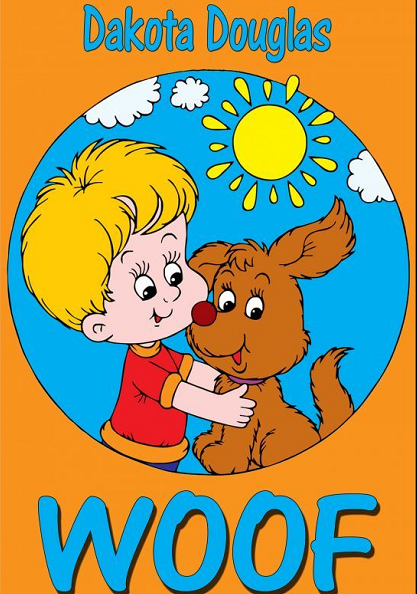
Woof: Two Short Stories

by: Dakota Douglas

Woofpic

This book consists of two short stories. These two stories are fairly easy to read with clear sentences. I think children aged six through nine will particularly identify with the characters and story line.

In the first book titled, A Dog’s Life, we meet Jeremy who has recently moved into the neighborhood. The children think he is stuck up and don’t ask him to play. For the last few days a dog that he has named Rufus has been following him everywhere. While Jeremy is watching the children play soccer, the dog suddenly jumps up and puts his paws on Jeremy. In a flash Jeremy has shrunk to the size of Rufus, and he is looking at a much larger version of himself. He has switched places with Rufus! As a dog, he diverts the ball and proves that he can really play soccer. The babysitter, Mrs. Peacock, has come to bring Jeremy home for dinner. But Jeremy is now a dog; he can only communicate by saying “Woof.” At the dinner table, he shocks his lawyer parents by flinging his steak to the carpet and clawing the floor. Meanwhile the real Jeremy is kept outside the house. Finally, Mr. and Mrs. Turner take their “son” to the doctor who tells them that he is acting out because they work long hours and don’t pay enough attention to their son. For the next few days, they take the dog, whom they believe to be their son, to the cinema, fairs and bowling. The parents reluctantly agree to keep the dog. Jeremy spends his days chasing cats and scrounging around looking for scraps of food. He begs his dog Rufus to change places and switch roles. Will he agree or will Jeremy be forced to remain a dog forever?

The second story is named, A Boy’s Best Friend.  In the beginning of the story, Jeremy is paying little attention to his dog Rufus because he is busy doing homework. Rufus is bored; he is tired of chasing cats. Later on, Jeremy and his dog Rufus are at the dinner table with Mr. and Mrs. Turner. Mr. Turner reads about a robbery in the neighborhood, but nobody seems to pay attention, Shortly after, Rufus discovers a hole under the fence which allows him to venture forth in the neighborhood. While Jeremy was at school and his parents at work, Rufus remembers seeing three men load boxes in a van. He now knows they must be the burglars. Frantically, he tries to get Jeremy’s attention and tell him, but he is unsuccessful. Can you guess what he will do to get Jeremy to follow him? Suddenly Jeremy Turner is acting strangely. Mrs. Peacock threatens to quit and chaos reigns. Will the burglars be apprehended?

What will happen to the members of the Turner family? Can things ever return to normal? You will have to read these two exciting adventures to find out.

If you enjoyed reading this post, please subscribe by clicking on the word Follow on the lower right hand side or hit the orange RSS feed button in the upper right hand corner.


FRIENDS OR FOES

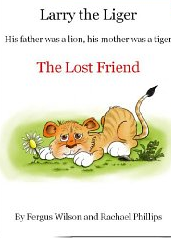
Larry the Liger

by: Fergus Wilson and Rachel Phillips

LarrytheLigerpic

This work of fiction is an adorable chapter book that has recently been released as an e book. It is part of a series featuring Larry the Liger. The story is marketed for ages two through eight. As a read aloud, it would need to be broken into several sessions for a younger child. The story is easy to follow, but there are few pictures to hold a young child’s interest. Children aged seven and up will find the story engrossing and want to read it to the end in one sitting.

At the beginning of the story we meet Larry who is a “liger.” His mother was a tigress from India and his father a lion from Africa. How did they meet then? They were intentionally mated to create hybrid cubs. From the beginning, Larry was the largest. He had just returned to the zoo after being featured as the Easter Liger, part of the local children’s Easter parade. Larry lives in the Prague Zoo with his five siblings. He has many friends there. Larry spends a lot of time with Chloe the cat, but for some reason not understood by him; she is always mean to him. On this particular day, Chloe has blocked the hole in the fence so that Larry cannot get back to the zookeeper for lunch. When he finally succeeds in returning, the day has almost ended. He finds Chloe with a fat tummy sleeping peacefully. That really makes the usually mellow liger mad! He yells and screams at her. That must have scared her because she disappears.

After two days, Larry is getting worried that Chloe might not be coming back. He finds that he actually misses that annoying little creature! So he sets out to find her. Larry discovers new friends like Olga the Owl and Cyrus the snake who are willing to help him in his quest. The journey and its outcome have unexpected results and teach both Chloe and Larry many things about themselves.

This is a charming adventure story that is lovingly well told and carefully written both to entertain and to teach. Boys and girls will want to read it over and over. Don’t overlook this book.

If you enjoyed reading this post, please subscribe to this blog by clicking on Follow at the lower right or hitting the orange RSS feed button on the upper right hand corner.

A TRUE FRIEND

Grandfather Tree

Written and illustrated by Allennita  C. Cooks

GrandfatherTreepic

Grandfather Tree is a simple book that makes quite a statement. The author has spent many years reading to and working with young children. She has also written skits, poems and short stories and is a member of the Florida Writer’s Association. This book is her first attempt at illustration; it succeeds because the simplicity of color and image works well with the succinct but powerful text.

An unnamed young boy and his dog are walking through the forest. He encounters a tree that reminds him of his grandfather who is strong and tall. He asks the tree, “Do you think of me?” He thinks of his life before as a baby and asks the tree if it remembers that part of its life.. He ponders about what life will be like when he grows up and asks if the tree would miss him coming to play with it. The boy expresses his fear of thunder and lightning and wonders if the tree is also afraid. Then he talks about the seasons using age appropriate analogies: the tree’s dropping leaves are compared to his hairs falling down when he gets his hair cut. He expresses his doubts to the tree. The boy wants to believe that this tree will always be there for him even when he grows old. However, he is unsure and afraid because he does not know what the future holds in store for him.

Throughout the story, the author integrates the boy’s thoughts into the story by showing a picture of what he is imagining and thinking in a bubble next to the tree. The facial expression of the tree changes as the story unfolds as well.

The author believes the book appropriate for ages four through ten. The simple pictures and the fact that there is only one rhyming line on each page make the story easy to follow. Older children will recognize the deeper layers of meaning in the story. The book is beautifully and lovingly done. Grandparents especially will want to include this book in their library.

If you liked this post, please subscribe by clicking on the word Follow at the lower right or hit the orange RSS feed button at the upper right hand corner.