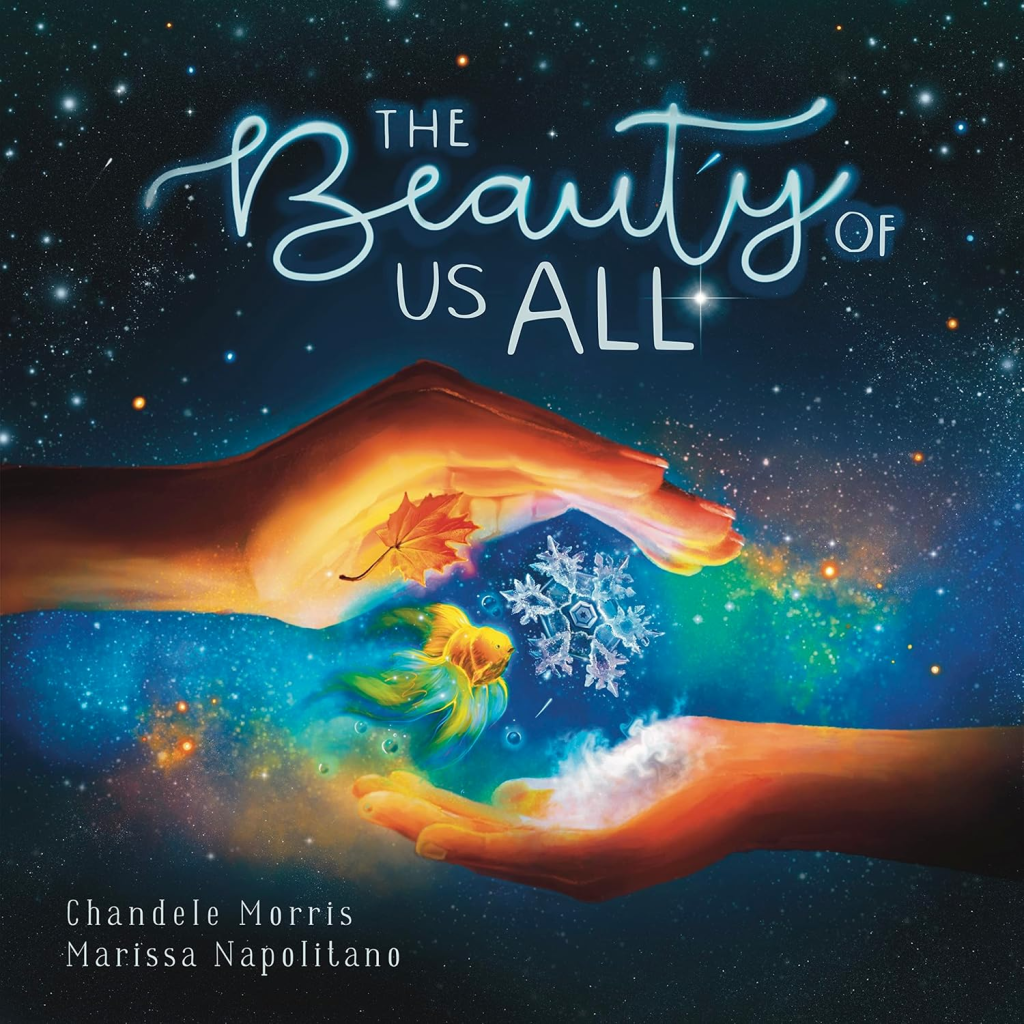
The Beauty of Us All: Celebrating The Diversity of The World
Written by Chandele Morris
Illustrated by Marissa Napolitano
A beautifully illustrated picture book to remind us of the simple beauty in objects and creatures all around us. The author reflects on the diversity and beauty of leaves, stars, fish, clouds, and the color of our skin. Each is beautiful, unique and loved.
Beautiful multicultural images enhance the message. Recommended for ages five and older.
SUBSCRIBE TO THIS BLOG FOR NEW BOOK REVIEWS EVERY WEDNESDAY AND SUNDAY.
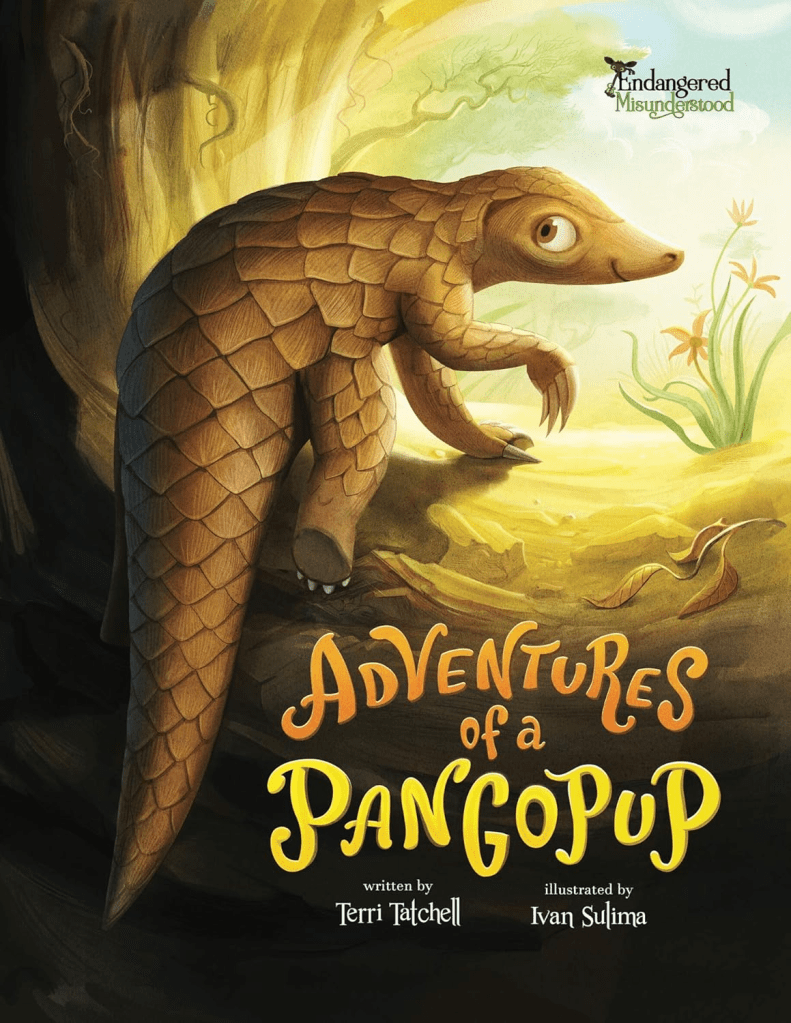
Adventures of a Pangopup (Endangered and Misunderstood Animals (Book 2)
Written by Terri Tatchell
Illustrated by Ivan Sulima
A charming picture book written in rhyme that teaches readers to heed their mother’s advice, while also educating them about endangered animals.
The book is part of a series about endangered animals. In this one readers learn about the pangalong and the dik-dik deer. When Pangopup decides to sneak away from his mom, he meets the deer who persuades him to go on an adventure. Will the two new friends survive?
The soft colors and exquisite rhymes teach without being preachy. Preschoolers and primary grade readers will delight in reading the book over and over. Lots of bonuses include drawing activities and information about these two unique animals.
Highly recommended for both home and school libraries.
SUBSCRIBE TO THIS BLOG FOR NEW BOOK REVIEWS EVERY WEDNESDAY AND SUNDAY.
Blimey There’s a Bunyip!: (Laugh out loud funny) (The Misadventures of Blimey Bunyip Book 1)
Written by Virginia Ferguson Perez
Illustrated by Natasha Kostovska
Book 1 in a series based on a mythical Australian animal called a Bunnyip who gets stuck on the narrator’s toilet (loo).
The story focuses on the outrageous antics the family tries to get rid of the creature who creates all sorts of chaos.
Children who enjoy off-beat humor will love it though vocabulary may appear strange to non-Australian readers. Adults will need to explain cultural nuances.
Recommended for ages two through seven who enjoy animal myths and zany humor.
SUBSCRIBE TO THIS BLOG FOR NEW BOOK REVIEWS EVERY WEDNESDAY AND SUNDAY.
It’s a difficult choice, but here’s what you need to consider in a nutshell.
Benefits of Homeschooling that outweigh Public Schools
Homeschooling Strengthens Values & Beliefs
Homeschooling allows families to intentionally instill values that are important to them and the freedom to share and practice their faith without restrictions.
Public schools promote a fixed set of values, often without room for critical thought or diverse perspectives.
Self-Disciplineis required in homeschooling.
In homeschool, discipline comes from within, not from peer pressure or performance competition.
Learning to do the work even when it’s hard or boring = real growth.
Contrast this with the high-achieving public-school students often running on OCD-like habits.
Early Intervention
Problems—academic, behavioral, learning disabilities—are often caught early in homeschool.
Public school systems often miss these issues until it’s too late or harder to reverse unhealthy habits.
Social Struggles and safety
Homeschooling minimizes exposure to toxic social games: popularity, fashion, peer pressure.
Public school culture tends to push conformity over individuality.
There has been a rise in school shootings and safety concerns over the years.
Bullying
It exists in public school, period—even the good ones.
Homeschool environments naturally reduce bullying due to smaller, safer social dynamics where adults are present.
Independent Thought
Public school tends to promote conformity through standard curriculum and groupthink dynamics.
Access to Certified Teachers & Specialists Public schools employ trained educators, special education professionals, counselors, and support staff who are equipped to handle a wide range of academic and emotional needs.
Built-in Socialization Students interact daily with a variety of peers, helping them develop essential social skills, emotional intelligence, and teamwork—sometimes these skills are hard to replicate in smaller settings.
Diversity of Perspectives & Experiences Public school classrooms often reflect broader society, exposing students to different cultures, beliefs, socioeconomic backgrounds, and worldviews.
Extracurricular Opportunities Sports teams, music programs, theater, clubs, and leadership organizations are often more accessible and varied and are often offered free of cost to students.
Support for Working Families Public schools provide consistent, structured schedules and resources like transportation and school meals, offering vital support for dual-income or single-parent households.
Challenges and Trade-offs
While both homeschooling and public schooling offer unique benefits, they also come with their share of challenges and trade-offs. Homeschooling requires a significant time and energy investment from parents, who are also juggling teaching with their other responsibilities. And while most homeschoolers are tired of hearing about “socialization” it can also be a concern if families aren’t intentional about creating community connections.
On the other hand, public school students may face larger class sizes, less individualized attention, and exposure to bullying or peer pressure. While public schools offer a more structured environment and access to trained educators, they also come with curriculum constraints and limited flexibility.
What It Really Comes Down To
It’s a big decision to decide on your child’s educational path. But you are the best person to make that choice. Consider what is truly important to you and what is best for your child and your family then move forward in that direction. Homeschooling has changed a lot over the years. You don’t have to do it alone. There is a plethora of online classes, support groups, co-ops, and people that are around you if you just look.
S Is For Swords: And So Are All The Other Letters (The Amazing World of Swords)
Written by Luke Ralliston
What a unique and fascinating book!
The author has managed to find a sword that begins with every letter of the alphabet. In addition, Rawlings lists the advantages and disadvantages of each with wry, sarcaster humor. The illustrations are amazing!
Readers learn letters of the alphabet along with the history and culture of each sword. A must for sword fans of any age. This book can be appreciated by a reader of any age who has an interest in swords.
SUBSCRIBE TO THIS BLOG TO GET NEW BOOK REVIEWS EVERY WEDNESDAY AND SUNDAY.
Every child is different—and so is the way they respond to discipline. How you parent impacts how your child learns boundaries, responsibility, and emotional control. Here’s a simple guide to how parenting styles shape discipline and how you can adjust to better support your child.
4 Parenting Styles and Their Discipline Approaches
Authoritative (Balanced and supportive) o Sets clear rules and explains them. o Focuses on guiding, not punishing. o Try this: Help your child make a plan after a mistake instead of just punishing them.
Authoritarian (Strict and controlling) o Enforces rules without discussion. o Often uses punishment. o Watch for: Anxiety or rebellion in sensitive kids.
Permissive (Lenient and avoidant) o Rarely sets rules or follows through. o May avoid conflict. o Risk: Kids lack structure and may push limits.
Uninvolved (Detached or inconsistent) o Few rules or expectations. o Minimal supervision or guidance. o Consequence: Kids may feel insecure or unsupported
How to Adjust Based on Your Child’s Needs
• For Anxious Kids: Use calm tones, predictable routines, and gentle corrections. • For Strong-Willed Kids: Offer choices within limits and enforce consistent boundaries. • For Independent Teens: Let them help set rules and learn through natural consequences.
5 Smart Discipline Tips for Any Style
✅ Watch how your child reacts—adjust when needed. ✅ Stay connected and respectful. ✅ Set clear limits, but allow flexibility. ✅ Model calm, respectful behavior. ✅ Evolve your approach as your child grows.
Final Thought
Discipline isn’t just about control—it’s about teaching. The best approach grows with your child, helping them become confident and capable.
The Mosquito Burrito: A Hilarious, Spanish Sprinkled, Rhyming Children’s Book
Written by Didi Dragon
Illustrated byLenaska Ti
What a fun bilingual read! Dragon cleverly rhymes Spanish and English short phrases that roll off the tongue.
The plot centers around a mosquito who finds himself stuck inside a burrito. After taking a bite, he simply cannot resist eating his way through it. I love the humorous play on words. This book has enthralling illustrations that enhance the plot.
I highly recommend the book as a read aloud for primary grade English and Spanish speakers to promote reading and language skills.
SUBSCRIBE TO THIS BLOG FOR NEW BOOK REVIEWS EVERY WEDNESDAY AND SUNDAY.
Publisher’s Book Summary: Alex, Kali, and Roman are three fifteen-year-old friends who live in a small town. Alex is a great communicator, Roman is a bit of an inventor, and Kali is an intuitive empath. It’s summertime, and an adventure is triggered when they find themselves in the middle of a protest outside the local library by people who want to ban certain books. During the protest, people are focused on what they believe to be their Constitutional rights, causing the three teenagers to realize how little they know about the Constitution.
In their search for answers, they discover a book with magical properties, which becomes a catalyst in helping them discover what the Constitution is really all about.
Join the teenagers as this mysterious book enables them to travel through time and space—bringing to life historical figures like Ben Franklin, Wyatt Earp, Alice Paul, Ruth Bader Ginsburg, and many more. Each of these historical figures will teach them about the original Constitution and its amendments. Through the eyes of these three teenagers, you’ll be able to explore what it was like when the original Constitution was signed. You’ll even travel to other countries, like Russia, where you’ll meet Aleksandr Solzhenitsyn in a field within the Gulag where he was imprisoned.
The Constitution, by itself, can be a difficult document to read, but The Constitution Kids will bring it to life with unusual experiences, humor, and fun, no matter your age.
Gary J. Gabel, Ed.D., has spoken to groups throughout the United States on the subjects of personal takeover, accountability, and leadership. He has personally trained thousands of people, primarily in the areas of leadership, management, motivating performance, presentation effectiveness, sales, and customer service. He has worked with over 200 CEOs, helping them build high-performing teams.
Gary has written several books, including Day One, which was jointly authored with Tom Buck and published in 2020. Gary’s other book, Personal Takeover, was published in the United States by Career Press in 2003. It was translated into Korean in 2004, with an Arabic translation in 2005. The second edition of Personal Takeover was released in October 2019.
Gary was the 2001 Entrepreneur of the Year for Service Companies in Michigan. He has bachelor’s and master’s degrees in Economics and a doctorate in Education. He formerly served as Chair of the National Council on Education and Human Development at The George Washington University. His current memberships include the Oakland Schools Education Foundation Board of Trustees and Mensa.
Gary’s presentations at TEDxDetroit and others can be viewed on YouTube. Gary lives with his wife, Lisa, in Michigan, and they have two children and three grandchildren.
MY REVIEW OF THIS BOOK:
THE CONSTITUTION IS ALIVE AND WELL The Constitution Kids Written by Gary Gabel
The author correctly points out that the subject of the Constitution rarely comes up in modern schools. Gabel decides to remedy that problem by incorporating its story within the pages of a time travel adventure containing three unlikely friends. Kali, Alex, and Roman who display unique interests and talents. Kali is an empath, Roman a science and tech prodigy, and Alex, an excellent communicator.
On a summer day, the three fifteen-year-old friends encounter a protest demonstration and demonstrators claiming the right to gather under the Constitution. Curious, the friends decide to research the Constitution in the library. When they find and open an old book, they meet Ben Franklin who initiates a time travel journey on which they investigate the Constitution, and the Amendments added to it.
During this journey, the teens meet famous people like Thomas Jefferson, Albert Einstein, and Wyatt Earp. In addition, they journey back and forward in time to colonial times, visit slaves, a gulag, and Nazi Germany, among other places. The threesome experience how the Constitution works and the reasons why for each amendment.
Gabel details the characters as relatable and integrates the past and present seamlessly. Modern readers learn not only what the Constitution contains but why it evolved and how it works.
This book is a wonderful tool to teach civics and responsibility. I recommend it for the bookshelves of middle-grade and high school readers.
GIVEAWAY
Enter for a chance to win one of ten copies of The Constitution Kids. Enter below to bring this magical journey home!
If Shapes Could Eat: A fun rhyming story encouraging a healthy relationship with food and trying new things.
Written by Rella B.
Illustrated by Wendy S.
The protagonists are colorful shapes who get together for a block party. At the party the shapes enjoy a variety of foods including meats, fruits and vegetables. I like the way the author portrayed shapes who were eager to share new things and explained to readers that it is okay if we do not all have the same taste. Also, there were shapes who had allergies and needed to avoid certain foods. This makes children who have allergies feel more comfortable in being different.
The rhymes are crisp and the illustrations fun and colorful. Highly recommened as a bedtime story or read aloud.
SUBSCRIBE TO THIS BLOG FOR NEW BOOK REVIEWS EVERY WEDNESDAY AND SUNDAY.
Illustrated by Obayomi Aanuoluwapo and Dirisu David
A beautiful multicultural picture book that teaches children about life in rural Ghana.
Kwame is respectful, obedient, and grateful for his simple life in a rural village. In this story, Kwame wakes early to help his mother wash clothes by hand. Then he sweeps the dirt floor of his one room hut before dressing in his uniform to walk to school at the Royal Promise Mission. Today is a special day. The children from around the area will be marching to celebrate the anniversay of Ghana’s independence.
Children from around the world learn a bit about the food, flag, customs , language, and difficult life of a small rural village. Kwame provides a good role model for children. Charming illustrations and an interactive activity keep readers engaged with the tale.
Highly recommended to parents and teachers of elementary school readers.
SUBSCRIBE TO THIS BLOG FOR NEW BOOK REVIEWS EVERY WEDNESDAY AND SUNDAY.
You must be logged in to post a comment.